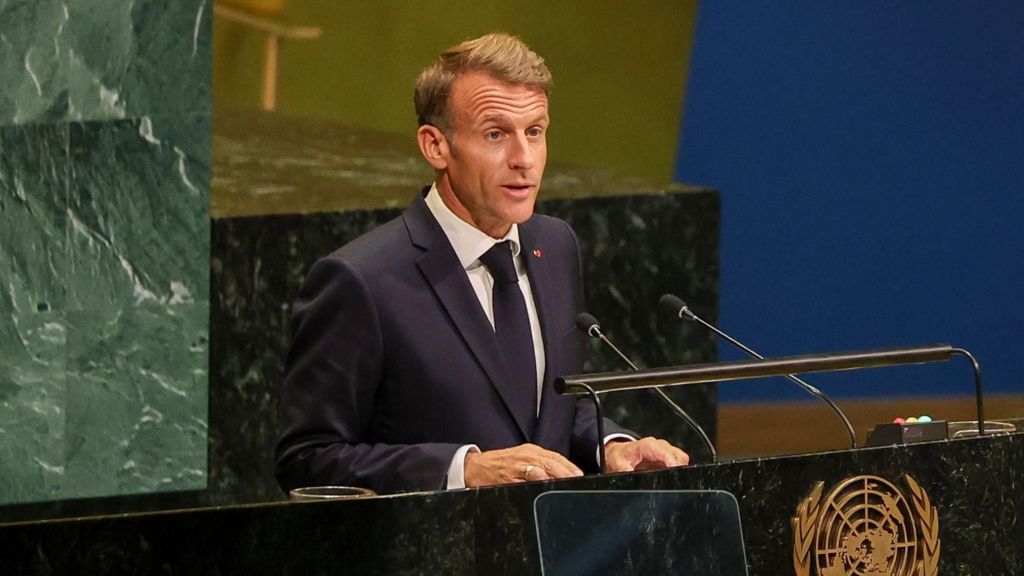
A sharp diplomatic conflict has erupted between French and Israeli leadership following controversial comments French President Emmanuel Macron made during his annual address to the United Nations General Assembly, drawing fierce condemnation from Israeli Prime Minister Benjamin Netanyahu.
During his speech, Macron called out ongoing violations in the Israeli-occupied West Bank, questioning the justification for these actions. According to the UN’s official interpreter, Macron stated that “Hamas was never very active in the West Bank.” The remark immediately triggered a blistering rebuke from Netanyahu’s office, which labeled the comment a “grotesque absurdity.”
Netanyahu’s statement highlighted a recent fatal attack that took place just two days before the UN address, on the eve of the Jewish holy day Yom Kippur. In that attack, 36-year-old Netanel Shukrun, a French national and father of six, was shot and killed while sitting in his car near the West Bank settlement of Neve Tzuf. Israeli police confirmed that a Palestinian gunman carried out the shooting, later arresting the suspect at a Ramallah hospital. While Hamas praised the attack, it did not formally claim responsibility. Netanyahu emphasized that Hamas operatives carry out nearly daily attacks against Jewish civilians across the West Bank, which Israel refers to by the biblical name Judea and Samaria, and have killed countless Israeli civilians in the region.
The condemnation extended beyond Israel, with U.S. Ambassador to Israel Mike Huckabee also dismissing Macron’s remarks as disconnected from on-the-ground reality.
While Macron’s official office has not issued a formal public response, an anonymous senior French diplomatic source clarified to the *Jerusalem Post* that the French president’s original comment was widely misinterpreted. In Macron’s original French speech, the line was “Le Hamas n’a jamais sévi en Cisjordanie,” which the source translated as “Hamas has never governed the West Bank,” not a claim that the group has never carried out attacks in the territory. The West Bank is currently partially administered by the Fatah-led Palestinian Authority, while Hamas, which has been designated a terrorist organization by France, Israel, and much of the international community, maintains de facto control over the Gaza Strip. Hamas has long been a political rival of Fatah, splitting control of Palestinian territories between the two factions for over a decade.
In addition to his comments on the West Bank, Macron also pushed back on former U.S. President Donald Trump’s claim that he had successfully ended the conflict between Israel and Hamas in Gaza. Despite a ceasefire agreement reached last October, the region has continued to see regular outbreaks of violence, including almost daily Israeli airstrikes, and catastrophic humanitarian conditions that have left millions of Gaza civilians without consistent access to basic aid. Macron rejected framing the current situation as peace, noting “Some boast of a supposed peace. But that peace has not reopened humanitarian access for a single second. Are we simply to stand by and watch this spectacle that should shame us all?”
The broader context of the dispute dates back to the 1967 Six-Day War, when Israel seized control of the West Bank, East Jerusalem, and Gaza from neighboring Arab states. Today, Israel has constructed roughly 160 official settlements in the West Bank and East Jerusalem housing more than 700,000 Israeli settlers, alongside an estimated 3.3 million Palestinians. The international community uniformly considers these settlements to be illegal under international law, and Palestinians seek all three territories — the West Bank, East Jerusalem, and Gaza — as the sovereign land for their future independent state.