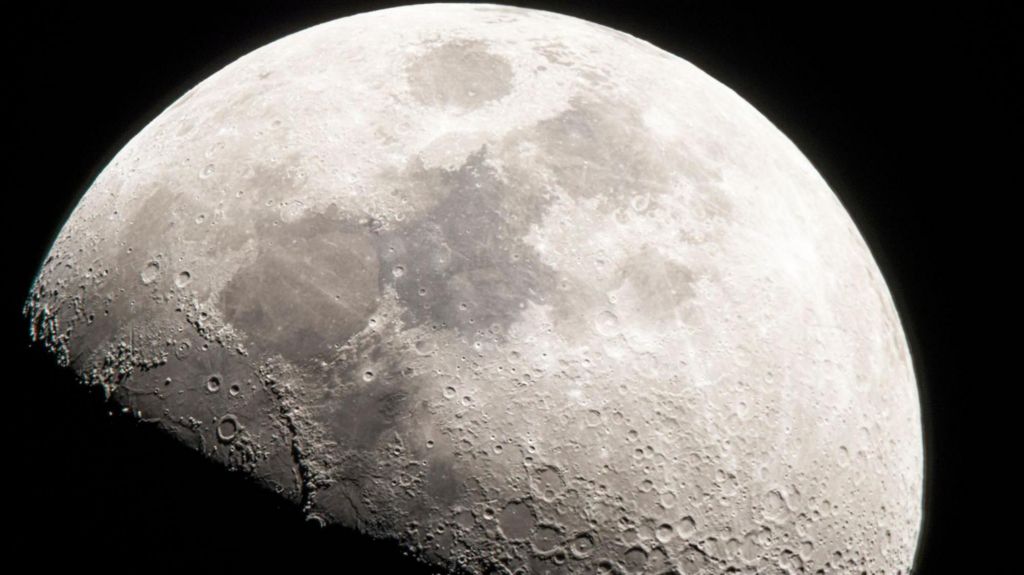
In a major update to its ambitious lunar exploration agenda, NASA has publicly released new design renderings and contract details for the robotic vehicles and infrastructure that will lay the groundwork for a permanent American outpost on the Moon. The announcement comes as the United States and China engage in a growing 21st-century space race, with both nations racing to put the first humans back on the lunar surface in more than 50 years.
As part of the $20 billion Ignition Moon Base program first unveiled in March 2025, NASA aims to complete a permanently crewed outpost powered by a mix of nuclear fission and solar energy at the Moon’s south pole by 2032. The program is structured in three distinct phases, starting with an extensive pre-human robotic exploration mission that will map the region’s harsh, cratered terrain and deliver critical scientific equipment. NASA has now awarded construction contracts for this initial phase to three private aerospace firms: Jeff Bezos-founded Blue Origin, Intuitive Machines, and Astrobotic Technology.
Each company has been tapped to deliver specialized hardware tailored to the challenges of lunar operations. Blue Origin’s Endurance lunar lander is being engineered to execute precision landings across uneven terrain while operating with full autonomous navigation and control. Astrobotic’s Griffin-1 lander, meanwhile, is targeted to touch down in the Nobile Crater, a permanently shadowed basin near the lunar south pole that scientists believe holds large deposits of frozen water ice. All robotic craft will carry a suite of scientific instruments, including high-resolution mapping cameras and laser-based landing assistance tools. Through 2029, the program plans 25 separate robotic launches, delivering a total of 4 metric tons of cargo to the lunar surface, according to Moon Base program executive Carlos García-Galán.
Following the completion of robotic exploration, the second phase will focus on installing the base’s energy infrastructure, including small modular fission reactors that can provide reliable power through the lunar south pole’s two-week-long dark nights. The third and final phase will see the construction of semi-permanent habitation modules and long-range rovers that will allow human crews to traverse the rocky polar landscape. The south pole was selected as the base site specifically for its accessible water ice, which can be processed into drinking water, breathable oxygen, and rocket fuel for future deep space missions, including crewed missions to Mars. A permanent lunar presence would also open new avenues for cutting-edge lunar science and potential commercial resource extraction, NASA officials say.
In a statement Tuesday, NASA administrator Jared Isaacman emphasized the long-term commitment of the U.S. to lunar exploration, saying the new contracts confirm America will “never give up the Moon again” after the end of the Apollo program. The U.S. has a stated political goal of landing American astronauts on the Moon before the end of the current presidential term in 2028, putting intense public pressure on NASA to meet the aggressive timeline.
This timeline puts NASA in direct competition with China’s own lunar program, which is on track to land the first Chinese humans on the Moon by 2030. Just this week, China moved forward with its human spaceflight program, launching the Shenzhou-23 mission to deliver a new crew to the Tiangong space station in low Earth orbit, demonstrating consistent progress in its space infrastructure development. Many independent space experts, however, say NASA’s 2028 landing target is unrealistic, given persistent delays in the development of the human landing system.
NASA has contracted Elon Musk’s SpaceX to develop the Starship Human Landing System, the craft that will carry astronauts from lunar orbit down to the surface. The project has faced repeated technical setbacks and schedule slippage that have pushed back its expected completion date. “It would not surprise me at all if China gets there first,” Dr. Simeon Barber, a lunar scientist at the U.K.’s Open University, told reporters. Barber noted that the ongoing delays to the human landing craft are the single biggest bottleneck for NASA’s lunar agenda. He also suggested that the aggressive timeline and recent string of announcements are driven as much by political pressure as technical planning, saying NASA feels compelled to demonstrate progress amid the high-profile competition with China. Even after the successful Artemis II mission that carried four American astronauts on a lunar flyby in April 2026, many scientists share Barber’s view that China is on track to beat the U.S. to the first crewed lunar landing of this new space race.