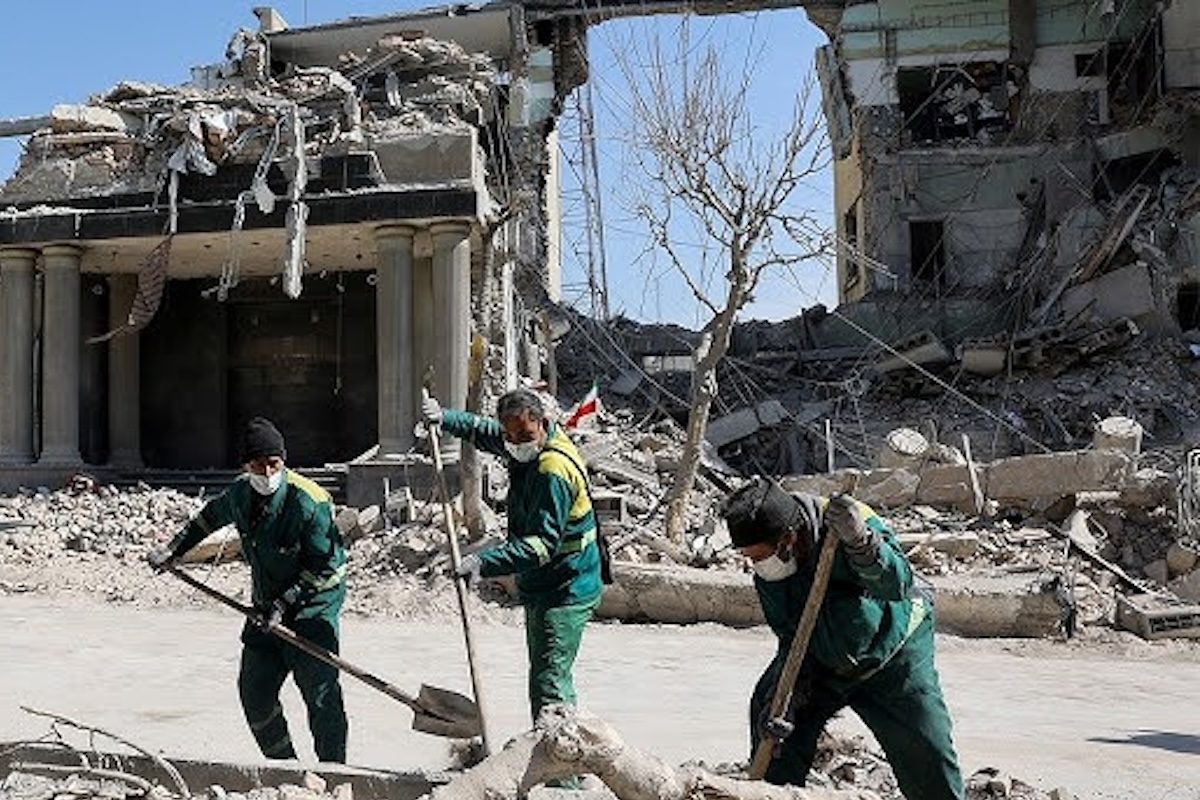
Hours after U.S. President Donald Trump drew global condemnation for issuing an unprecedented genocidal threat against Iran, warning that “a whole civilization will die tonight,” the American leader announced a last-minute two-week suspension of military operations, contingent on Iran lifting its blockade of the strategic Strait of Hormuz.
Citing an anonymous senior White House source, CNN confirmed that Israel — which has partnered with the U.S. in bombing Iranian targets including civilian infrastructure since the war began on February 28 — will also participate in the ceasefire, pausing its aerial campaign while negotiators work toward a long-term deal.
International diplomatic efforts paved the way for the truce: according to The Associated Press, Iran’s Supreme National Security Council confirmed its acceptance of the ceasefire in an official statement. New York Times correspondent Farnaz Fassihi later reported that the breakthrough followed frantic shuttle diplomacy led by Pakistan, with a final late-stage intervention from China, a long-standing major ally of Tehran.
In its statement, the Iranian security council stressed the temporary nature of the pause in hostilities, noting: “This does not signify the termination of the war. Our hands remain upon the trigger, and should the slightest error be committed by the enemy, it shall be met with full force.”
Trump made his ceasefire announcement via his Truth Social platform, as widespread global outrage mounted over his apocalyptic morning comments, including growing demands for his removal from office, and just hours before his self-imposed 8:00 p.m. Eastern Time deadline for Iran to reopen the critical global waterway to all commercial shipping traffic.
In his official statement, Trump outlined that the ceasefire came at the request of Pakistani Prime Minister Shehbaz Sharif and Pakistan’s top military leader Field Marshal Asim Munir. “Subject to the Islamic Republic of Iran agreeing to the COMPLETE, IMMEDIATE, and SAFE OPENING of the Strait of Hormuz, I agree to suspend the bombing and attack of Iran for a period of two weeks. This will be a double sided CEASEFIRE!” he wrote.
The U.S. president framed the pause as a reflection of progress toward a lasting peace deal, adding: “The reason for doing so is that we have already met and exceeded all Military objectives, and are very far along with a definitive Agreement concerning Longterm PEACE with Iran, and PEACE in the Middle East. We received a 10 point proposal from Iran, and believe it is a workable basis on which to negotiate. Almost all of the various points of past contention have been agreed to between the United States and Iran, but a two week period will allow the Agreement to be finalized and consummated. On behalf of the United States of America, as President, and also representing the Countries of the Middle East, it is an Honor to have this Longterm problem close to resolution.”
Despite the breakthrough, analysts warn that Iran’s 10-point peace framework is likely to face fierce pushback from Israel and Gulf Arab monarchies, which have been targeted by Iranian retaliatory strikes amid the ongoing U.S.-Israeli military offensive. U.S. political commentator and lawyer Will Stancil noted on social platform Bluesky that regional stakeholders who have heavily backed Trump are unlikely to accept the terms. “It’s hard to see how anyone else in the region could possibly agree to this,” he said, adding with sharp criticism that it would be ironic if the Gulf states that have poured billions into supporting Trump now face fallout from his last-minute policy shift mid-war to claim a political victory.
Trump’s extreme threats — including vows to destroy Iran’s civilian bridges and power plants, classified as clear war crimes under international law, and his public threat to erase “whole civilization” of Iran — prompted urgent calls from global human rights advocates and political leaders for the United Nations and national governments to intervene immediately to de-escalate the conflict.
While the ceasefire has been broadly welcomed as a step away from all-out war, some observers have pointed out that Iran’s existing government, which has faced international criticism for its violent crackdown on domestic anti-government protests that left thousands dead, is well-positioned to emerge from the truce claiming a domestic political victory, a narrative already being pushed by Iranian state media.
Raed Jarrar, advocacy director at the NGO Democracy for the Arab World Now (DAWN), argued that the ceasefire terms amount to a major strategic defeat for the U.S. and Israel. “A ceasefire is welcome, but if the terms Iran announced tonight are accurate, the United States and Israel are facing a truly humiliating defeat,” Jarrar told Common Dreams. “They launched a catastrophic war of aggression that killed thousands of civilians, wasted tens of billions of dollars, and triggered the worst global energy crisis in half a century. Iran kept its enrichment. Iran took over the Strait [of Hormuz]. The United States agreed to lift sanctions and pay reparations.”
Skepticism over the ceasefire has also emerged from U.S. political opposition circles. Democratic Senator Chris Murphy of Connecticut told CNN that he questions whether the truce is actually holding, citing ongoing reports of Iranian missile strikes targeting Israel and the United Arab Emirates. “Who knows what’s going on,” Murphy said. “Donald Trump lies every single day.”
Murphy also highlighted Iran’s public claims that the deal includes U.S. concessions on key sticking points, including recognition of Iran’s right to nuclear enrichment, a full suspension of U.S. sanctions on Tehran, and allowing Iran to retain its ballistic missile, drone, and nuclear programs. “If, at the very least, this agreement gives Iran the right to control the strait that is cataclysmic for the world, and it is just stunning that that’s where we have gotten to that Donald Trump took a military action that has apparently, at least for the time being, given Iran control over a critical waterway that they did not have control over, before the war began,” Murphy added.
Critics of Trump, including multiple members of the U.S. Congress, have doubled down on calls for the president’s Cabinet to invoke the 25th Amendment to the U.S. Constitution to remove Trump from office over his inflammatory threats and unconstitutional war. They have also reminded U.S. military service members of their legal obligation to refuse any orders that constitute war crimes under international and U.S. law.
This report was sourced from Common Dreams.