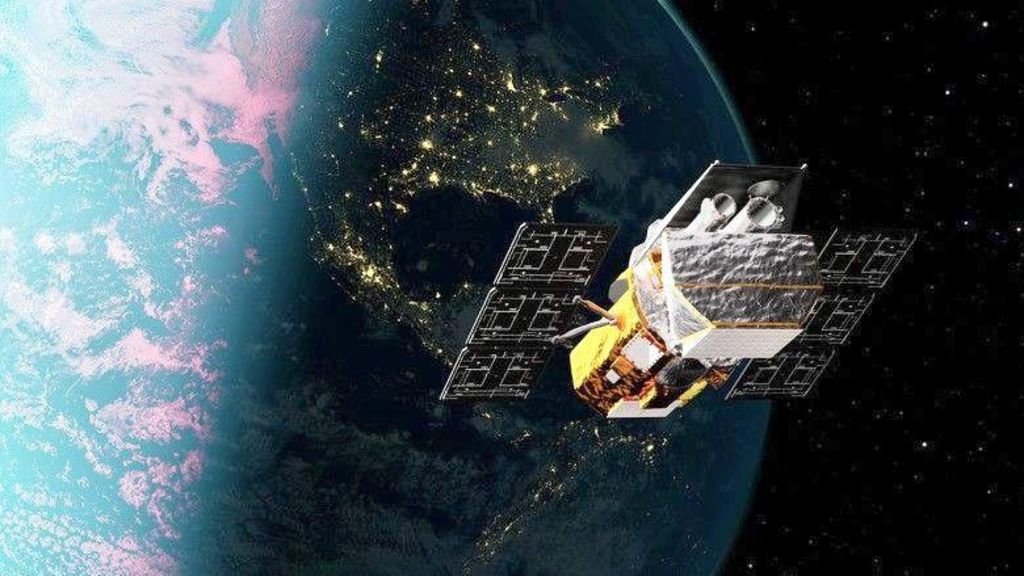
On Friday, NASA made space exploration history by launching a first-of-its-kind, funded mission to rescue the iconic Swift Observatory, a pioneering space telescope that has unlocked groundbreaking insights into the universe’s most extreme cosmic events, before it burns up during atmospheric reentry in the coming months.
Launched originally in 2004, the car-sized Swift Observatory was purpose-built to detect and study gamma-ray bursts—cataclysmic explosions triggered by the death of massive stars or collisions of neutron stars that release as much energy in seconds as the sun will output over its 10-billion-year lifespan. Built for speed and agility to capture these fleeting, high-energy events (for which it earned its name), Swift has operated for more than two decades, delivering transformative data that allows astronomers to study phenomena that no other active instrument can observe. In 2022 alone, it captured a detailed image of a gamma-ray burst originating from a dying star 2 billion light-years from Earth.
In recent years, however, increasing solar activity has expanded Earth’s upper atmosphere, creating drag at Swift’s current orbital altitude that has gradually slowed the telescope and pulled it lower. From its original 600-kilometer (373-mile) orbit, Swift’s altitude has dropped to roughly 360 kilometers (220 miles), with most of that decline occurring in just the last two years. Left unaddressed, it will fall below 300 kilometers (186 miles) in the coming months, making any rescue attempt impossible, before eventually reentering the atmosphere and burning up completely.
For the global astronomy community, losing Swift would be an irreversible blow. “It’s an important telescope that enables us to study super high-energy phenomena that we have no other means to study,” explained Dr. Simeon Barber, a senior research fellow at the Open University and a space scientist familiar with the mission. While he acknowledges the operation is “high risk,” Barber added that the scientific community remains optimistic that the unprecedented attempt is worth pursuing.
Tasked with the extraordinary rescue is Arizona-based startup Katalyst Space Technologies, which was given less than a year to design, build, and launch its custom-built LINK intercept craft. In a remarkable engineering feat, the Katalyst team completed the entire project in just eight months. “What the Katalyst team has accomplished in just eight months is extraordinary,” said Katalyst CEO Ghonhee Lee. “The team designed, built, tested, and integrated a robotic spacecraft capable of performing one of the most ambitious commercial servicing missions ever attempted.”
The fridge-sized LINK craft is fitted with three robotic gripper arms, an array of high-resolution cameras, precision navigation sensors, and small maneuvering thrusters. Launched aboard a Pegasus XL rocket that placed it in the general vicinity of Swift’s orbit, LINK will spend the next several weeks systematically powering on and testing all its systems to confirm they survived launch.
Over the following three to four weeks, LINK will conduct a precision approach to the moving, descending telescope, gradually maneuvering into formation. Before attempting a capture, LINK will circle Swift and capture full imagery of the observatory—critical because 22 years in orbit have likely altered the telescope’s structure, and it was never originally designed to be grappled in space.
The LINK craft will approach at an extremely slow pace before its three arms extend to secure a firm grip on Swift. If capture is successful, LINK will slowly fire its thrusters over two to three months to gently lift the combined craft back to Swift’s original stable 600-kilometer orbit, allowing the decades-old telescope to resume its critical scientific work.
This ambitious mission has never been attempted before, and success is far from guaranteed: countless variables must align perfectly for the operation to reach its goal. If the rescue of Swift succeeds, however, space experts say the next candidate for an orbital rescue mission could be one of astronomy’s most beloved instruments: the iconic Hubble Space Telescope. The astronomy community worldwide will be watching closely as the unprecedented operation unfolds over the coming months.