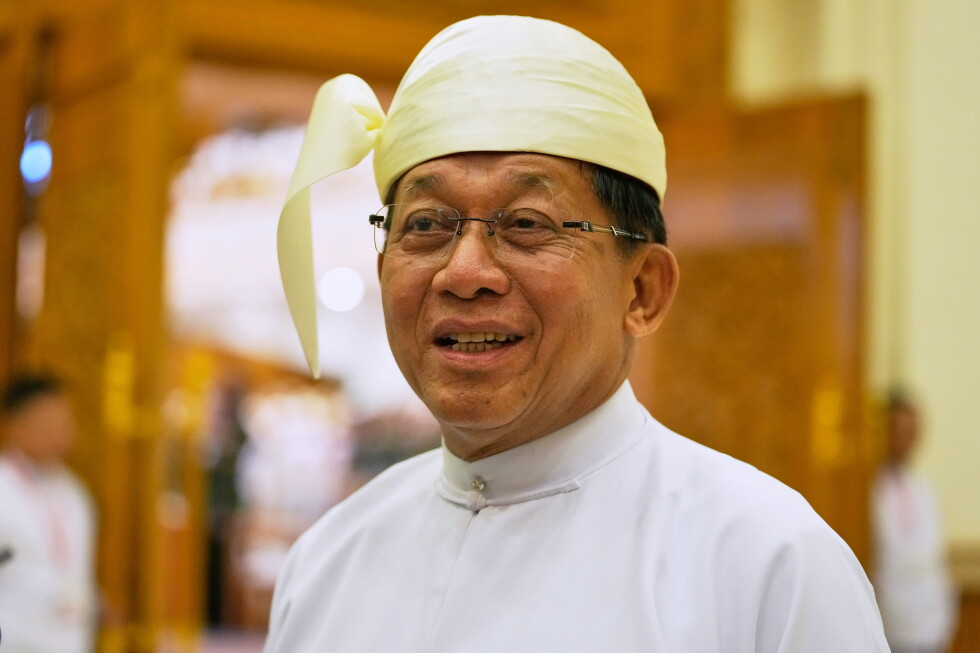
NAYPYITAW, Myanmar — On Friday, the leader of Myanmar’s military-aligned administration marked the first 100 days of his current term in office, using a national address to defend his government’s early track record and lay out a comprehensive five-year governance agenda — all as the country grapples with widespread internal armed conflict and mounting condemnation from the international community.
Min Aung Hlaing, the former head of Myanmar’s military who first seized state control from the democratically elected civilian government in a 2021 coup, was formally sworn in as president in April of this year. His appointment followed a general election that political analysts and global critics widely dismiss as a prearranged process to cement the military’s long-term hold on national power.
Speaking before an audience of more than 900 legislators, senior government officials, and military delegates gathered at the national parliament in Naypyitaw, Min Aung Hlaing asserted that his administration has already laid “critical groundwork” for the country by advancing its two core priorities: reestablishing nationwide peace and security, and driving inclusive national development.
Under the five-year roadmap he outlined, the first two years will be dedicated to accelerating efforts to build a modern, economically developed nation founded on democratic principles and a federal governing structure. The remaining three years will be devoted to full-speed implementation of infrastructure and social development projects, he said.
Min Aung Hlaing also confirmed that special by-elections will be held in 2027 for 102 townships across Myanmar. These constituencies were unable to participate in the military government’s three-phase general election held late last year, due to ongoing armed conflict that has made normal electoral operations impossible in those areas.
The president added that the administration will continue enforcing the military’s controversial conscription law, while expanding and strengthening the country’s armed forces and national police as they battle pro-democracy opposition groups and ethnic minority insurgent movements across most of Myanmar’s territory. He noted that his government has extended an offer of dialogue to anti-military armed groups, and has already held formal talks with 13 separate ethnic armed organizations.
In a striking rebuke of regional diplomatic efforts, Min Aung Hlaing also criticized the 2021 five-point peace consensus brokered by the Association of Southeast Asian Nations (ASEAN), which was designed to de-escalate Myanmar’s civil conflict. He claimed the agreement was finalized without the consent of all ASEAN member states, and argued that the regional bloc has systematically discriminated against Myanmar since the 2021 coup. The ASEAN framework requires Myanmar’s ruling authorities to immediately end all violence against opposition groups and open inclusive dialogue between all warring parties, mediated by a special ASEAN envoy.
Turning to economic and infrastructure policy, Min Aung Hlaing announced plans to move forward with 10 major new power generation projects, including the long-suspended and highly controversial Myitsone hydropower dam. The project was halted more than a decade ago following large-scale public protests over major environmental and displacement risks. He added that the government will also continue preliminary work to develop the country’s first nuclear power plant.
On law enforcement and transnational crime, Min Aung Hlaing stated that Myanmar authorities have stepped up efforts to crack down on money laundering, drug trafficking, and the transnational online scam centers that have operated with relative impunity in parts of the country in recent years. To date, he said, more than 72,000 foreign nationals linked to illicit scam operations have been deported back to their home countries, covering 58 nations worldwide.
Min Aung Hlaing did acknowledge that the large-scale outflow of young working-age Myanmar citizens has created significant headwinds for the country’s economic development. However, he declined to acknowledge the well-documented link between the military’s conscription policy and this mass youth exodus, which independent analysts and opposition groups widely identify as one of the primary drivers of the trend.
Opposition leaders have pushed back sharply on Min Aung Hlaing’s address, arguing it does little to address the country’s deepening crises. Nan Lin, a spokesperson for the General Strike Coordination Body — one of Myanmar’s leading nonviolent pro-democracy opposition organizations — said the speech makes clear the military’s sole goal is to entrench its authoritarian grip on power. He added that widespread economic hardship will only worsen under what he called the junta’s failed governing agenda.
“No meaningful change can be expected from the junta,” Nan Lin said in a statement following the address. “They will use the conscription law to control young people through fear, and the situation could worsen as they continue to sacrifice young people in order to hold on to power.”