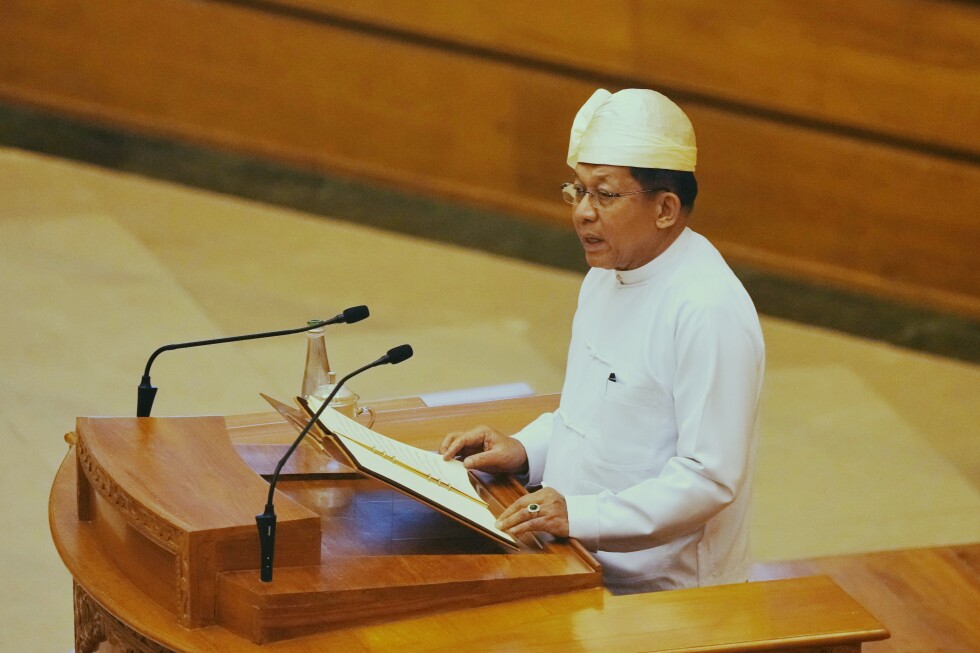
BANGKOK – Nearly four years after seizing control of Myanmar from the elected civilian government of Aung San Suu Kyi, the country’s long-time military leader Min Aung Hlaing has been formally inaugurated as the nation’s president, cementing the military’s grip on power behind a veneer of electoral legitimacy. The 69-year-old, who ruled Myanmar with an iron fist as the head of the ruling junta since the 2021 coup, took the oath of office on Friday in Naypyitaw’s newly renovated parliament building, which sustained damage during a 2023 earthquake. He was joined by two vice presidents: Nyo Saw, a retired general and close personal adviser, and Nan Ni Ni Aye, an ethnic Karen politician from the military-aligned Union Solidarity and Development Party (USDP).
Min Aung Hlaing’s ascent to the presidency follows his April 3 election by the national legislature, where the pro-military bloc controls close to 90 percent of seats across both parliamentary chambers. The government formed after his inauguration reflects the military’s enduring dominance: 28 of the 30 newly sworn-in cabinet members are either active or retired military generals, USDP lawmakers, or holdovers from the previous junta administration. In a post-inauguration address, Min Aung Hlaing claimed Myanmar has “returned to the path of democracy” and pledged to work toward peace with anti-junta armed groups and repair strained relations with the Association of Southeast Asian Nations (ASEAN), which has isolated the junta over its post-coup political repression and ongoing conflict.
The inauguration is the final step in the junta’s plan to transition to a nominally civilian government, a move widely dismissed by global observers as a calculated tactic to retain full military control. The December 2024 general election that paved the way for the new government has been universally condemned by United Nations experts, human rights organizations, and independent election monitors as fundamentally unfree and unfair. The popular National League for Democracy (NLD), Suu Kyi’s party which won landslide victories in the 2015 and 2020 democratic elections, was barred from participating after being forced to disband in 2023 for refusing to comply with restrictive military-backed electoral rules.
Independent election monitor the Asian Network for Free Elections, based in Bangkok, released a new assessment Friday noting that voting was only able to proceed in 42 percent of Myanmar’s territory due to the ongoing civil war that broke out immediately after the 2021 coup. The group added that every stage of the electoral process, from the composition of the election management body to the design of electoral rules and party registration requirements, was intentionally structured to guarantee a preordained outcome favorable to military-aligned parties. Ahead of taking office, Min Aung Hlaing stepped down from his post as commander-in-chief of the armed forces to comply with constitutional term limits, handing the powerful role to his close confidant Gen. Ye Win Oo.
Min Aung Hlaing’s presidency comes as he faces a defining challenge: ending a years-long civil war that has engulfed the country since his 2021 coup ousted Suu Kyi and sparked widespread armed resistance from pro-democracy and ethnic minority groups. According to the Assistance Association for Political Prisoners, a Thailand-based human rights monitoring group, nearly 8,000 civilians have been killed since the coup, and more than 22,000 political detainees remain imprisoned, including Suu Kyi herself. The 80-year-old former leader is currently serving a 27-year prison sentence on charges that are widely recognized as politically motivated and fabricated.
Min Aung Hlaing also remains a controversial figure globally for his central role in the 2017 persecution of the Rohingya Muslim minority. When he served as military commander under Suu Kyi’s pre-coup government, he oversaw a brutal counterinsurgency campaign that forced more than 700,000 Rohingya to flee to neighboring Bangladesh. The campaign has been labeled a genocide by multiple international courts and human rights bodies, though Min Aung Hlaing has never faced accountability for the alleged atrocities. As he begins his five-year presidential term, the international community continues to reject the legitimacy of his government, while the country’s civil war shows no sign of de-escalation.