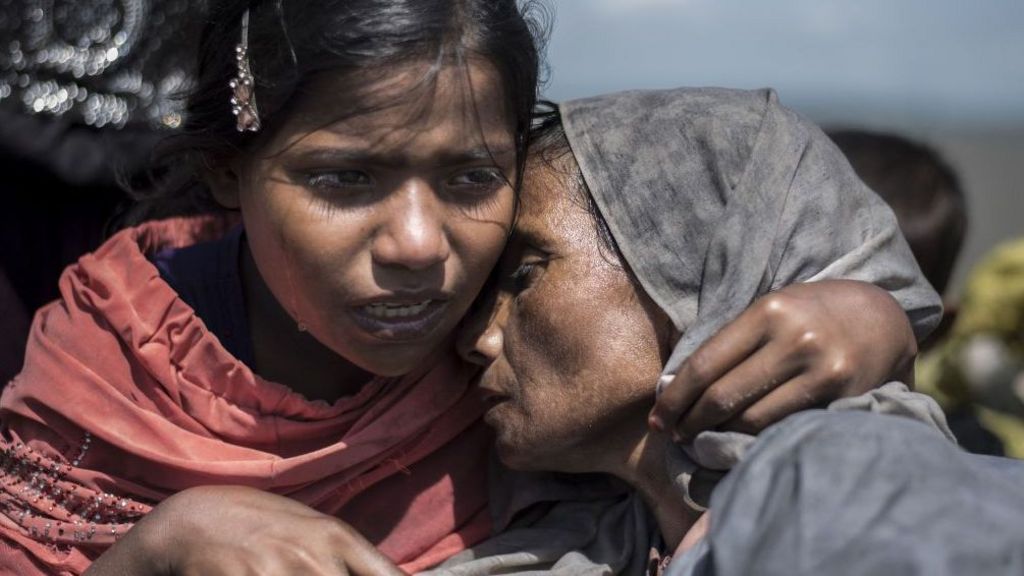
When the 15 judges of the International Court of Justice (ICJ) deliver their long-awaited ruling this Thursday in the 7-year-old genocide claim brought by The Gambia against Myanmar, the decision could mark an unprecedented milestone in global human rights law. Since the 1948 adoption of the Genocide Convention, drafted in direct response to the atrocities of the Nazi Holocaust, dozens of individual perpetrators have been successfully prosecuted for genocide in tribunals addressing conflicts in Rwanda and the former Yugoslavia. But to date, no sovereign state has ever been formally found guilty of perpetrating genocide by an international judicial body.
Arsalan Suleman, lead counsel for The Gambia’s legal team at the ICJ, emphasized the transformative stakes of the case: “A ruling in our favor would be a landmark judgment that breathes new life into the 1948 Genocide Convention, and reinforces the core principle that states can be held legally accountable for the most heinous crime known to international law.”
The August and September 2017 mass expulsion of Myanmar’s Rohingya population from Rakhine State was universally documented as a military campaign of extraordinary brutality. As one of a small cohort of on-the-ground journalists who witnessed the deliberate arson of Rohingya villages and the harrowing exodus of hundreds of thousands of displaced people fleeing across the border into Bangladesh, this reporter can attest to the scale of suffering. Extensive testimonies of extrajudicial killings, systematic torture, and mass sexual violence perpetrated by Burmese military personnel have been rigorously verified by leading human rights organizations and a dedicated United Nations fact-finding mission. Years of on-the-record interviews with ethnic Rakhine residents have also documented widespread anti-Muslim animosity, alongside the systematic, state-sanctioned erasure of remaining Rohingya village sites across Rakhine. The central legal question before the UN’s highest judicial body, however, is whether this pattern of atrocities meets the strict legal threshold for genocide.
Established in 1945 to mediate inter-state disputes rather than prosecute individual international crimes, the ICJ became the only viable legal avenue for Rohingya survivors to seek redress due to critical gaps in other global judicial frameworks. Myanmar’s ruling authorities have consistently rejected all accusations of ethnic cleansing or genocide, framing the 2017 operations as legitimate counterterrorism responses to attacks by Rohingya militant groups. A 2018 UN investigation, drawing on hundreds of firsthand interviews, concluded that the military’s tactics were “grossly disproportionate to any actual security threat,” and recommended top Myanmar military commanders be investigated for genocide in Rakhine State and crimes against humanity across other parts of the country — a finding the Myanmar government formally rejected. Because Myanmar was not a signatory to the Rome Statute establishing the International Criminal Court, there was no legal pathway to file charges against senior officials accused of Rakhine atrocities at that tribunal.
In November 2019, backed by the Organisation of Islamic Co-operation, The Gambia filed its historic inter-state case at the ICJ, arguing that all signatory nations to the Genocide Convention bear a collective legal interest in upholding the treaty’s provisions, granting the small West African state formal standing to bring the claim against Myanmar as a whole, rather than only individual military figures. This represented a novel, untested precedent in international law: a state with no direct territorial or national stake in the alleged events asserting legal standing based on shared responsibility for upholding a foundational human rights treaty. Though Myanmar formally challenged The Gambia’s eligibility to bring the case, ICJ judges later ruled that the West African nation had full legal standing to proceed.
The case garnered global public attention when Nobel Peace Prize laureate Aung San Suu Kyi, then the head of Myanmar’s elected civilian government, traveled to The Hague in person to lead her country’s initial legal defense — a decision that drew widespread international condemnation. Though Suu Kyi held negligible operational influence over the Myanmar military’s actions in Rakhine State, her public refusal to denounce the campaign shattered the admiration of millions of global supporters who had long celebrated her as a champion of democratic values. Following the 2021 military coup that ousted her government and placed her under indefinite detention, the defense team has been replaced by legal representatives appointed directly by the junta led by Min Aung Hlaing, the senior general who oversaw the 2017 Rakhine operations and now serves as Myanmar’s head of state.
Proving genocide under international law is notoriously difficult, with judges applying an extraordinarily high evidentiary bar. In the absence of an explicit, state-documented genocidal program comparable to Nazi Germany’s Final Solution, courts require conclusive evidence that the only reasonable inference that can be drawn from the state’s pattern of actions is the existence of specific intent to destroy, in whole or in part, a targeted ethnic or religious group. When Bosnia and Herzegovina brought a genocide case against Serbia at the ICJ in 1993, the court took 14 years to issue its final ruling: it acknowledged that the 1995 Srebrenica massacre constituted an act of genocide, but found insufficient evidence to prove the Serbian state held explicit genocidal intent, though it did rule Serbia had violated international law by failing to prevent the massacre. Myanmar’s legal team, including Suu Kyi during her 2020 ICJ appearance, has advanced a comparable line of argument, claiming The Gambia’s legal team misrepresented the complexity of the Rakhine conflict. While Suu Kyi acknowledged that isolated war crimes may have occurred during the 2017 operations, she insisted such incidents do not constitute proof of premeditated genocidal intent.
Suleman, however, argues the extensive body of evidence his team submitted to the court easily meets that strict legal standard. “We presented the court with the decades-long documented history of state-sponsored discrimination targeting the Rohingya people, and how that systemic pattern of policy, state propaganda, and discriminatory rhetoric provides the necessary contextual framework to establish the genocidal intent behind the 2017 clearance operations,” Suleman explained. “We laid out the impact of the 1982 citizenship law, and the successive layers of discriminatory regulation that stripped the Rohingya of access to education, formal healthcare, legal livelihoods, and freedom of movement — policies that made sustainable, dignified life for the Rohingya effectively impossible, all of which we argue are clear, corroborating indicators of premeditated genocidal intent.”
If the ICJ rules in favor of The Gambia, Myanmar will become the first sovereign state in history to be formally labeled a perpetrator of what is widely called “the crime of crimes,” placing its actions in the same legal category as the Nazi Holocaust, the 1994 Rwandan genocide, and the Srebrenica massacre. Such a ruling would represent a major public relations setback for Min Aung Hlaing, who has spent recent months attempting to rehabilitate his regime’s deeply tarnished global reputation. While ICJ verdicts are final and carry no possibility of appeal, the court has no authority to impose punitive sanctions on non-compliant states. The Burmese junta’s diplomatic strategy remains overwhelmingly focused on mending ties with neighboring Asian nations, most of which have signaled they will largely disregard any ICJ genocide ruling, rather than pursuing normalized relations with Western governments that prioritize human rights accountability.
For the more than one million Rohingya displaced by the 2017 campaign, however, the verdict carries incalculable personal and symbolic weight. “This ruling would be the first formal global legal recognition of the decades of suffering our community has endured,” said Mohammed Nowkim, a Rohingya refugee who fled the Rakhine town of Buthidaung in 2017 and now resides in Canada. “For the Rohingya people, this trial is our long-awaited moment of acknowledgement, after generations of state-sponsored denial. We have not waited just one year for justice — we have waited decades.” Nowkim and other Rohingya refugee advocates hope a favorable ruling will spur coordinated international action to create a safe, viable pathway for the Rohingya to return to their ancestral lands in Rakhine State. The vast majority of displaced Rohingya currently live in overcrowded, under-resourced camps in Bangladesh’s Cox’s Bazar region, where they are barred from formal employment and basic services as international humanitarian funding continues to decline.
Massive structural obstacles stand in the way of realizing that hopeful outcome, however. Rakhine State is now largely controlled by the ethnic Rakhine insurgent Arakan Army, which enjoys widespread support from the local non-Rohingya population, almost uniformly opposed to the repatriation of Rohingya refugees. Most historic Rohingya village sites have been completely bulldozed and erased, and global public and diplomatic attention to the Rohingya crisis has steadily faded over the past seven years. Even an unprecedented, historic ICJ genocide ruling cannot on its own resolve these deeply entrenched, on-the-ground realities.
Myanmar faces historic genocide verdict at UN court over Rohingya massacres