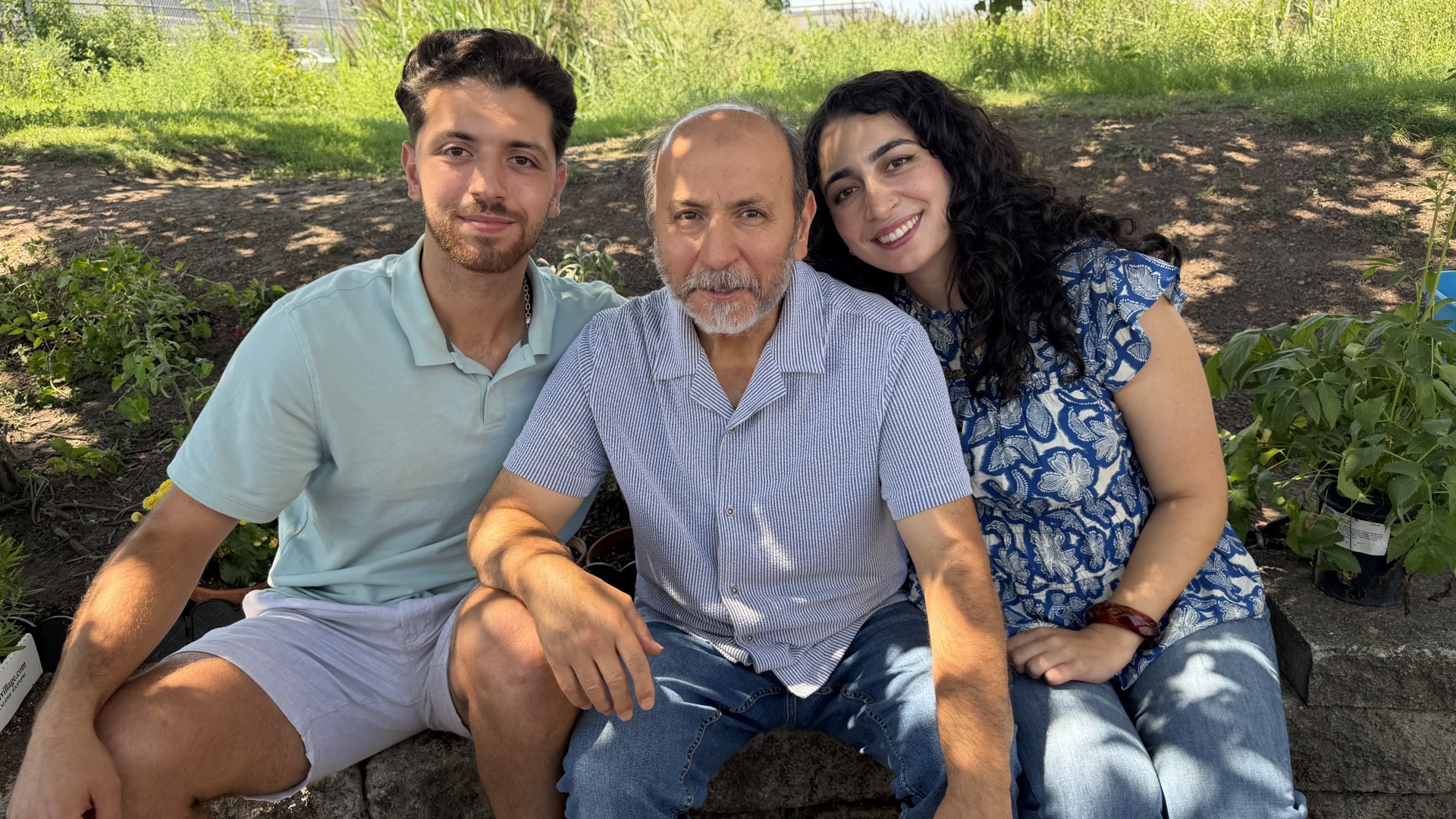
On the morning of July 31, 25-year-old Zena Saifo walked alongside her 65-year-old father, Syrian immigrant Iemad Saifo, into a U.S. Immigration and Customs Enforcement (ICE) field office in Mount Laurel, New Jersey, for what they assumed would be a routine check-in. Iemad had followed all requirements of his ongoing immigration case, working closely with his legal team for years to navigate the system, and he had no reason to anticipate that the appointment would end in custody. The family was aware of widespread immigrant detentions across the country, but they never expected Iemad – a longstanding small business owner with a wife and four children who all hold U.S. citizenship – to be taken into custody that day.
After waiting more than an hour past his scheduled 8 a.m. check-in, an agent asked Iemad if he carried any daily medication with him. The question sent a jolt of alarm through Zena. “That’s when I kind of started to question – is he going to be detained?” she recounted in an interview with Middle East Eye. Minutes later, Iemad was escorted to a private back room with his lawyer. When the attorney emerged alone to confirm ICE had placed Iemad in detention, Zena’s request to say a final goodbye to her father was flatly denied. “I just felt like my whole world had stopped. My heart dropped to my stomach,” she said.
Iemad’s journey to the United States began in 2002, when he entered the country on a B-1/B-2 business and tourism visa. He went on to put down deep roots in New Jersey, opening the popular Zena’s American Mediterranean Cuisine in Collingswood and launching other local small businesses. For two decades, his family has pursued legal pathways to secure permanent residency for Iemad, but his immigration history remains tangled. Department of Homeland Security (DHS) records show his visa expired in May 2002, an immigration judge ordered his removal in 2010, and his case was reopened months later before being administratively closed in February 2023. He also has a decade-old non-violent criminal conviction for witness tampering, for which he completed five years’ probation, 100 hours of community service, and paid all required fines and restitution, alongside past arrests for theft by deception and identity impersonation that did not result in additional convictions. DHS labels Iemad a “criminal illegal alien”, but his family rejects that framing, noting he has complied with all immigration requirements for years and been a contributing member of his local community.
Zena Saifo described her father as “a pillar of our family and our community”, arguing that his 10-year-old non-violent offense did not justify tearing their family apart. “My father did what was asked of him and since then has focused on his family, his restaurant and our community,” she said. Following his detention, Iemad, who spent 14 days in ICE custody before being granted release on bond August 15, pushed back on the government’s description of his status, explaining he had been waiting for a permanent residency interview through his U.S. citizen family members. “I am pending, I am compliant, and I’m waiting for my interview,” he said after his release.
Iemad’s account of his time in detention paints a stark picture of poor conditions and dehumanizing treatment. He told reporters he was handcuffed at the wrists and ankles, with his hands chained to his waist during transport, where he and other detainees waited more than 30 hours to be processed. “A human line, but a person doesn’t feel like a human. There was no humanity in the treatment,” he said. He went nearly two days without sleep in overcrowded holding rooms where contagious illnesses spread rapidly, and he struggled to access his regular prescription medication after one of his drugs was never logged into the detention center’s computer system. Requests to see a doctor went unanswered for days, he said, and by the time of his release, he was physically exhausted and severely weakened. Zena said her father lost 15 pounds during his two weeks in custody, and a pre-existing vocal cord condition worsened significantly after he missed critical doses of his medication. After returning home, he spent nearly a week sleeping and recovering from the ordeal.
For Zena and her family, the uncertainty of not knowing how Iemad was faring during detention was one of the hardest parts of the experience. Acting on guidance from Iemad’s legal team that strong community support would boost their case for bond, Zena organized a community letter-writing event to gather testimonials vouching for Iemad’s character. The response far exceeded their expectations: more than 150 community members submitted notarized letters of support, thousands of people signed a petition backing Iemad’s release, and local elected officials and community organizations added their endorsements. Fiona Powell, Iemad’s attorney, confirmed that the overwhelming community support was a key factor in the judge’s decision to grant bond, with the judge specifically citing Iemad’s deep community ties in his ruling. For Zena, the outpouring of support was a reminder the family was not fighting alone. “I don’t think we expected to get over 150 letters of support. It was really amazing to see,” she said.
Iemad’s detention comes amid a sharp expansion of ICE enforcement operations across the United States under the second Trump administration. Data shared with the University of California Berkeley’s Deportation Data Project shows ICE arrested 49,571 people in July 2025 – the highest monthly arrest total of the current administration, marking a 15% increase from June and a 70% jump from February 2025. The growth in arrests has been driven by an increase in detentions during routine, low-stakes interactions with immigration authorities – including scheduled check-in appointments like Iemad’s, traffic stops, and worksite checks – rather than high-profile public raids. This shift has sparked widespread anxiety among immigrant communities, where many previously viewed routine check-ins as low-risk. The data also shows that more than half of all people arrested by ICE in July had no criminal convictions or pending charges, contradicting the administration’s claims that enforcement efforts prioritize public safety by targeting people with criminal records.
The Trump administration and DHS have defended the expanded crackdown as a necessary measure to enforce existing U.S. immigration law, reiterating that ICE prioritizes the arrest of people with criminal histories. In a statement addressing Iemad’s detention, a DHS spokesperson said, “Under President Trump and Secretary Mullin, ICE is targeting the worst of the worst. Nearly 70 percent of ICE arrests are of illegal aliens charged or convicted of a crime in the US.”
Even though Iemad is now home with his family, the fear generated by his detention has not faded. His immigration case remains pending, and Zena says she continues to worry that he could be taken into custody again at any time. “The anxiety, the fear, the immense stress experienced the past two weeks, it’s not just something that goes away,” she said. While the family is deeply grateful for the community support that secured Iemad’s release, the experience has reshaped Zena’s understanding of how immigration policy impacts entire communities, not just individual detainees. “Her father’s detention, she said, showed that the consequences of an immigration crackdown can extend far beyond the person taken into custody, affecting families, friends and communities who are left to navigate the uncertainty with them,” she said. “It really just shows we have a responsibility to the communities around us. We were able to ensure that we’re standing up for others and that we don’t let any harm go without being addressed.”