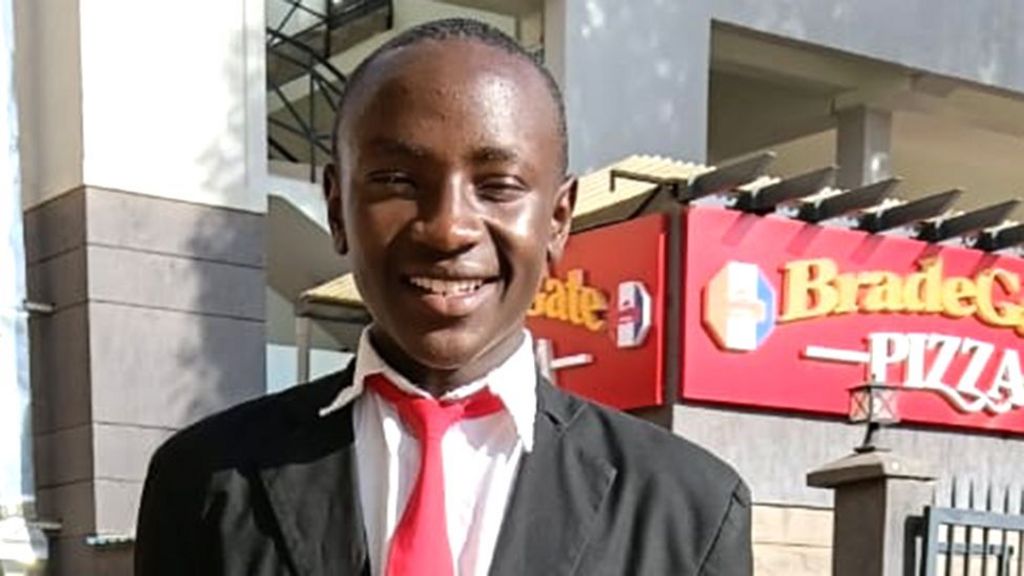
In the central Kenyan town of Nanyuki, a grieving single mother is calling for accountability after her 17-year-old son became the third fatality in violent clashes between police and demonstrators protesting a planned U.S.-backed Ebola quarantine facility.
Lucy Kagure, who earns just $2.30 a day doing casual labor to raise her son Sylvester Muigai Ndung’u, has described the devastating aftermath of her child’s death. The teenager left his home on a routine Tuesday errand — picking up a new school uniform from his aunt — when he unknowingly walked into the middle of erupting unrest. Two days after he went missing, Kagure found his bloodied body listed as an unknown male in a local mortuary, where half his head had been severely damaged.
“I have struggled to raise that boy from nursery school to form three, and then they just killed him,” Kagure told the BBC through tears. She has openly accused Kenyan police of using excessive force to break up the demonstration, asking, “Are they not parents too?”
Witnesses on the scene claim Muigai was shot in the head during the chaos, while family members say police have suggested the injury came from a tear gas canister rather than a live bullet. Local police commander Daniel Kitavi told reporters that authorities are still awaiting post-mortem results to confirm the official cause of death, declining to comment further ahead of the autopsy.
Those close to Muigai remember the teen as a quiet, well-behaved young man who regularly helped his family at home and harbored dreams of one day becoming a priest. His death has cast a harsh light on the growing tensions over the proposed 50-bed Ebola isolation facility, which is set to be built at Kenya’s Laikipia Air Base to treat U.S. citizens affected by the ongoing Ebola outbreak in the Democratic Republic of Congo.
The project has sparked widespread public anger across Kenya, with residents and activists raising alarms over potential cross-border infection risks and criticizing the Kenyan government for a lack of transparency around the facility’s development. Last month, Kenya’s High Court ordered a halt to all construction work after a human rights group filed a lawsuit arguing the center posed “grave and imminent risks” to public health. However, satellite imagery obtained by the BBC confirms construction work has continued at the air base in defiance of the court order.
U.S. officials acknowledged the ongoing legal challenge last week, saying they remained “optimistic we can resolve objections” to the facility. Kenyan President William Ruto has publicly defended the project, noting the U.S. requested the center and arguing that turning down the proposal would be “inhuman.” He has urged Kenyans not to politicize the Ebola response and called on politicians to avoid what he described as “reckless” rhetoric around the issue.
The Tuesday protest that led to Muigai’s death was originally organized as a peaceful march to deliver a petition calling for the facility to be relocated out of the area. But the demonstration turned violent after police blocked demonstrators’ access to the construction site. Police deployed tear gas and water cannon to disperse crowds, while protesters responded by erecting roadblocks and setting bonfires across Nanyuki.
The Kenya Human Rights Commission, an independent non-governmental organization, has accused police of widespread excessive force during the unrest, including the use of live ammunition and arbitrary mass arrests. As of this report, Kenyan authorities have not issued any public response to these allegations.
For Kagure and her family, the immediate priority is not the larger political debate over the quarantine center — it is justice for a young life cut tragically short. “I want justice for my boy,” she said.