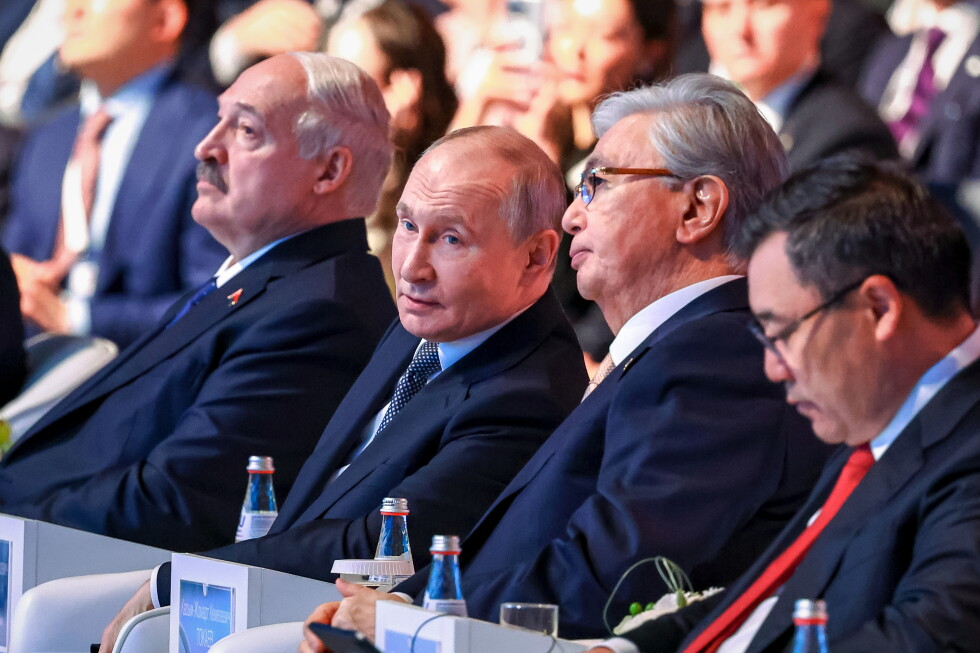
ASTANA, KAZAKHSTAN — At a high-stakes summit of the Russia-led Eurasian Economic Union (EAEU) held Friday in Central Asia’s capital, top leaders from the bloc have issued a stark warning to member state Armenia: move forward with plans to seek European Union membership, and face immediate suspension from the Moscow-dominated economic alliance. The public rebuke amplifies already simmering tensions between the Kremlin and Armenia’s pro-Western government, just days ahead of a critical national parliamentary election that will shape the small Caucasus nation’s future geopolitical alignment.
Russian President Vladimir Putin was joined by the heads of state of Belarus, Kazakhstan, and Kyrgyzstan — the four full voting members of the 2015-founded single market bloc — in issuing the demand. The group emphasized that Armenia’s formal bid for EU membership creates “significant systemic risks” to the collective economic security of all EAEU members, who enjoy tariff-free movement of goods, capital, and labor across their shared market. They instructed top regional officials to prepare a comprehensive policy report by December detailing the procedural and economic implications of suspending Armenia’s EAEU membership.
In an unusual step that goes beyond standard bloc diplomacy, the four leaders also called on Armenian authorities to put the geopolitical choice to a national public vote: let Armenian voters decide between pursuing integration with the EU or retaining full membership in the Eurasian Economic Union. That call has already been rejected by Armenian Prime Minister Nikol Pashinyan, who has led the country since the 2018 Velvet Revolution and is currently campaigning to retain his office in the June 7 parliamentary election.
The escalation from EAEU leaders is no coincidence: it comes just over a week before Armenians head to the polls, with Pashinyan’s government having spent the past two years steadily shifting Armenia’s foreign policy away from Moscow and toward Western institutions. Last year, Yerevan signed a US-brokered peace deal with neighboring Azerbaijan, ending decades of armed conflict over the Nagorno-Karabakh region. Since then, Pashinyan has openly declared his government’s intention to pursue full EU membership, and already suspended Armenia’s participation in the Collective Security Treaty Organization (CSTO), the Moscow-dominated regional security bloc.
This deliberate westward pivot has enraged the Kremlin, which has long viewed Armenia as a key ally in the South Caucasus. Putin has repeatedly warned Pashinyan that moving closer to the EU would bring severe economic consequences for Armenia. In recent weeks, Moscow has already taken preliminary punitive steps: it has threatened to cut off supplies of heavily subsidized natural gas — a critical energy input for Armenia’s economy — and imposed a full ban on imports of Armenia’s signature brandy, as well as fresh fruit and vegetable products. Analysts widely view these measures as direct interference in the upcoming election, designed to turn voters against Pashinyan and his pro-Western agenda.
Putin doubled down on that position Friday, stressing that Armenia cannot maintain membership in both blocs simultaneously. He warned that if Armenia withdraws from the EAEU, the country could see its total gross domestic product drop by as much as 14% as it loses access to the large, tariff-free Eurasian market. In comments that carried clear historical weight, Putin also drew a direct parallel between the current standoff with Armenia and the 2014 crisis in Ukraine. At that time, Ukraine’s decision to move forward with an association agreement with the EU led to the ouster of Moscow’s allied president, Russia’s annexation of Ukraine’s Crimean Peninsula, the outbreak of a separatist insurgency in eastern Ukraine, and ultimately the full-scale Russian invasion of Ukraine in 2022 — the largest European military conflict since World War II.
Pashinyan has pushed back against the Kremlin’s warnings, arguing that for the immediate future, Armenia can balance its existing EAEU membership with deepening political and economic cooperation with the European Union. As campaigning enters its final stretch, the election is set to deliver a clear verdict on whether Armenians will back their government’s push westward, or pivot back to closer alignment with Russia.