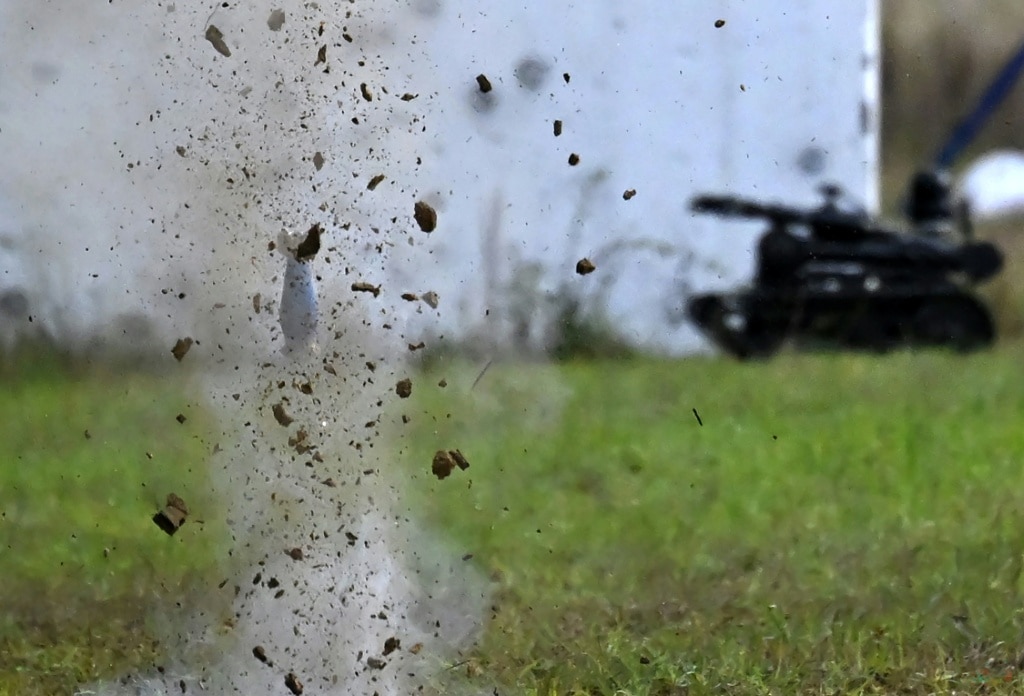
As Colombia grapples with the highest levels of armed violence in a decade, the nation’s military has rolled out a domestically developed drone weapons system to counter a growing threat: guerrilla groups that have already turned improvised drone technology into a weapon of terror across the country’s rugged Andean terrain.
Weeks ahead of the May 31 presidential election, the new combat drone represents the Colombian military’s formal response to a tactical shift by irregular armed groups, which have increasingly adopted low-cost drone tactics inspired by the Russia-Ukraine war to strike military outposts, civilian communities, and infrastructure. Unlike the jury-rigged explosive-laden drones built by guerrillas, the military’s new system can hover at altitudes up to 1,000 meters, and launch 60-caliber grenades capable of destroying all targets within a 15-meter radius. AFP was granted exclusive access to a capabilities demonstration in Sogamoso, a municipality roughly 210 kilometers northeast of Bogotá, where the military successfully test-fired 16 consecutive grenades on a dedicated test range.
“This puts us on equal footing” with illegal armed groups, explained Andrés Julián Salamanca, a 37-year-old electrical engineer who contributed to the system’s development.
Colombia now joins Venezuela as one of the only Latin American nations deploying armed drones for internal counterinsurgency operations, marking a major paradigm shift for a military that has spent decades combating guerrilla groups funded by drug trafficking and illegal mining. For months, irregular groups have sourced off-the-shelf drone components from online retailers, modifying the devices to carry explosives. In remote rural regions, the faint hum of a drone has become inextricably linked to fear: official 2025 defense ministry data records at least 8,000 drone attacks that left 20 people dead and nearly 300 more injured, with targets including schools and Indigenous settlements.
“Drones are an essential part of modern warfare. They are becoming cheaper and more lethal,” noted Willy Gaitán, manager of the Sogamoso production plant run by Indumil, Colombia’s state-owned arms manufacturer. Development of the drone grenade launchers began in October 2023 at the direct request of Colombian Defense Minister Pedro Sánchez. The domestic production push aligns with the policy of current leftist President Gustavo Petro, who ended Colombian military cooperation partnerships with Israel in 2024 and has prioritized building up local arms manufacturing. Petro has also backed a $1.6 billion project to acquire a comprehensive national anti-drone defense system to counter guerrilla attacks.
Colombia’s defense sector frames the new armed drone program as a critical technological breakthrough in the long-running fight against irregular armed groups. Indumil now has plans to expand the system’s capabilities, increasing the number of grenades each drone can carry and upgrading to larger-caliber projectiles for greater destructive power.
Salamanca characterized the ongoing tactical evolution as “a cat-and-mouse game”: “As militias gain capabilities, the government is looking for ways to counter them.”
The deployment comes as Colombians prepare to head to the polls Sunday to elect a new president. Recent polling indicates the election is headed for a June 21 runoff between leftist Senator Iván Cepeda, who supports continuing Petro’s policy of negotiated peace talks with armed groups, and right-wing millionaire lawyer Abelardo de la Espriella, who has pledged to launch an all-out military offensive against irregular groups if elected.