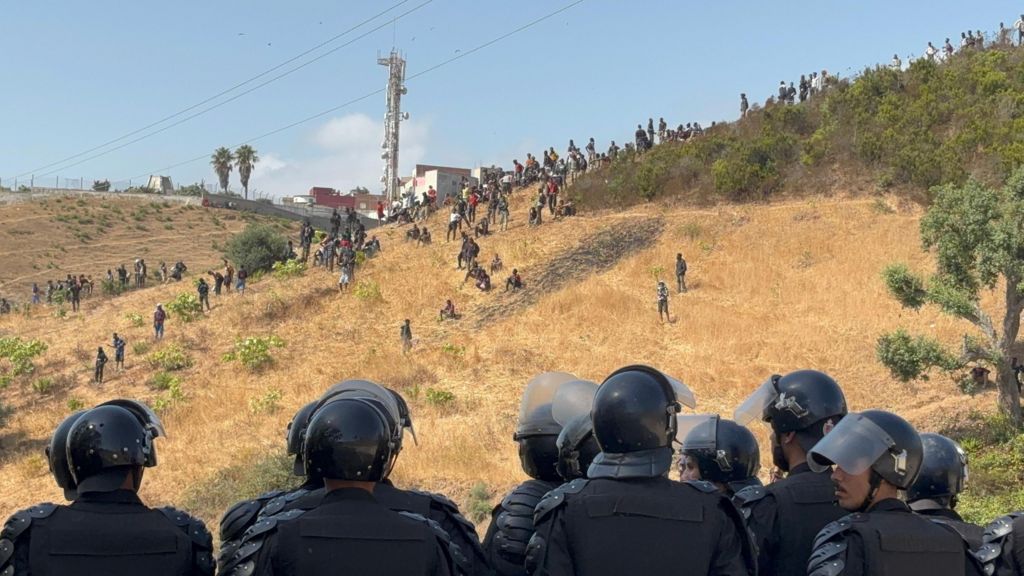
On Saturday, Moroccan security officials intercepted more than 100 migrants who were attempting to cross the border into Ceuta, the Spanish-controlled North African exclave, ending a widely anticipated repeat of the unprecedented mass migration event that shook European border policy two weeks prior.
According to Moroccan security sources quoted by Reuters and major Spanish media outlets, the 111 detainees were held in and around Fnideq — a town located just 3 kilometers from the Ceuta border, known as Castillejos in Spanish. The vast majority of those intercepted were migrants originating from sub-Saharan Africa, who had gathered on nearby hills ahead of a planned coordinated crossing. Local reports note that riot-equipped Moroccan police deployed tear gas to disperse the assembled groups, as security forces moved in to make detentions.
This interception comes exactly two weeks after an unforeseen mass influx saw nearly 78,000 migrants cross into Ceuta by sea over a single 24-hour window. The city’s mayor confirmed that around 100 migrants lost their lives during that chaotic crossing event. In the weeks that followed, both Moroccan and Spanish authorities moved rapidly to reinforce border security, after unconfirmed social media posts from unknown sources began circulating calls for a second mass crossing attempt on Saturday. Days before the planned date, Moroccan officials in Rabat publicly confirmed they were monitoring these social media calls, and issued a clear warning that both organizers and participants in unauthorized crossing attempts would face criminal prosecution.
To secure the border ahead of the weekend, Morocco deployed an extensive multi-layered security presence: beyond reinforced police units, the country sent army personnel, naval speedboats and surveillance drones to patrol the boundary, in addition to the new metal fencing and floating barriers installed earlier that week. On the Spanish side, authorities responded by deploying over 1,500 additional security officers to patrol Ceuta’s borders. Leading Spanish newspaper El País reported that security at the key breakwater entrance to the exclave was 10 times more robust than it had been just 24 hours prior to Saturday’s attempted crossing.
While Saturday’s interception has averted a second large-scale influx, the original late-July migration crisis continues to send political ripples across the European Union. The mass arrival has already sparked sharp tensions between EU member states that participate in the bloc’s open-border Schengen Area, and drawn significant criticism to Spanish Prime Minister Pedro Sánchez’s government. Italy has already suspended its Schengen border arrangements with Spain, a move backed by Finland and Denmark, while the Czech Republic went so far as to call for a temporary suspension of Spain’s Schengen membership. Sánchez has pushed back against these measures, pointing out that Ceuta is not officially part of the Schengen border-free zone, but the political fallout over the crisis remains unresolved.