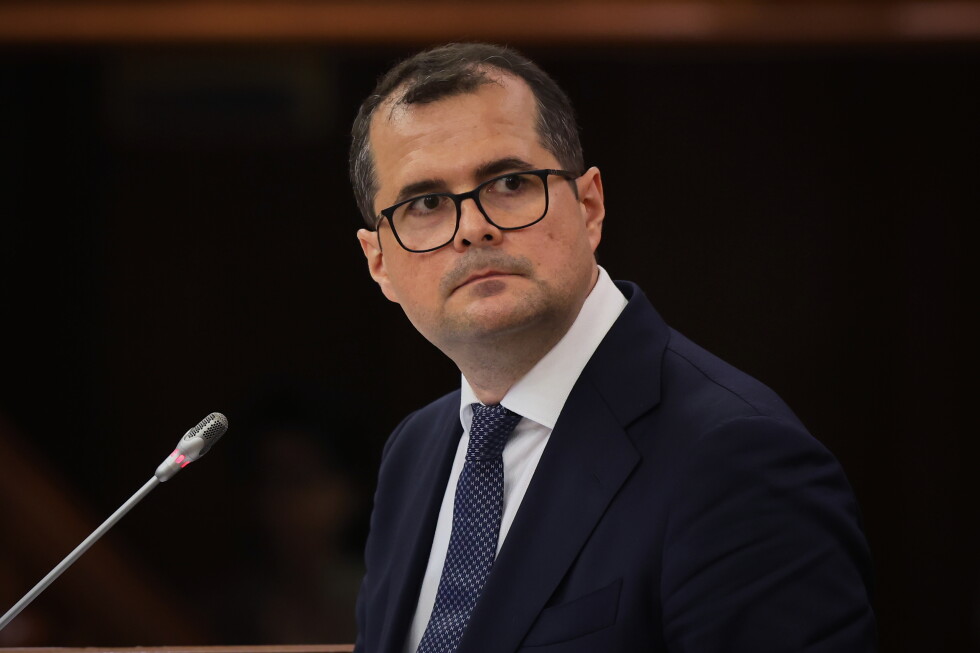
CHISINAU, Moldova — In a landmark vote that underscores Moldova’s continued commitment to Western integration, the country’s pro-European parliament voted Tuesday to install 44-year-old businessman and investor Vasile Tofan as the new prime minister, tasking a political outsider with steering the former Soviet republic’s ongoing bid for European Union membership.
Backed by pro-Western President Maia Sandu and her ruling Party of Action and Solidarity, Tofan secured the parliamentary approval with a clear majority: 53 lawmakers voted in favor of his appointment, 21 voted against, and another 21 abstained in the 101-seat unicameral legislature.
Speaking to assembled legislators moments ahead of the confirmation vote, Tofan emphasized he recognized the heavy weight of his new mandate. “I understand my responsibility to fight for the interests of all Moldovans,” he said, adding that he and his incoming cabinet would govern “with integrity and the unwavering will to push Moldova forward.”
Until his appointment to the top government post, Tofan served as a senior partner at Horizon Capital, a Ukraine-based investment firm. He brings robust international academic credentials to the role: he holds a Master of Business Administration from Harvard Business School, as well as both bachelor’s and master’s degrees in public administration from Erasmus University Rotterdam in the Netherlands. In a surprising remark for a new head of government, Tofan clarified that he does not plan to build a long-term career in domestic politics. “I want to finish my mandate and look back at it with pride in the things I did,” he explained.
Tofan’s elevation comes three weeks after his predecessor, Alexandru Munteanu, stepped down in an unexpected move after just eight months in office. Munteanu’s resignation automatically dissolved the entire previous cabinet, but the former prime minister offered no explicit explanation for his departure, stating only that he could “no longer exercise my mandate in accordance with my principles and beliefs.”
President Sandu, who nominated Tofan for the prime ministerial role, has stressed that Moldova requires a cohesive, effective governing team to advance its EU accession goals. Following the previous government’s collapse, she charged Tofan with assembling a new cabinet to take forward the country’s integration agenda.
Geopolitically, Moldova occupies a strategic position in Eastern Europe: a landlocked nation bordered by Ukraine to the east and Romania — a member of both the EU and NATO — to the west, it gained independence from the Soviet Union in 1991. While the majority of its population speaks Romanian, it is home to a large Russian-speaking minority, and in recent years its clear shift toward Western integration has turned the country into a key point of geopolitical tension between Russia and the European bloc.
Moldova made tangible progress on its accession path in recent weeks. Last month, the country and neighboring Ukraine — which is also pursuing EU membership — opened negotiations on a first cluster of five accession chapters covering the foundational values of the EU, including the rule of law, protection of fundamental rights, and the functioning of democratic institutions. Just last week, both nations moved forward again by opening a second cluster of negotiations focused on foreign relations, security and defense policy, trade rules, development cooperation, and humanitarian aid.