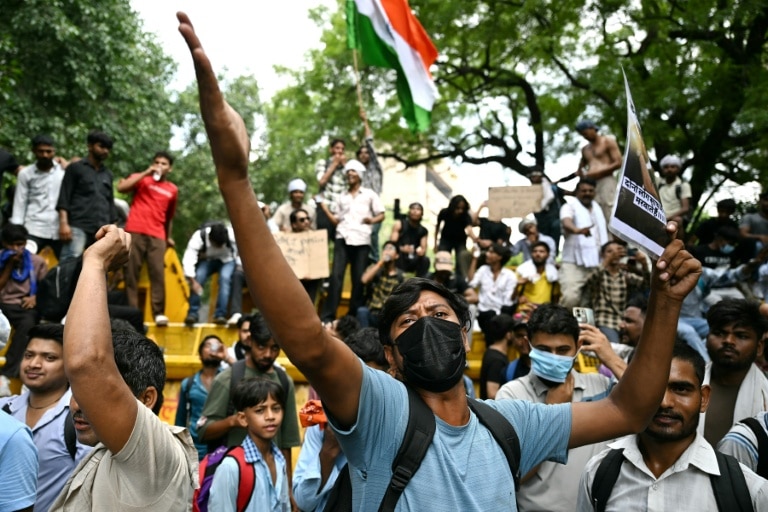
Weeks of growing youth unrest over widespread exam cheating and paper leaks in India has reached a fever pitch in New Delhi, drawing one of the sharpest challenges to Prime Minister Narendra Modi’s third-term administration yet. In his first direct public address addressing the protests that have paralyzed parts of the capital and spread across the country, Modi vowed Thursday that anyone involved in rigging recruitment and entrance exams will face harsh, swift consequences. “Nothing matters more than protecting the welfare and future of India’s young people,” the prime minister wrote in a social media post, announcing plans to establish fast-track special courts to rapidly prosecute those responsible for orchestrating question paper leaks. “Anyone who tries to destroy the future of our youth will not be spared,” he added. The prime minister’s comments came one day after thousands of demonstrators, organized under the banner of the viral social media movement Cockroach Janta Party (CJP), rallied at New Delhi’s iconic Jantar Mantar protest site, spilling into surrounding streets and triggering renewed violent clashes with local police. The CJP movement began unexpectedly in May, launched as a satirical rebuke after India’s Chief Justice Surya Kant was widely reported to have compared restless young Indians to “cockroaches” and “parasites” during a public court hearing. What started as an online joke quickly evolved into a mass grassroots movement that now counts millions of followers across major social platforms, expanding its demands to cover systemic youth issues: soaring youth unemployment, shrinking economic opportunity, and what organizers decry as Modi’s growing authoritarian turn in governing. The current wave of protests erupted earlier this month, snowballing into major unrest on Monday, the opening day of India’s annual monsoon parliamentary session. Tens of thousands of students attempted to march to India’s parliament building to demand action, prompting Delhi Police to deploy tear gas and baton charges to disperse the crowd. Protesters responded by throwing stones, in what became the largest mass street demonstration held in the national capital in nearly five years. Official police reports confirm at least 178 people, including dozens of security personnel, were injured in the day’s violent clashes. Protesters, most of whom are college students and young job seekers, are demanding the immediate resignation of India’s federal education minister over the government’s failure to stop repeated exam leaks and irregularities. CJP spokesperson Ashutosh Ranka accused Delhi Police of excessive force during Wednesday’s continued protests, writing in a social media post that authorities had shut down mobile internet access in the protest zone and “brutally beaten” peaceful demonstrators. Delhi Police, for their part, pushed back against the claims, saying protesters first attacked responding officers with stones and plastic bottles, leaving multiple officers with “serious injuries.” The protest movement has quickly gained broad political support from India’s fragmented opposition bloc, which has paralyzed parliamentary proceedings for days and demanded Modi issue a formal public apology for the violent police crackdown on Monday’s demonstration. Rahul Gandhi, leader of the main opposition Congress Party, directly attacked Modi in a social media post Thursday, arguing the prime minister was the ultimate party responsible for harming India’s young people. “You allowed and encouraged the total capture and destruction of our education system — and protected every person responsible for it,” Gandhi wrote. The unrest has now spread far beyond New Delhi, with smaller but coordinated demonstrations popping up across India on Wednesday in major population centers including Mumbai, Bengaluru and Patna. International solidarity has also emerged: student organizers in neighboring Bangladesh called for a mass “torch rally” Thursday evening to stand with the Indian protesters, a notable show of support just months after mass youth-led protests in Bangladesh toppled the long-ruling government of Sheikh Hasina earlier this year. The current unrest stems from a growing crisis of public trust in India’s national testing and recruitment system, which has been rocked by repeated high-profile cheating scandals in recent months. Earlier this year, a major medical entrance exam question paper leak forced more than two million registered candidates to retake the high-stakes test, delaying admissions for months. More recently, a dispute over flawed online grading for nearly two million high school leaving examinations has further stoked public anger at the government’s failure to reform the broken system. Political analysts note the youth-led protests represent one of the most significant domestic challenges to Modi’s Hindu nationalist government since he won a third consecutive five-year term in national elections held earlier this year, tapping into widespread frustration among India’s large youth population over stagnant economic opportunity and institutional corruption.