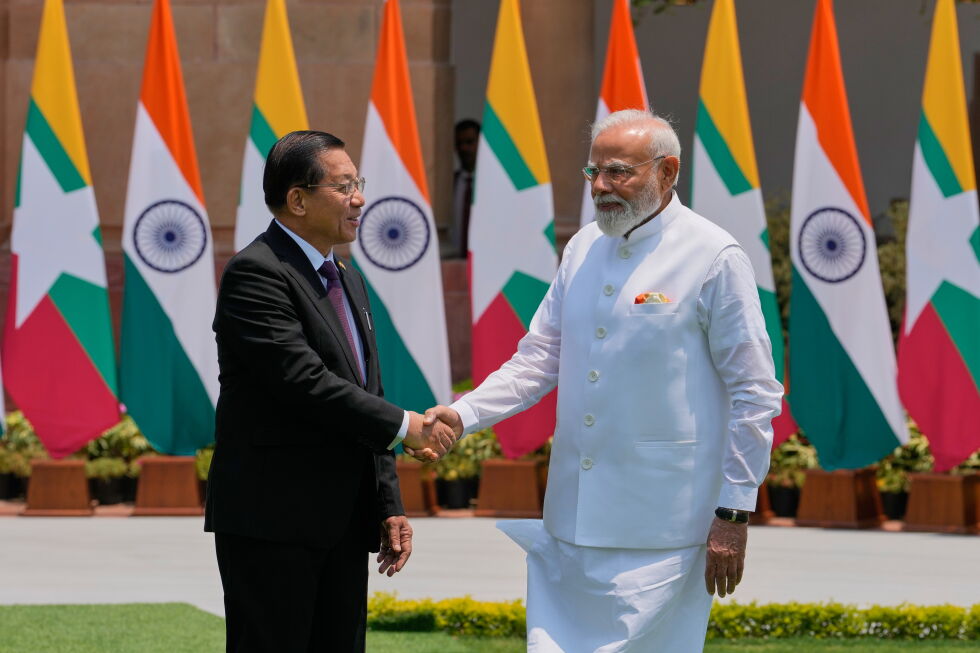
NEW DELHI – In a move that defies Western efforts to isolate Myanmar’s ruling military junta, India has announced it will maintain open diplomatic and bilateral engagement with Myanmar’s military-backed administration following high-level talks Monday between Prime Minister Narendra Modi and junta leader Min Aung Hlaing, the country’s recently installed president. This meeting comes nearly three years after the 2021 military coup that ousted the democratically elected government led by Aung San Suu Kyi, a development that triggered sweeping Western sanctions, a brutal nationwide crackdown on opposition, and a deepening humanitarian and armed conflict across Myanmar.
Addressing reporters in the Indian capital shortly after the closed-door talks, Indian Foreign Secretary Vikram Misri emphasized that New Delhi’s longstanding policy of engagement with Myanmar is not an endorsement or commentary on the country’s internal political order. Misri argued that cutting ties and isolating Myanmar would backfire, pointing to historical precedent to back New Delhi’s approach: “History has shown that disengagement doesn’t give us any results that are better than engagement,” he told reporters.
This visit marks Min Aung Hlaing’s first trip to India since he was sworn in as president in April, following a general election widely dismissed by international critics as a sham to consolidate the military’s grip on national power. His last official visit to India took place in 2019, when he served as the commander-in-chief of Myanmar’s military.
Western governments have led a global push to isolate Myanmar’s military rulers since the 2021 coup, and human rights organizations and international critics have warned that Min Aung Hlaing’s high-profile trip to New Delhi risks granting unearned legitimacy to a government that came to power through force. The coup ousted Suu Kyi’s civilian administration and sparked a widespread popular resistance movement that has devolved into a prolonged nationwide armed conflict, displacing hundreds of thousands and creating a dire humanitarian emergency.
Geography and strategic interests have long shaped India’s approach to its eastern neighbor. India shares a 1,643-kilometer land border and a shared maritime boundary in the Bay of Bengal with Myanmar, and the country currently hosts thousands of Myanmar refugees who have fled fighting in Chin State and other conflict-hit border regions. For India, Myanmar is also a critical partner for national security: the two countries have a long history of collaboration on border security and intelligence sharing to counter insurgent groups that operate across the shared frontier.
In an unusual departure from standard protocol for visiting heads of state in New Delhi, neither Modi nor Min Aung Hlaing spoke to reporters following their bilateral meeting. Misri however outlined the key topics on the agenda, noting that discussions covered trade, defense and security coordination, border governance, and regional strategic issues, with a particular focus on expanding economic and technological ties. He added that both sides reached agreement to deepen cross-sector collaboration in key areas including trade, energy, and critical mineral supply chains, as well as to speed up work on major cross-border connectivity infrastructure projects.
The talks also addressed growing transnational threats that have directly impacted India: cybercrime and human trafficking linked to scam compounds operating in Myanmar that have lured thousands of Indian citizens into forced criminal work. Misri confirmed that joint counter-criminal efforts between the two countries have already resulted in the rescue of more than 2,400 Indian nationals from these scam operations over the past 18 months.
Beyond his meeting with Prime Minister Modi, Min Aung Hlaing held separate talks during his visit with India’s President Droupadi Murmu, Foreign Minister Subrahmanyam Jaishankar, and National Security Adviser Ajit Doval, covering multiple dimensions of the bilateral relationship.