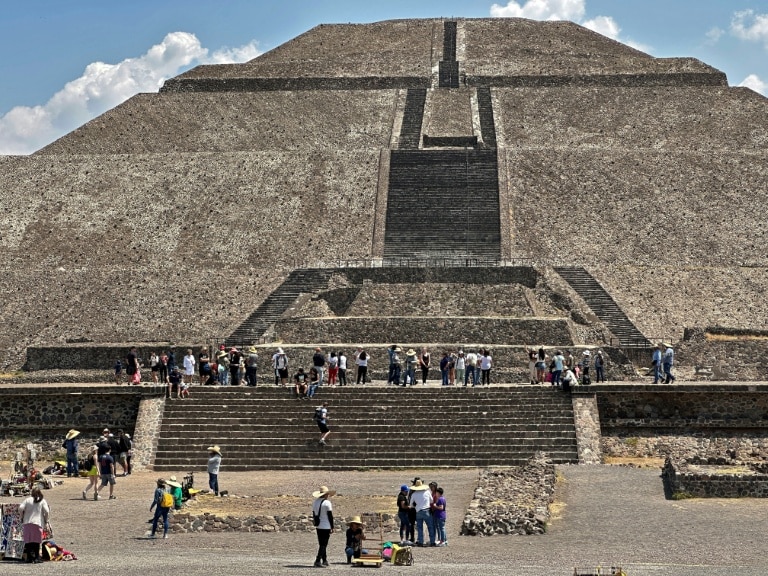
A deadly premeditated shooting at one of Mexico’s most iconic cultural landmarks has left one international tourist dead and more than a dozen injured, sending shockwaves through the country’s tourism sector just weeks ahead of the 2026 FIFA World Cup. Authorities confirmed Tuesday that the attack, carried out Monday at the UNESCO World Heritage-listed Teotihuacan archaeological site, was planned days in advance and directly inspired by one of the United States’ most infamous mass killings.
The shooter, identified as 27-year-old Julio Cesar Jasso Ramirez, a resident of Mexico City, took his own life as Mexican military personnel approached to apprehend him. The sole fatality was a Canadian woman in her early 20s who was visiting the site. Thirteen other people were wounded in the attack, which unfolded on the Pyramid of the Moon – the 45-meter-tall ancient monument that draws thousands of global visitors annually. Among the injured were a six-year-old boy, a second Canadian national, a Colombian woman, a Brazilian man, and two American citizens.
Mexico State Prosecutor Jose Luis Cervantes told reporters at a press briefing alongside Mexican President Claudia Sheinbaum that the attacker had carried out extensive pre-attack preparation. “He made multiple visits to the pyramids, stayed in hotels near the site ahead of time, and from there planned his violent acts,” Cervantes said. Investigators recovered a backpack at the shooting scene that contained a loaded firearm, a knife, 52 additional rounds of ammunition, and printed materials and images directly connected to the 1999 Columbine High School massacre in Colorado, according to Cervantes.
The 1999 Columbine attack, carried out by two teenaged students who killed 12 classmates and one teacher before dying by suicide, has become a twisted inspiration for dozens of copycat mass shootings around the globe in the decades since. Jacqueline Gutierrez, an American visitor who survived Monday’s attack, told Mexican newspaper Milenio that the shooter explicitly referenced the attack’s 27th anniversary, which fell on April 20. He also made comments tying the Teotihuacan site to its history of pre-colonial ritual sacrifices, Gutierrez added.
President Sheinbaum confirmed that investigators have found no links between the shooting and organized crime, noting that the perpetrator “had psychological problems” and “was influenced by events that had occurred abroad.” She called the attack an unprecedented event for Mexican archaeological sites and pushed for immediate policy changes to strengthen safety protocols at tourist destinations across the country. “We need to have better security to make sure someone can’t enter an archaeological site, a tourist site, with a firearm,” Sheinbaum said.
Teotihuacan, the ancient capital of a pre-Aztec civilization that built its massive step pyramids between the 1st and 7th centuries AD, is Mexico’s second most-visited archaeological site, drawing millions of visitors every year. Until Monday, the site had no history of violent mass attacks. Prior to the shooting, visitors entered the site without any security screenings for weapons, Juan Carlos Mejia, executive director of local tourism agency Estur, told AFP. “Previously they never check you,” before entering, Mejia said.
In response to the attack, authorities have closed the site temporarily to adjust safety measures, with a scheduled reopening on Wednesday that will introduce enhanced security protocols. The shooting comes just three weeks before Mexico is set to host multiple matches in the 2026 FIFA World Cup, including the tournament’s opening match on June 11 in Mexico City – just 50 kilometers from the Teotihuacan site. President Sheinbaum’s call for tighter gun controls at tourist sites has drawn broad support from tourism industry leaders, who say the changes are critical to protecting both visitors and Mexico’s reputation as a top international travel destination.