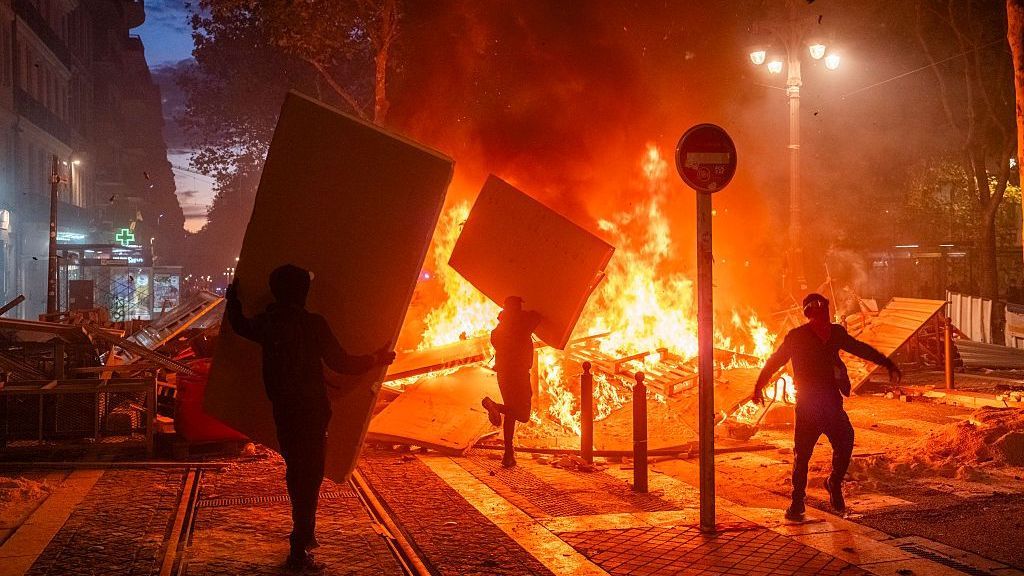
When thunder and lightning cracked open the sky over Marseille in the days after France’s worst bout of modern civil unrest, the storm illuminated a scene of chaos: hundreds of storefronts stood with cracked glass panes and hastily boarded entryways, left scarred when peaceful student protests dissolved into widespread looting and violence Saturday.
As France’s second-largest city bore the brunt of the national chaos, the scale of damage has shaken local leaders, law enforcement and residents alike. Local business associations confirm more than 500 commercial locations were damaged, the vast majority also targeted for looting across central neighborhoods and outlying shopping districts. For frontline police officers, the weekend was nothing short of catastrophic: 118 Marseille officers were hurt in the unrest, accounting for more than 10% of all injuries sustained by police nationwide during the riots. As of early this week, 101 people have been taken into custody in the port city, 25% of whom are minors.
By Monday, a drastic emergency intervention had cleared protesters from Marseille’s streets: an 8-hour ban on all demonstrations and public gatherings was enacted to block a third straight day of disorder. The measure appeared to deliver temporary calm; the largest group to gather in the city center that day was a cluster of weather-worn tourists walking the waterfront quayside. In a further move to head off renewed unrest, local officials are set to implement an overnight curfew for minors in targeted parts of the city starting Tuesday.
Marseille, long France’s most ethnically diverse urban hub, has been a landing point for generations of new arrivals to the country, and the unrest has split opinions across its diverse population even as it has left a shared trail of damage. For 18-year-old student Maryame, who moved to the southern city just a few weeks ago from a nearby rural area, Saturday’s violence was her first frightening experience of both big-city life and political protest.
She joined the original student march, which first launched in September to demand improvements to dilapidated school infrastructure before expanding to address broader grievances including France’s ongoing cost of living crisis. The early solidarity of the march felt “beautiful,” she told reporters, but the situation shifted dramatically when looters broke away to attack nearby shops. Still, she remains conflicted about the unrest, echoing a thread of thought that runs through many French debates over civil protest.
“It is a very complicated question if violence is legitimate,” Maryame said. “But the thing is, France, our history is really based on revolution, and sometimes we really have to make a really big impact. Sometimes it goes too far.”
For rank-and-file police, the speed and severity of the collapse of order was unprecedented. “It was a war,” said Arnaud Blaise, a representative for the UN1TE police union. “An unheard-of level of violence. Unprecedented.”
Looting stretched across the entire city: from La Canebière, Marseille’s bustling central boulevard equivalent to Paris’s Champs-Élysées, and Rue Paradis, to the popular Centre Bourse shopping mall, and out to the Grand Littoral and Le Merlan malls in the city’s northern districts. Blaise said officers eventually exhausted their non-lethal riot supplies, forcing tactical retreats as disorder spread.
Blaise blamed the chaos on a combination of far-left Black Bloc agitators who he said provoked the unrest, and young people from deprived northern neighborhoods who seized the opportunity to loot. “The Black Blocs provoked, and the youngsters took advantage to start looting,” Blaise explained. “That created chaos, with police officers running right, running left, and in effect, we got overwhelmed.”
When questioned about widespread accusations that police used heavy-handed tactics against peaceful student demonstrators while failing to intervene to stop looting, Blaise rejected the claim. He noted far more officers than protesters were injured in the clashes, adding: “Four thousand tear gas grenades were fired and then we ran out of ammunition. So at a certain point, you have no choice but to retreat.”
On Monday evening, French Interior Minister Laurent Nuñez traveled to Marseille to meet with local leaders, after President Emmanuel Macron rejected calls for Nuñez’s resignation in the wake of the riots. During his visit, he stopped at Marseille City Hall, which was briefly occupied by protesters Saturday, for talks with Socialist Mayor Benoît Payan.
Payan has openly demanded answers from the national government over how the chaos was allowed to unfold, calling the entire response to the unrest a “fiasco” from start to finish. He criticized understaffed, poorly deployed police forces and called for a complete overhaul of crowd control tactics. “If there isn’t a radical change of approach on this issue – if, by chance, the only target remains high school students – then we will see looting scenes again,” Payan warned. “I don’t know what’s left to loot in Marseille, but for the little that remains, it will be looted.”
While emergency measures have brought a fragile, temporary calm to Marseille, more national demonstrations are already scheduled for the coming weekend. For long-time Marseille residents like 79-year-old grandmother Chantal Bellanger, the unrest reflects deep, unaddressed failures across French society that have left young people disillusioned.
Standing near a shattered tram stop in a damaged neighborhood, Bellanger said she had been worried about growing unrest for a long time. “We can clearly see that France has lost its grip on many things,” she said. “Public services, hospitals, education is in a horrible state, the peripheral neighbourhoods are dilapidated, they are abandoned.”
Bellanger, who once worked in the impoverished northern suburbs where much of the unrest originated, said she fears anger and despair are pushing an entire generation of young people into criminal activity that will exclude them from society for life. “It tugs at your heartstrings,” she said. “To see children whose actions are going to place them completely outside of society. It’s painful to watch.”