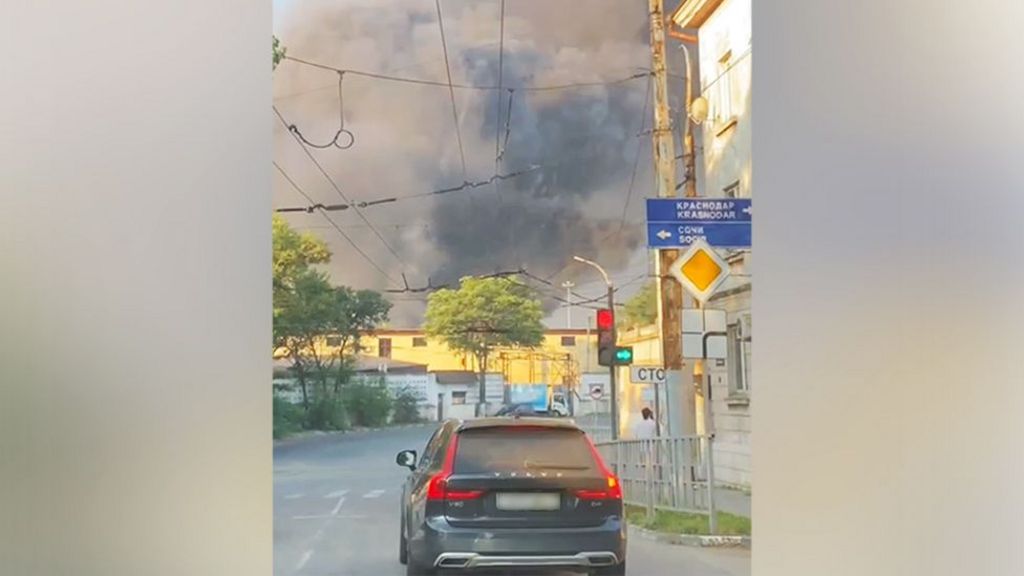
Escalating cross-border attacks between Russia and Ukraine have sent new shockwaves through the Black Sea region, after Ukraine launched a large-scale overnight drone and missile assault on Russia’s key Black Sea port of Novorossiysk, striking critical grain infrastructure and the country’s last major remaining Black Sea naval base.
Local Russian officials confirmed the attack left three people dead – including an 8-year-old child – and injured 24 more. The assault, which Ukrainian President Volodymyr Zelenskyy framed as a “unique operation” involving rockets, crewed aircraft and sea drones, targeted the Russian naval facility based at the port. Zelenskyy did not explicitly reference the damaged grain terminals in his public remarks, but did issue a stark warning: “The occupying fleet and all the infrastructure that supports it will not be safe as long as Russian aggression continues.” Ukraine’s military later claimed four Russian warships, among them two frigates, were damaged in the strike. As of Wednesday, Russia’s defense ministry had not issued any public comment on the naval casualties.
Novorossiysk, one of Russia’s largest commercial and military ports, became the primary base for Russia’s Black Sea Fleet after the service was forced to relocate from its longstanding home in occupied Sevastopol, Crimea. The Crimean base had grown increasingly vulnerable to repeated Ukrainian long-range strikes, prompting the full shift of the fleet’s main assets to Novorossiysk.
Two major international grain trading firms have confirmed their export terminals at the port sustained damage in the attack, matching independent on-the-ground reports. The overnight barrage triggered repeated explosions across the city as Russian air defense systems engaged incoming aerial targets. A state of emergency was declared across Novorossiysk on Wednesday, after the strike damaged local pipelines and cut off running water for much of the city’s population. Across the wider Krasnodar Krai region, regional governor Veniamin Kondratyev reported an additional civilian death from falling drone debris, saying “several hundred drones” struck multiple locations overnight, damaging dozens of civilian structures including private residences.
The Ukrainian strike prompted an immediate retaliatory aerial assault from Moscow across Ukrainian territory. Between Tuesday night and Wednesday morning, Russian ballistic missiles and glide bombs struck the southern Ukrainian city of Zaporizhzhia and other locations, killing at least 11 Ukrainian civilians, according to local casualty reports.
In the wake of the Novorossiysk attack, Russia’s Ministry of Agriculture announced Wednesday it is actively rerouting all agricultural cargo flows away from Black Sea ports to alternative terminals on the Baltic and Caspian Seas, as well as overland transport corridors. The ministry did not directly name the Ukrainian attack as the trigger for the shift, saying only that the changes are being implemented “taking into account current logistical constraints.”
The latest escalation marks a sharp intensification of port targeting in the Black Sea this summer, after months of relative calm along the maritime frontline. Russia has repeatedly targeted Ukraine’s remaining Black Sea export infrastructure, particularly the port of Odesa, launching a string of attacks on commercial cargo vessels in a campaign to deter foreign shipping companies from trading with Ukraine. The Ukrainian Agribusiness Club reported in July that Ukrainian grain exports had dropped 23% year-on-year as a result of the persistent pressure on maritime shipping.
At the same time, Ukraine has dramatically improved its long-range strike capabilities over the past year, and its recent assaults on Russian shipping in the eastern Black Sea have severely disrupted Russia’s own agricultural export operations. As the world’s top wheat exporter, Russia is facing a steep drop in August shipments: a Moscow-based analytics firm projects that August grain exports could fall by more than 50% compared to the five-year average, due to ongoing transport disruptions across the Black and Azov Seas.
Russian Foreign Ministry spokesperson Maria Zakharova condemned the attack Wednesday, accusing Ukraine of deliberately targeting agricultural infrastructure to drive up global food prices and exacerbate international grain shortages. Zakharova also reiterated Russia’s commitment to continuing strikes on Ukrainian maritime military infrastructure, saying operations would continue “until the full elimination of threats to security projected to the Sea of Azov and the Black Sea.”
Fears of a global food supply crisis tied to the Ukraine conflict have persisted since Russia launched its full-scale invasion in February 2022. Together, Russia and Ukraine account for nearly 30% of global wheat exports and a large share of global sunflower oil and corn shipments, with most of these exports going to low-income and import-dependent markets in North Africa, the Middle East, and South Asia. The 2022 Black Sea Grain Initiative, brokered by the United Nations and Turkey to allow safe Ukrainian agricultural exports from Black Sea ports, collapsed in 2023 after Russia withdrew from the deal and resumed attacks on commercial shipping bound for Ukrainian ports.