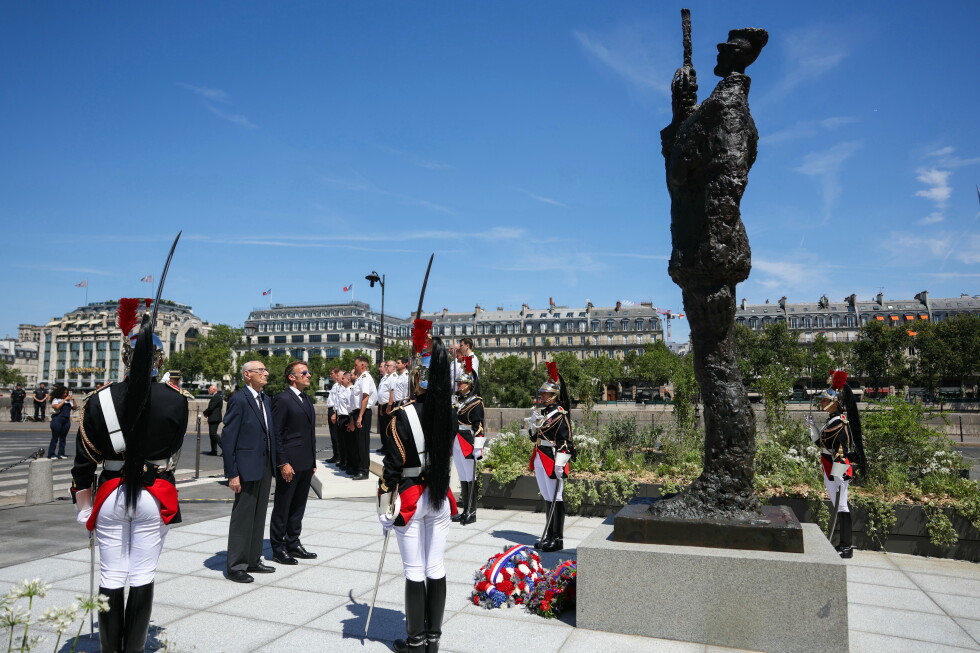
PARIS – On the 120th anniversary of Alfred Dreyfus’s full exoneration, French President Emmanuel Macron used a landmark inauguration Sunday to sound the alarm over a dangerous resurgence of antisemitic sentiment that has haunted the nation for centuries. The event, held outside France’s highest court where Dreyfus was cleared of false treason charges in 1906, honored the Jewish army captain whose wrongful conviction laid bare the deep-seated anti-Jewish prejudice embedded in 19th-century French institutions.
The somber commemoration came hours after authorities disrupted a potential terror threat targeting France’s Jewish community: police evacuated roughly 300 residents from the Paris suburb of Sarcelles, a neighborhood with a large Jewish population, after intelligence flagged a suspicious vehicle holding a military-grade long weapon near a local synagogue. French prosecutors have launched a full terrorism investigation into the incident, and Interior Minister Laurent Nunez told reporters that authorities have not yet confirmed whether the weapon was intended to attack Jewish community sites.
France is home to the largest Jewish population in Europe, and the country has recorded a sharp spike in antisemitic incidents—including threats, property vandalism, and physical assaults—since the October 7, 2023, Hamas attacks on Israel and the outbreak of the Gaza war. The ceremony also comes amid ongoing international criticism of Macron’s 2024 decision to recognize Palestinian statehood: Israeli Prime Minister Benjamin Netanyahu and U.S. Ambassador to France Charles Kushner have both argued that the move has emboldened antisemitic attitudes across France.
Speaking to the assembled crowd that included Dreyfus’s 99-year-old grandson Charles, Macron stressed that the “old demons of antisemitism” have never fully been eradicated from French society. “We need constant vigilance to stop acts that target people simply because of who they are,” the president said, announcing that starting this year, July 12 will be recognized as a national day of commemoration for Dreyfus’s exoneration.
The Dreyfus affair remains one of the most defining episodes of injustice in modern French history. In 1894, the Jewish captain was falsely accused of passing French military secrets to Germany, wrongfully convicted of treason, and sentenced to life imprisonment. Prominent writer Emile Zola and a cohort of leading intellectuals rallied to his defense, exposing that the French military had scapegoated Dreyfus because of his Jewish identity. After 12 years of public campaigning and legal battles, the Court of Cassation—France’s highest judicial body—cleared Dreyfus of all charges on July 12, 1906. He later rejoined the French army, served with distinction in World War I, and died in 1935.
Charles Dreyfus, who attended Sunday’s inauguration of the bronze statue depicting his grandfather holding a broken sword, a symbol of his overturned conviction, reflected on the unsettling parallels between the 19th-century affair and 2024. “I must sadly admit that I would not have imagined, at my age, seeing antisemitism resurface with such virulence in our country,” he said. That sorrow, he added, was balanced by “deep joy” at seeing his grandfather’s legacy honored at the site of his exoneration.