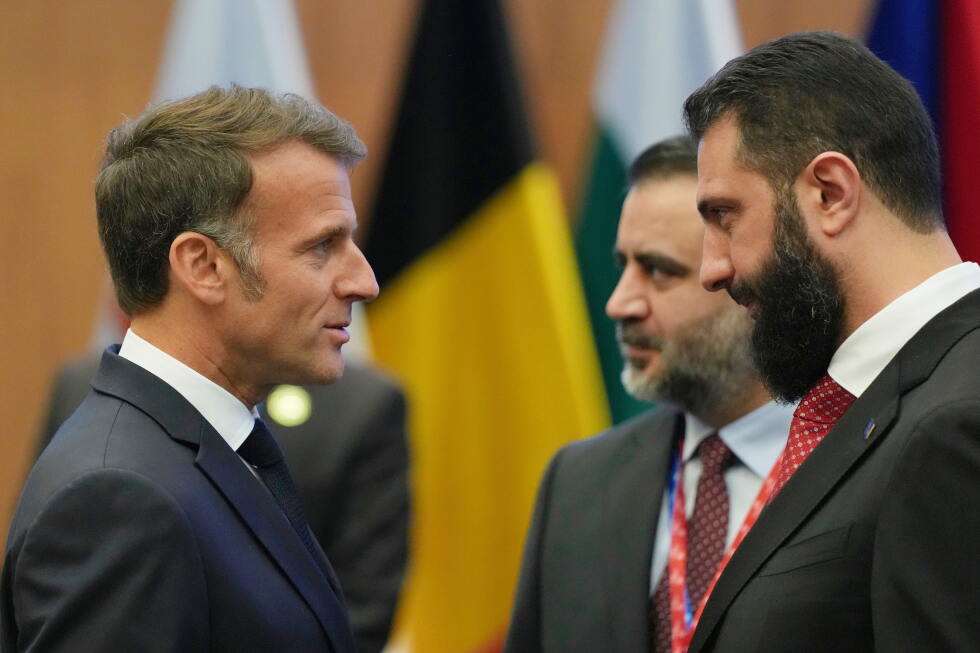
In a landmark moment for post-conflict diplomacy in the Middle East, French President Emmanuel Macron touched down in Damascus on Monday, marking the first visit to war-ravaged Syria by a major Western European or North American leader since Bashar al-Assad was ousted from power in 2024. Ukrainian President Volodymyr Zelenskyy had traveled to the country earlier this year in April, but Macron’s trip breaks new ground for Western engagement with Syria’s new transitional government.
The visit arrives at a fragile juncture for the region, coming on the heels of a month-long conflict between Iran and Lebanon that has recently de-escalated, leaving a tentative period of relative calm across the Middle East. Following his engagements in Damascus, Macron will travel onward to Ankara, Turkey, to attend a high-stakes NATO summit. At that same gathering, Syrian President Ahmad al-Sharaa is also scheduled to appear, where he is set to hold a widely anticipated high-profile meeting with U.S. President Donald Trump.
According to Syria’s official state-run news agency SANA, Macron is not traveling alone: he is accompanied by a delegation of French business leaders, with an agenda focused on two core pillars: regional security cooperation, and unlocking new business and investment opportunities for the war-battered country. Upon his arrival at Damascus International Airport, Macron was formally welcomed by Syrian Foreign Minister Asaad al-Shibani.
In a public post shared to the social platform X shortly after his arrival, Macron outlined the core purpose of his trip. “I have come to express France’s commitment to the Syrian people. For a sovereign Syria, united in its diversity and at peace with its neighbors,” he wrote. “Together, let us open a new chapter of stability and peace.”
A statement from Macron’s office expanded on France’s long-running position toward Syria’s new governance, noting that France backs all actors working to build a new Syrian state aligned with the aspirations for political change that emerged during the 2011 Arab Spring uprisings across the Middle East.
During his time in Damascus, Macron is set to hold formal talks with al-Sharaa at the Syrian presidential palace, and his office confirmed he will also hold direct engagements with a broad cross-section of Syrian society from diverse backgrounds. Full details of the visit’s schedule have not been released to the public, a decision made out of an abundance of caution for security reasons.
This visit is the latest step in growing diplomatic ties between Paris and Damascus: Macron previously hosted al-Sharaa in Paris back in May 2025. During that meeting, Macron urged European and U.S. leaders to roll back decades-wide crippling economic sanctions imposed on the Assad-era Syrian government. Following that push, the vast majority of those sanctions have now been lifted.
Notably, France has thrown its support behind Syria’s new leadership even as many other Western governments held initial skepticism, due to al-Sharaa’s background leading the Islamist faction Hayat Tahrir al-Sham, a group that previously maintained ties to al-Qaida. Western capitals have also raised ongoing concerns about three key issues: the protection of women’s rights, the political inclusion of ethnic and religious minority groups, and whether the new transitional government will follow through on its pledges to transition to full democratic rule.
While Syria has avoided being drawn into the most recent wave of regional conflict, the country still bears the devastating scars of 13 years of full-scale civil war. Much of the country’s critical infrastructure lies in ruins, millions of Syrians have been pushed into extreme poverty, and preliminary estimates place the total cost of reconstruction at hundreds of billions of dollars. To date, while Syria has signed preliminary memorandums of understanding for large-scale infrastructure and investment projects with multiple foreign governments and multinational corporations, none of these major projects have yet moved into implementation.