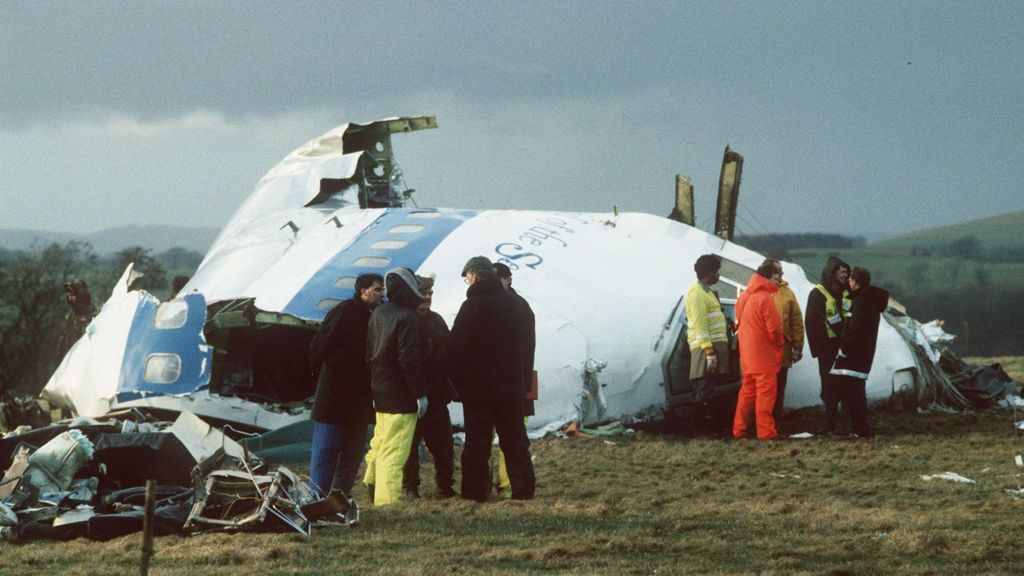
More than 35 years after the deadliest terror attack on British soil that killed 270 people when Pan Am Flight 103 exploded over Lockerbie, Scotland, the case has returned to legal headlines with new allegations from the only suspect currently facing trial: Abu Agila Mas’ud Kheir Al-Marimi claims he was illegally kidnapped from his home in Libya and forcibly rendered to U.S. authorities in a secretive overnight operation.
Al-Marimi, who has repeatedly denied building or arming the bomb that downed the 1988 flight, has laid out his full account of his capture and transfer for the first time in legal documents submitted by his defense team to a Washington D.C. federal court. The 71-year-old Libyan national is requesting that the court dismiss the charges against him entirely, arguing the manner of his removal violates both international law and Libyan sovereignty, stripping the U.S. court of jurisdiction over the case.
The sequence of events that brought Al-Marimi into U.S. custody begins in September 2021. At the time, Al-Marimi was serving a prison sentence in Libya for charges related to his role in attacks on rebel forces during the 2011 uprising against former Libyan leader Muammar Gaddafi. He was granted compassionate release from prison and allowed to return to his family home in Tripoli. Approximately two weeks after his release, Al-Marimi says a group of masked armed men arrived at his residence and seized him without explanation.
According to his defense lawyers, the abduction was carried out by a Libyan militia known for human rights abuses and brutal tactics. Al-Marimi, who suffers from pre-existing health and mobility issues, was dragged across the floor during the arrest, while his son was beaten with a rifle and his wife and daughter were physically assaulted. He was then transported to a high-security prison in Misrata, a city roughly 187 kilometers east of Tripoli, where he was held in solitary confinement for several days.
On the morning of December 11, 2022, Al-Marimi was given food and told to pack his belongings, leading him to believe he would finally be released. Instead, he was bound, hooded, and handed directly over to waiting FBI agents. A U.S. government aircraft was already on standby at Misrata Airport, where onlookers had begun to gather, prompting Al-Marimi’s Libyan escorts to rush the handover to speed up the process. His personal belongings, including a Quran, prayer rug, medication, clothing, and toiletries, were handed over to the FBI in a simple plastic trash bag. During the flight to the U.S., Al-Marimi’s legal team says FBI agents questioned him, conducted a full medical examination, and provided basic supplies including clean clothing and blankets.
Al-Marimi’s defense team further alleges that the abduction and handover came after diplomatic extradition negotiations stalled, and that the operation was carried out with implicit U.S. approval. They also claim that following Al-Marimi’s transfer, the Tripoli-based Libyan Prime Minister Abdulhamid Dbeibah secured significant financial benefits from the U.S., including $16 million in funding to support Libya’s democratic transition and a commercial contract with U.S. energy giant Honeywell International. In legal filings, the defense argues the entire process was a blatant violation of Libyan law and national sovereignty. They wrote, “This is not the rule of law. This is the rule of the strong. Mr Al-Marimi’s rendition sends a chilling message to the people of the world: ‘If we want you, we will take you.” Al-Marimi’s legal team is demanding that he be returned to Libya.
The U.S. Department of Justice has pushed back against these claims, arguing that long-standing U.S. legal doctrine holds that a court’s jurisdiction over a defendant is not dependent on the legality of how that defendant was brought into the country, even in cases involving forcible abduction. Federal prosecutors argue that the limited exceptions to this doctrine do not apply to Al-Marimi’s case. They maintain that Libya was legally permitted to transfer Al-Marimi to the U.S. through any method the Libyan government chose, and that the actions of any Libyan militias cannot be legally attributed to the U.S. government, which would be required for Al-Marimi’s claim to succeed.
Al-Marimi was originally charged by the U.S. government with destroying Pan Am Flight 103 in December 2020, three years after the first suspect in the case, Abdelbaset al-Megrahi, died of cancer. At the time of the charges, U.S. authorities formally requested Al-Marimi’s extradition, expulsion, or other lawful removal from Libya to face trial. His trial has already been postponed three times, and is currently scheduled to begin in January. Al-Marimi’s defense has requested an evidentiary hearing before Judge Dabney Friedrich to argue their motion to dismiss.
The transfer of Al-Marimi to U.S. custody sparked immediate public outrage in Libya, where many viewed the seizure as a violation of national sovereignty. Prime Minister Dbeibah has defended his administration, stating that Libya was cooperating with an established international judicial framework for the extradition of accused citizens. An Interpol red notice for Al-Marimi’s arrest and extradition was in effect at the time of his capture. Dorothy Bain KC, the then-head of Scotland’s prosecution service, told the Scottish Parliament that she had received official confirmation that Al-Marimi’s transfer to U.S. custody was carried out on a lawful basis. Al-Marimi has remained in U.S. federal custody since his arrival in December 2022.