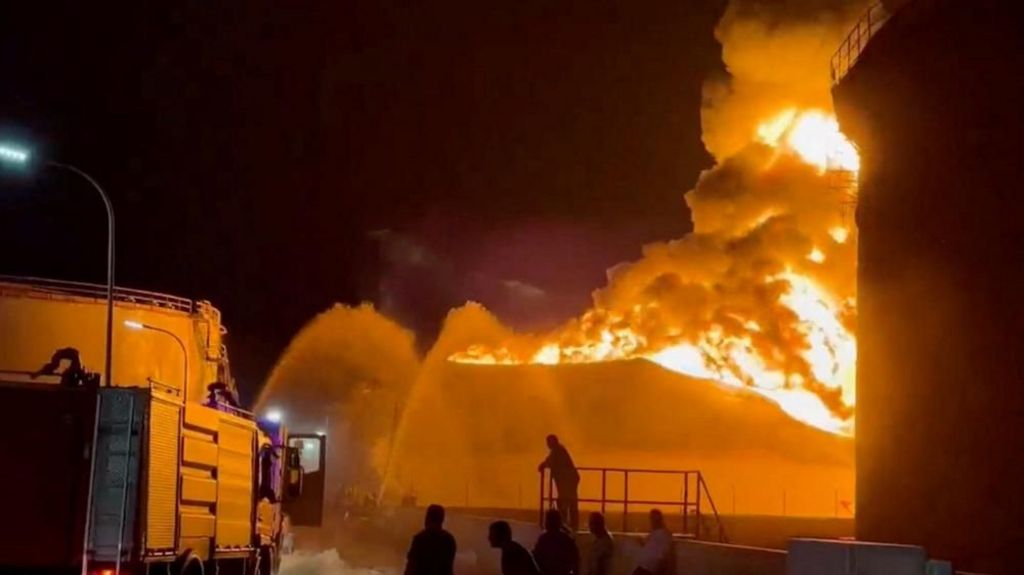
A massive, uncontrolled fire has broken out at Libya’s flagship Zawiya refinery after an attack by unidentified assailants, leaving emergency crews working around the clock to contain the inferno and prevent further damage to the country’s already fragile energy sector.
The strike, carried out via drone, hit the facility — located just west of the capital Tripoli — on Monday evening. It marks the third major attack on energy and critical infrastructure near Zawiya in a 48-hour period, according to initial reports from Libyan officials.
The National Oil Corporation (NOC), Libya’s state-owned energy authority, confirmed that a storage tank holding roughly 4.5 million liters of petroleum fuel took a direct hit from the drone. The impact ignited an intense blaze that ultimately caused the entire tank structure to collapse. In a statement following the attack, NOC warned that it may be forced to suspend all operations at the key refinery if a wave of targeted violence against energy sites continues unabated.
As of Tuesday, there have been no reports of fatalities or critical injuries linked to the fire. Libya’s Ambulance and Emergency Service confirmed that most people affected by the incident were treated on-site for minor smoke inhalation, with no patients requiring prolonged hospital care.
The Zawiya refinery holds outsized importance for Libya’s energy-dependent economy: it is the largest fully operational oil processing facility in the country, with a daily production capacity of 120,000 barrels of crude oil products.
The latest attack follows two similar strikes on infrastructure in the Zawiya area in the preceding 48 hours: an earlier drone strike targeted a naphtha storage reservoir, while a second hit a local water desalination plant that serves the refinery and surrounding communities. NOC has issued a formal condemnation of all three attacks, and has called on national security authorities to launch a full investigation to identify and prosecute the groups behind the violence.
The string of coordinated attacks on critical Libyan infrastructure has once again drawn global attention to the persistent political instability that has plagued the North African nation for more than a decade. Libya has remained a deeply divided state since a 2011 popular rebellion, backed by Western military intervention, toppled and killed longtime authoritarian leader Muammar Gaddafi, who had held power since a 1969 coup.
Today, two rival competing administrations control separate portions of the country: an internationally recognized government led by Prime Minister Abdulhamid Dbeibah is based in Tripoli in western Libya, while a parallel eastern administration is backed by powerful military commander Khalifa Haftar. The two blocs have continued to vie for full political and military control of the country, creating a security vacuum that has allowed repeated attacks on energy infrastructure — Libya’s primary source of government revenue — to occur with increasing frequency.