For more than half a century, Exarcheia has stood as a one-of-a-kind social and political landmark in the heart of Athens. This central neighborhood has long functioned as a welcoming gathering space for grassroots movements, anti-authoritarian and left-wing activist networks, and displaced migrants and refugees, all of whom found mutual aid and a strong sense of community within its boundaries. Today, however, Exarcheia is undergoing an irreversible transformation, and the communities that forged its unique identity are being systematically pushed to the margins.
Rising residential rents, booming tourism, surging foreign property investment, large-scale urban redevelopment schemes, and an increasingly visible police presence are combining to rewrite the neighborhood’s social map, eroding the tight-knit community that defined its character for generations. “The human geography of Exarcheia is changing a lot,” explains Nikos, a long-term resident and core organizer with the No Metro in Exarcheia Square assembly, a movement that launched five years ago to oppose the local construction project. “The cost of living crisis is rampant at the moment. Many people who have been active in our neighborhood’s social movements have been forced to relocate because of skyrocketing housing costs, and that has gutted the collective dynamics and strength of our community.”
Exarcheia’s gradual shift began years before Greece’s center-right New Democracy party took national power in 2019. In the years during and after Greece’s devastating decade-long economic crisis, platforms for short-term holiday rentals like Airbnb exploded across central Athens, as international investors poured capital into the country’s relatively affordable property market. This trend was accelerated further by the introduction of Greece’s Golden Visa program, which grants five-year renewable residency permits to non-EU nationals and their families in exchange for property investment.
The impact of these shifts has been uniquely dramatic in Exarcheia. Research from the Athens Social Atlas found that foreign buyers accounted for 42.5% of all property purchases in the neighborhood in 2018, with Israeli citizens making up the largest single group of foreign purchasers during that period. Since taking office, the New Democracy government has doubled down on a policy of expanding state control and pushing forward major redevelopment projects in Exarcheia, a combination that has accelerated the neighborhood’s transformation.
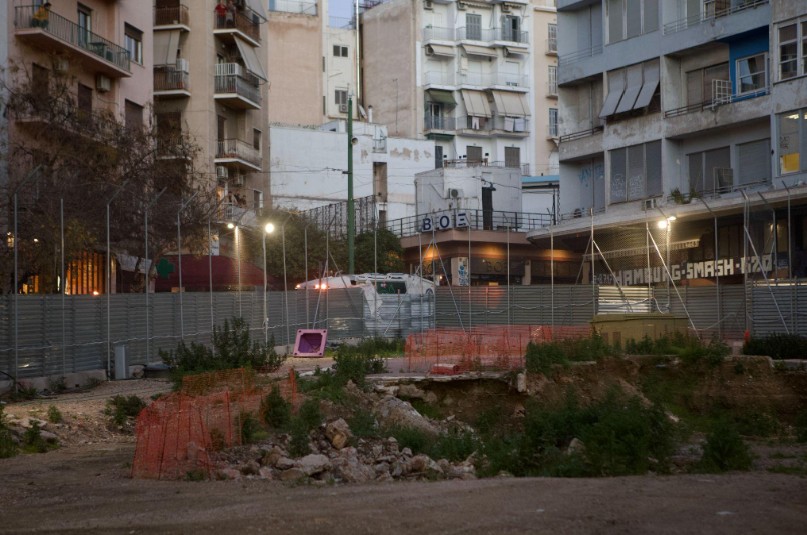
The most visible and contentious of these projects is the construction of Athens’ new Metro Line 4 directly beneath Exarcheia Square, the historic heart of the neighborhood’s community and political life. Work began on the project in 2022, turning a beloved open public gathering space into a heavily fenced-off, restricted construction zone. Residents and activists have repeatedly raised urgent safety concerns over the site’s layout, which at one point left only 1.5 meters of clearance between the construction barriers and adjacent buildings – too little, they argue, for pedestrians and emergency vehicles to navigate safely.
For opponents of the project, the reclamation of the square is a powerful symbol of the neighborhood’s broader erasure. For decades, the open space served as the primary meeting point for political organizing, community events, and grassroots mutual aid work. The construction has also brought with it a heavy, aggressive police presence, which Nikos frames as a deliberate effort to crush dissent against the government’s redevelopment plans. “We have faced extreme police presence and police repression around the construction site,” he says. The anti-construction movement has responded with a wide range of direct action tactics, including public cultural events, mass protests, site blockades, and confrontations with law enforcement.
Greek government officials have framed their intervention in Exarcheia as a project to restore “normality” and reassert state control over a neighborhood long known for its autonomous organizing. In the days before New Democracy won the 2019 national election, current Migration and Asylum Minister Thanos Plevris released a viral campaign video filmed in Exarcheia, in which he pledged a hardline crackdown on the neighborhood’s culture of self-governance and anti-authoritarian politics. This framing became a core part of the party’s law-and-order election platform, with incoming leaders promising to bring state authority back to a neighborhood long associated with left-wing and anti-fascist movements.
Years later, this policy is visible across Exarcheia, from the expanded riot police patrols to the Metro construction and a wave of other redevelopment projects that have reshaped the area. Activists reject the “restoring normality” framing, arguing that these changes are deliberately pricing out long-term low-income and activist residents to remake the neighborhood for wealthy new arrivals and foreign investors.
The pressures facing Exarcheia extend far beyond the Metro construction. Nikos frames tourism, foreign real estate speculation, and gentrification as interconnected parts of the same deliberate transformation, as rising property values make it impossible for many generations of residents to stay. The new face of the neighborhood is visible immediately around the square: at the intersection of Themistokleous and Solomou streets, the historic Hotel Exarchion has been rebranded as the upscale Square Hotel by X&N, currently undergoing renovations.
The 93-room property is under a 12-year lease awarded via public tender to Aura 1 Monoprosopis SA, a firm represented by Dan Israel Hineson, a partner of the Israeli investment firm Ficus Investments, according to Greek financial outlet Dnews. The hotel is just one high-profile example of the wave of Israeli property investment in Exarcheia: data from the height of Greece’s economic crisis shows Israeli buyers purchased 74 properties in the neighborhood, more than any other foreign nationality. Israeli investment in Greek real estate has continued to grow in recent years, hitting €129 million in 2024 – a 46.5% increase from 2023 – and Israeli buyers remain among the largest groups of foreign property purchasers in both Athens and Thessaloniki, Greece’s second-largest city.
Tourism has also become a core pillar of Exarcheia’s shifting economy. As demand for tourist accommodation outgrew Athens’ traditional tourist zones like Plaka, Monastiraki, and Psyrri, Exarcheia grew in popularity with visitors drawn to its alternative bars, restaurants, iconic street art, and reputation as Athens’ preeminent counterculture hub. Researchers have labeled this shift the “touristification” of Exarcheia, with the boom in short-term holiday rentals driving up housing costs for permanent residents.
For many local activists and residents, the problem is not simply tourists visiting the neighborhood – it is the political tensions that arise from the intersection of massive Israeli investment and Exarcheia’s long-standing identity as a hub of Palestinian solidarity and anti-Zionist politics. Those commitments have been renewed with urgency since Israel’s 2023 military campaign in Gaza, and activists report open tension with Israeli visitors who publicly express support for the Israeli government and its military offensive. Pro-Palestinian graffiti and posters line the walls of nearly every street in the neighborhood, and mass solidarity demonstrations and actions have become a core part of Exarcheia’s modern identity.
For Ahmed, a Palestinian activist originally from Gaza who has lived in Exarcheia for years, this political identity is personal. “Exarcheia for me means to fight for your right,” he says. Ahmed credits his time in the neighborhood with shaping his activist work, saying he built deep connections with other organizers who share his commitment to Palestinian freedom and resistance.
Today, it remains uncertain whether Exarcheia can preserve the unique counterculture identity that made it famous around the world. Nikos acknowledges that the neighborhood can never return to what it was a decade ago, but he remains defiant about preserving its legacy. “The important thing is that memory doesn’t fade away. There is a community that is eager to uphold this memory and to preserve it in a way,” he says. “We are doomed to win. In a way, it is a necessity for us, for our community.”
Still, as Exarcheia’s transformation accelerates, the core question remains unanswered: where will the communities that built the neighborhood’s identity go, and what will be left of the radical, welcoming culture that made Exarcheia unlike anywhere else in the world?