Twenty-five-year-old Inam Ahmad’s strained, flickering gaze behind thick glasses is a permanent, visible marker of the irreversible harm pellet guns have inflicted on countless civilian lives in Indian-administered Kashmir. In 2017, at just 16 years old, not long after passing his matriculation exams, Ahmad was struck by dozens of pellets fired by Indian armed forces outside his Srinagar home. The shrapnel became embedded in his skull, neck, and behind his eyes, robbing him of 80 percent of his vision. “Every day I live with pain when the pellets shift or heat up,” he explained. “They never let me forget I will never be normal again.”
Ahmad’s mother Fahmeeda Jan holds a faded childhood photo of her son: a grinning three-year-old in a green tracksuit, clinging to his younger sister’s hand, bright eyes looking up toward the camera. Full of energy before the shooting, her son’s life and the entire family’s future was upended by the injury. After multiple rounds of surgery, crippling medical debt that drained their savings, and the abrupt end to Ahmad’s education, the constant unrelenting pain often pushes Ahmad to breaking point. “He gets so fed up that he pulls his hair in frustration, becomes aggressive, and says he wants to end his life,” Jan shared. Desperate to restore her son’s sight, she once offered to donate one of her own eyes during a trip for treatment outside Kashmir, but doctors told her such a transplant was medically impossible. “Only those who this weapon has hit truly know what it is,” she says.
Originally designed for bird hunting, pellet shotguns fire hundreds of small metal fragments over a wide, scattered area, making precise targeting impossible. Indian authorities introduced the weapons to Kashmir in 2010 as a so-called “non-lethal crowd control tool” following widespread anti-India protests. But this official classification has been repeatedly challenged by global human rights and medical bodies. The United Nations Office of the High Commissioner for Human Rights has labeled pellet guns “one of the most dangerous weapons used in Kashmir”, and a 2020 UN guideline on less-lethal law enforcement weapons explicitly states: “Metal pellets, including those discharged by shotguns, should never be used.” Amnesty International has similarly condemned the weapon, noting that “injuries and deaths caused by this cruel weapon bear testimony to how dangerous, inaccurate and indiscriminate it is.” While the weapon is banned for hunting in many countries, official Indian data from 2018 recorded 6,221 people wounded by pellets between July 2016 and March 2017 alone, and no comprehensive full count of casualties has ever been released.
Ahmad’s story is far from unique. In 2016, 14-year-old Insha Mushtaq was struck by pellets while standing by the window of her family home in Shopian district, resulting in permanent blindness and lifelong facial disfigurement. Just two years later in the same district, 18-month-old Hiba Nisar – the youngest recorded pellet victim – was hit while sitting in her mother’s lap. For thousands of survivors like these, the harm is permanent: pellets remain lodged in soft tissue and bone, causing chronic pain and permanent disability for decades.
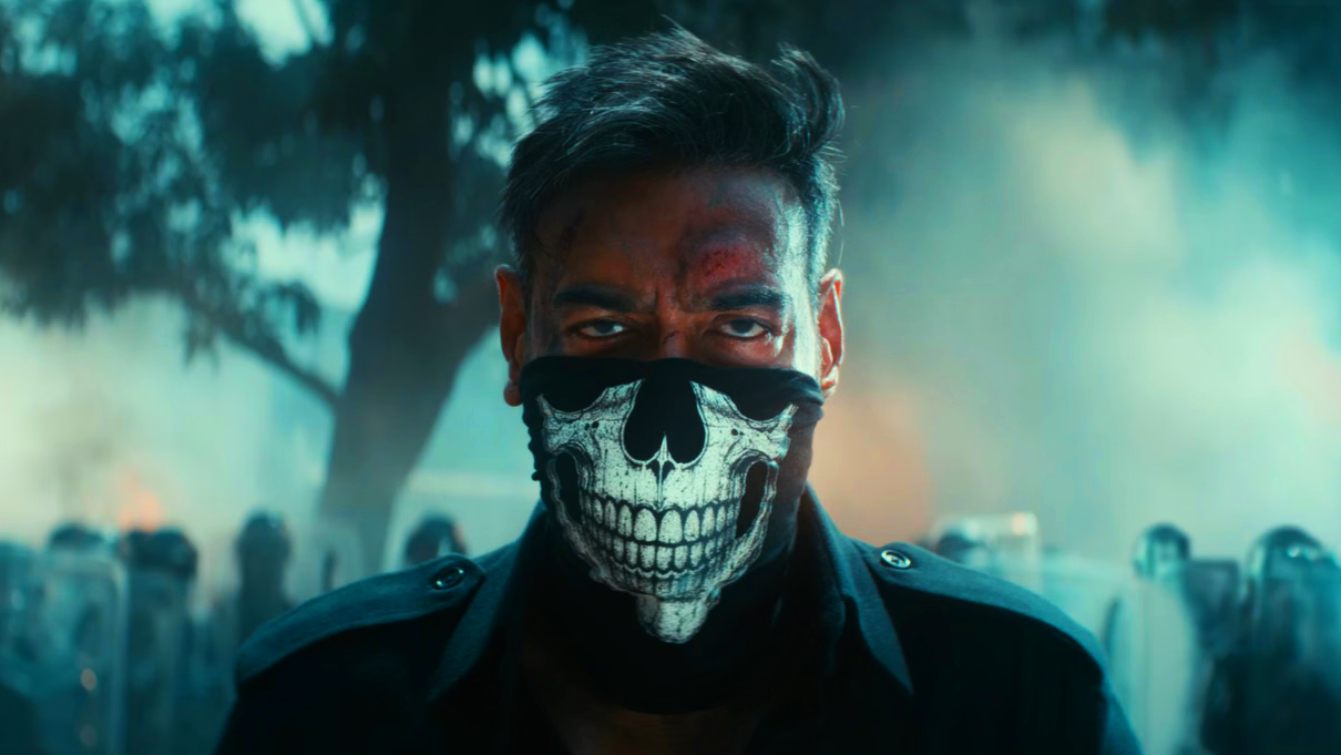
It is against this backdrop of ongoing collective trauma that a 144-second teaser for the upcoming Bollywood film *Chauhaan* has ignited widespread anger and condemnation across Kashmir and among human rights observers. The film, starring A-list actor Ajay Devgn and backed by major production houses Colour Yellow Productions and Jio Studios – owned by Reliance Industries, a conglomerate led by billionaire Mukesh Ambani long tied to Prime Minister Narendra Modi’s ruling Bharatiya Janata Party and its right-wing Hindutva agenda – claims in its promotional material that pellet guns inflict only “limited damage” on protesters. In the teaser, Devgn’s voiceover argues that India’s current pellet gun use for crowd control is actually too restrained, calling for harsher measures against unrest in the region. Scheduled for a October 2025 theatrical release, the film is set against the backdrop of the decades-long Kashmir conflict, split between India, Pakistan and China, with early footage showing stone-pelting protests, pellet injuries, and paramilitary operations, pointing to a politically charged narrative aligned with the ruling party’s position.
Critics say the teaser’s claim of “limited damage” is a grotesque trivialization of a humanitarian crisis that has left thousands permanently blinded or maimed across the region. *Chauhaan* is not an isolated case: for years, activists and locals have decried a pattern of Bollywood films set in Kashmir that advance Hindutva ideology, whitewash civilian suffering, and misrepresent the region’s history. Recent high-profile releases including *Uri: The Surgical Strike*, *Shikara*, *The Kashmir Files*, and *Article 370* all drew massive backlash for framing Kashmiri Muslims as terrorists, altering historical events to align with the ruling party’s narrative, and celebrating the 2019 unilateral revocation of Kashmir’s semi-autonomous status, a move endorsed personally by Modi. Author and Kashmir scholar Mirza Waheed argues that the *Chauhaan* trailer reflects a dangerous shift in Indian public life. “Instead of asking what life is really like for a young person permanently blinded by these weapons, what happens to their dreams and their families, the film explicitly calls for even more severe and lethal tactics,” Waheed explained. He calls this trend a symptom of India’s “post-truth, anti-history” political environment, where “such mendacious narratives seek to subvert Kashmir’s recent history, painting the victims in a completely dehumanized light and the perpetrators as virtuous, heroic.”
Aga Ruhullah Mehdi, a Kashmiri parliamentarian with the opposition National Conference, described the teaser as deeply disturbing for anyone who has lived through pellet gun violence in the region. “What they call ‘ineffective’ left behind thousands of shattered lives,” he wrote. “For those who lost their eyesight, those who still live with pellets lodged in their bodies, and the families who continue to bear those scars, this is not an action sequence or a cinematic backdrop. It is a lived trauma.” Mehdi added that mainstream Indian cinema has repeatedly reduced Kashmir to a setting for conflict-framed narratives that reinforce harmful stereotypes, noting that “Kashmir deserves empathy, honesty and dignity – not the commercialization of its pain.”
Scholar and author Dr. Niharika Pandit, whose work examines the impact of widespread militarization in Kashmir, says that since 2014, when Modi’s BJP first took national power, Bollywood has increasingly functioned as a public relations arm for the ruling party. “Earlier Hindi cinema used to project Kashmiris as ethereal, but without any agency; the latest batch of movies has turned far more explicitly propagandist,” Pandit explained. “They peddle the narrative that everything is normal in Kashmir, justify the government’s decisions like the abrogation of Article 370, and further erase Kashmiri histories and lived realities. This is epistemic violence: first you inflict widespread bodily harm that cripples young Kashmiris, then you pretend it never happened or frame it as necessary for national security.” Kashmiri academic Dr. Mohamad Junaid, who teaches at the Massachusetts College of Liberal Arts, adds that Hindi cinema has long followed a pattern of exoticizing Kashmir’s landscape while demonizing its people. “The violence we see on screen is a natural outcome of that dynamic. Hindi cinema is just reflecting what the Hindu right-wing has done to India’s public sphere,” he noted.
For survivors like Inam Ahmad, the controversy over the teaser is not just an abstract political debate – it is a fresh reopening of a wound that never heals. The damage from that 2017 shooting was never limited. It is a daily reality he and thousands of other Kashmiris will live with for the rest of their lives.