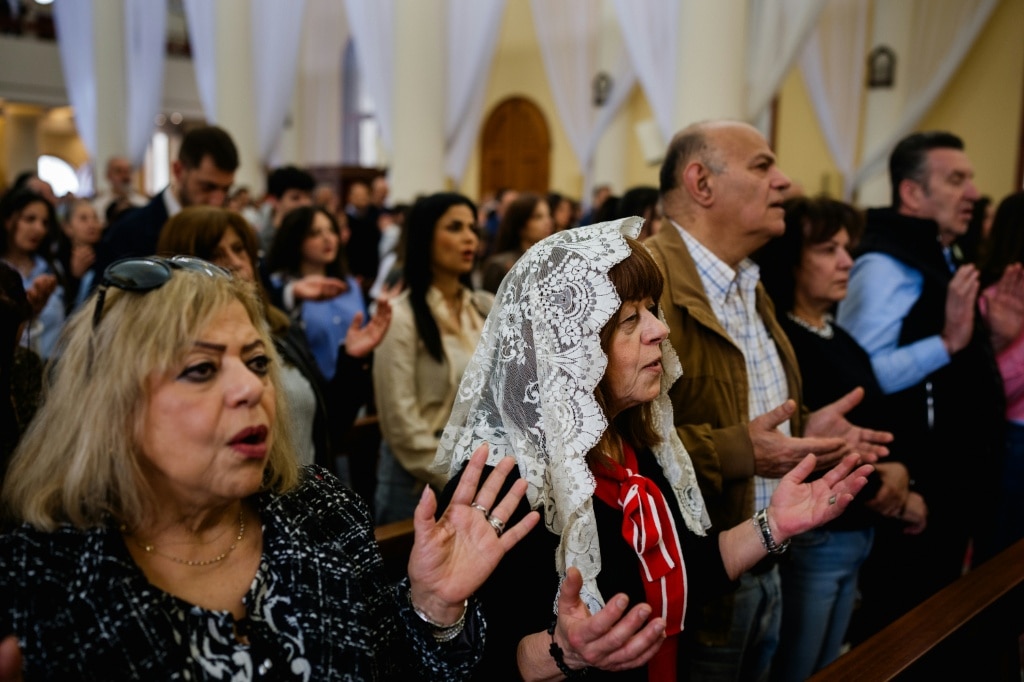
Easter Sunday, one of the holiest days on the Christian calendar, took on a somber tone across Lebanon this year, as worshippers centered their prayers and celebrations on the hundreds of thousands of civilians trapped in the country’s southern border region, where relentless clashes between Israel and Hezbollah have turned once-quiet communities into active conflict zones.
The annual joy of the resurrection was woven through with urgent calls for peace, as communities across the country opened their churches to displaced southern residents and demonstrated unwavering solidarity with those caught in the crossfire. At a parish church in Jdeideh, a northern suburb of the Lebanese capital Beirut, turnout for Easter mass far outstripped the building’s capacity. Crowds spilled out of the pews and onto the sidewalk outside, as worshippers gathered to stand with their compatriots in the south.
Jenny Yazbek al-Jamal, a 55-year-old Beirut resident who leads the parish choir and has family members still residing in southern conflict zones, said this year’s Easter festivities were explicitly dedicated to all people displaced and endangered by the border fighting. “It is not only Christian villages suffering in this war,” al-Jamal told reporters after mass. “Muslim villages too… we stand with all the people of the south who were forced to flee their homes.”
Inside the packed church, placards listing the names of cut-off and embattled Christian southern villages lined the base of the altar, a quiet, visible tribute to communities trapped between warring factions. Even in the capital, the shadow of the conflict was impossible to ignore: the roar of low-flying Israeli fighter jets, which regularly break the sound barrier over Beirut to intimidate local populations, drowned out portions of the hymns sung by the parish choir. al-Jamal noted that the constant overflights have become a new normal, even during the holiest days of the Christian calendar. “Even during our religious holidays, even on Good Friday, jets fly over us and break the sound barrier just to scare us,” she said.
Worsppers across the country echoed her calls for an end to the fighting, describing the humanitarian catastrophe unfolding in the south as a crisis that impacts all Lebanese, regardless of faith. Marina Awad, another 55-year-old worshipper who attended mass with her husband, called for an immediate end to hostilities, saying she was heartbroken by the scale of displacement. “It’s truly very sad to know people had to abandon homes built over a lifetime, unsure if they will ever return,” she said.
The situation for civilians who remain in border villages is catastrophic, according to 65-year-old Dori Ghrayeb, who outlined the collapse of basic services in embattled communities. “No food, no water, no bread, no medicine, and no medical care,” he said, adding his voice to widespread calls for a ceasefire. “I am for peace; the war must stop so that we can sit at the same table.”
The depth of the crisis was highlighted this weekend by the last-minute cancellation of a high-profile humanitarian aid convoy that had been organized jointly by the Vatican’s envoy to Lebanon, the United Nations Interim Force in Lebanon (UNIFIL), and two prominent Lebanese Christian charities. The convoy, which was carrying 40 tonnes of life-saving medicine and essential basic supplies, had been scheduled to reach the border village of Debl, one of several majority Christian frontier villages trapped between advancing Israeli forces and Hezbollah fighters.
The Maronite Patriarchate, Lebanon’s largest Christian church body, issued a statement Sunday expressing “deep disappointment” over the cancellation, which was announced for unspecified security reasons. Several key Christian border communities, including Ain Ebel, Rmeich and Debl, have become focal points of the conflict in recent weeks. Local residents have rejected repeated Israeli calls to evacuate the area, insisting they have no stake in the ongoing conflict between Israel and Hezbollah. Many have spoken of feeling abandoned after official Lebanese military forces withdrew from multiple border positions in the region, leaving civilians to fend for themselves.
Caritas-Lebanon and L’Oeuvre d’Orient, the two charities that partnered on the aid mission, issued a joint statement condemning the cancellation as a clear violation of international humanitarian law, emphasizing that the decision punishes vulnerable civilians who are already trapped in life-threatening conditions. As Easter celebrations close across Lebanon, the collective call for peace from Christian communities adds to growing international pressure to de-escalate the border conflict and open unimpeded access for humanitarian aid to trapped civilian populations.