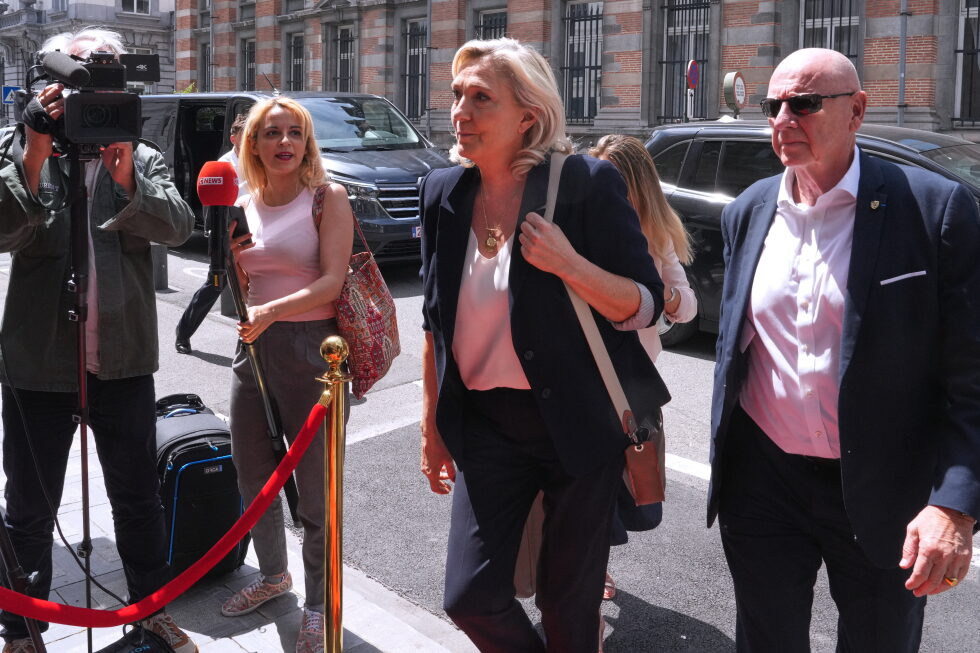
PARIS — As France approaches its 2027 presidential election, far-right National Rally leader Marine Le Pen has issued a stark ultimatum: she will withdraw from the presidential race if Paris’s appeals court upholds a controversial sentence requiring her to wear an electronic monitoring bracelet over the long-running EU funds misuse conviction. The court is scheduled to hand down its highly anticipated ruling this Tuesday, a decision that could reshape the entire landscape of French electoral politics. The 57-year-old far-right leader is currently appealing a March 2025 lower court verdict that found her and multiple other senior National Rally figures guilty of defrauding the European Parliament out of €2.9 million (roughly $3.4 million) between 2004 and 2016. Prosecutors alleged that the party misappropriated funds by hiring parliamentary aides who were actually working full-time for the National Rally rather than fulfilling official legislative duties. The lower court’s original conviction handed down a four-year prison sentence, a five-year ban from holding elected public office, and a two-year term of house arrest enforced by electronic monitoring. If the appeals court reaffirms the conviction, it has the power to uphold any combination of the original penalties, including a public office ban or the mandatory electronic bracelet. In an exclusive interview with French broadcaster LCI on Wednesday evening, Le Pen outlined her conditions for entering the 2027 race. “If I am able to stand as a candidate and campaign freely, I will run,” she stated. “But if I am formally permitted to candidate yet effectively barred from campaigning on my own terms, it simply would not be possible.” When pressed directly on whether a requirement to wear an electronic monitoring bracelet would disqualify her from running, Le Pen gave an unhesitating response. “Of course it would,” she said. “I cannot be reliant on a judge’s approval every time I want to hold a campaign rally, or visit a local market to meet voters. That is no way to run a national campaign.” Le Pen has repeatedly and categorically denied any wrongdoing, insisting she was never the mastermind of a fraudulent scheme to siphon EU public funds. Should the appeals court’s ruling bar her from candidacy, Le Pen confirmed she will pursue every legal avenue to challenge the decision, including an appeal to France’s highest judicial body, the Court of Cassation. That court does not reevaluate the facts of a case, but instead reviews lower court rulings to ensure procedural and legal compliance, a process that typically takes up to six months to reach a final verdict. French election authorities have scheduled the first round of the 2027 presidential election for April 18, with a runoff between the top two candidates set for May 2. Incumbent centrist President Emmanuel Macron is constitutionally barred from seeking a third consecutive term, opening the door for an open race to the Elysée Palace. Le Pen is currently ranked as one of the frontrunners to win the presidency if she is allowed to stand, with polling consistently placing her in the top two heading into the runoff. If she is forced to withdraw from the race, the National Rally’s standard-bearer will almost certainly be 30-year-old party president Jordan Bardella, Le Pen’s handpicked protege and designated successor. Le Pen downplayed any talk of division between the two, framing their roles as complementary rather than competitive. “I have run for president three times before, so I am the natural candidate for our political camp,” she explained. “We bring different strengths to the table: I have decades of national political experience, while Jordan has an incredible dynamism and the energy that comes with his youth. We work very well together.” The outcome of Tuesday’s appeals court ruling is expected to send shockwaves across French politics, reshaping candidate strategies and shifting voter alignments ahead of one of the most consequential European elections of 2027. The case has also drawn renewed attention to long-running tensions between the European Union and euroskeptic far-right parties across the bloc, over allegations of misuse of EU institutional funds by nationalist political movements.