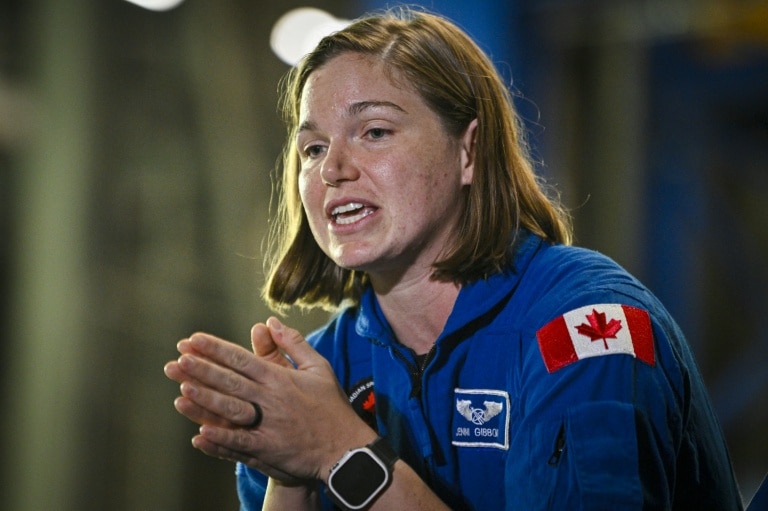
On a momentous Monday inside NASA’s Houston mission control center, Canadian astronaut Jenni Gibbons stood at the center of a landmark moment for human space exploration, remotely guiding her Artemis II crewmates through their groundbreaking voyage around the Moon. Handpicked as the mission’s backup astronaut, Gibbons spent months training alongside the four primary crew members: NASA astronauts Christina Koch, Victor Glover, Reid Wiseman, and Canadian Jeremy Hansen. On flight day, her core role was managing real-time communications between ground teams and the crew as they checked off a long list of historic milestones during their lunar flyby.
In an exclusive interview with AFP, Gibbons shared her firsthand account of the emotional, electric atmosphere inside the control room, more than 50 years after humanity first reached the Moon. The air was thick with tangible, contagious excitement, she recalled, a once-in-a-generation moment punctuated by tears, warm hugs, and unbridled laughter. “Every flight controller in that room grew up inspired by the Apollo missions, and many have spent their entire careers working toward this day,” Gibbons explained. “When the crew called down their descriptions of the space and views around them, the energy in the room was unmatched.”
Over the course of nearly seven hours, the Artemis II crew fixed their gaze on the lunar and deep space landscape outside their capsule windows, shattering long-standing records and making modern space history. Most notably, the team broke the 54-year-old distance record set by Apollo 13, which had stood as the farthest humans have ever traveled from Earth. When Artemis II reached its maximum distance from our home planet, it clocked in at 252,756 miles (406,771 kilometers) – more than 4,000 miles (6,400 kilometers) farther than Apollo 13’s 1970 record. “That moment was so special,” Gibbons said. “At one point, people were crying, people were hugging, people were laughing out of joy. It’s one of the most cherished moments of my entire career.”
When asked why this lunar flyby will go down as a defining chapter in space exploration history, Gibbons outlined two key breakthroughs beyond the distance record. First, all previous Apollo missions flew much closer to the Moon than Artemis II, meaning the crew experienced a unique perspective of Earth that no human had ever witnessed firsthand. The flyby also brought the crew to the far side of the Moon, where terrain features had never been illuminated for direct human observation during the Apollo era. “We’ve mapped these areas with remote imaging before, but this is the first time human eyes – the most sensitive cameras in existence – have been able to observe these landscapes directly,” she noted.
One specific observation from the crew stood out to Gibbons above the rest: thanks to the timing of the mission’s launch and unique orbital mechanics, the crew witnessed a solar eclipse as they completed the final leg of their lunar flyby. The alignment of the Sun, Moon, and capsule allowed the team to see faint deep space and lunar features that are usually hidden by bright sunlight, including fine details of the Sun’s corona as it passed behind the Moon. The crew carried eclipse glasses for safe viewing, a small detail that Gibbons says helps connect their out-of-this-world experience to eclipse watchers here on Earth.
The crew also made a rare scientific observation while the Moon was fully shadowed: they spotted four to five impact flashes on the lunar surface, created when space material collides with the Moon to form new craters. While Apollo astronauts occasionally reported seeing similar events, such observations are extremely rare and hold high scientific value. “The fact that they saw multiple impact flashes during the flyby is just outstanding,” Gibbons added.