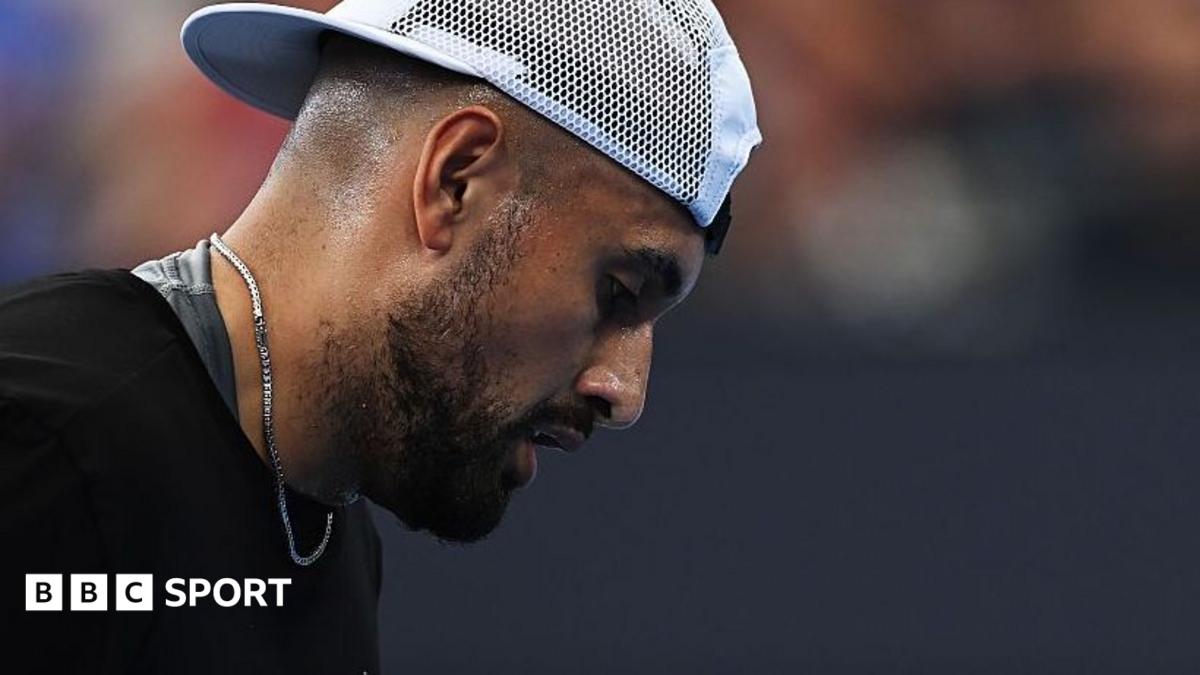
Controversial Australian tennis star Nick Kyrgios has cleared his suspension and is eligible to return to professional competition, after accepting a one-month ban triggered by a positive cocaine test from a June tournament.
The 31-year-old, whose ranking has plummeted to 918th in the world after years of injury struggles, was first placed on a provisional suspension on August 4, following a routine out-of-competition sample collected at the Mallorca Open that tested positive for benzoylecgonine, a well-documented metabolite of cocaine.
Kyrgios did not dispute the finding during his investigation with the International Tennis Integrity Agency (ITIA). He confirmed to investigators that he consumed cocaine during a late-night visit to a nightclub in Magaluf in the early hours of June 20, just two days before his first-round singles match at the Mallorca Open. He ultimately lost that match in straight sets to fellow Australian Adam Walton.
After an independent expert consultation, the ITIA confirmed that Kyrgios used the banned substance outside of official competition, a ruling that supported a reduced penalty. While the maximum possible suspension for the offense was three months, the ban was cut to one month after Kyrgios committed to and enrolled in a formal treatment program for substance use. His suspension officially concluded on September 3, making him immediately eligible to return to tour events. In addition to the suspension, Kyrgios has been stripped of his 6,570 euro (approximately £5,650) prize money from the Mallorca Open.
When the positive test was first announced, Kyrgios pledged to step away from social media and public life for the 28-day suspension period to “focus on getting myself right.” This season, the former world No. 13 has only competed in four singles matches, as persistent knee and wrist injuries have sidelined him for most of his schedule since the 2022 Wimbledon final. His most recent competitive appearance was in men’s doubles at this year’s Wimbledon, where he and partner Alexander Bublik exited in the opening round.
In a public statement released shortly after his initial suspension, Kyrgios acknowledged that years of recurring injuries have taken an immense toll on both his physical and mental health. “My body hasn’t been able to do what my mind expects it to do,” he wrote on Instagram. “Coming to terms with being near the end of my career has been harder than I ever imagined. None of that excuses what I did.”
Cocaine is categorized as a prohibited stimulant and substance of abuse on the World Anti-Doping Agency’s (WADA) official banned list.
Kyrgios has long been one of the most polarizing figures in men’s professional tennis. He has faced widespread criticism for repeated on-court misconduct, including multiple large fines for racket-smashing, verbal outbursts, obscenities, and arguments with umpires. Off the court, his history of controversy includes a 2023 admission of assaulting a former girlfriend in 2021, a case that ended with no criminal conviction, and multiple accusations of misogynistic remarks. Most recently in 2024, he faced backlash for sharing a post from controversial influencer Andrew Tate, though he later stated he had gone to great lengths to distance himself from Tate, who has openly described himself as a misogynist.
Kyrgios was also an outspoken critic of the anti-doping rulings in two high-profile cases involving top tennis players Jannik Sinner and Iga Swiatek, labeling the handling of those cases “disgusting” for the sport and calling the global tennis integrity system “awful.” Notably, his one-month ban matches the length of suspension given to Swiatek, and is two months shorter than the three-month ban handed to Sinner, a outcome that aligns with Kyrgios’ own prior criticism of lenient penalties for top players.
The timeline of Kyrgios’ cocaine use places it less than 24 hours before the official start of the Mallorca Open singles draw on June 21, even though his first match was not held until June 22. The ITIA granted the reduced penalty after Kyrgios provided official documentation confirming he had paid for and started his treatment program on August 28.
Despite his immediate eligibility to return, Kyrgios has struggled to remain competitive on tour since his historic run to the 2022 Wimbledon singles final, where he lost in four sets to Novak Djokovic. He has undergone reconstructive knee and wrist surgery in the years since that run, and has only won two of the eight total matches he has competed in since the start of 2023. Beyond his 2022 Wimbledon singles final appearance, Kyrgios holds seven ATP Tour singles titles, and won the 2022 Australian Open men’s doubles title alongside compatriot Thanasi Kokkinakis. He has also spoken openly about his long-standing struggles with mental health, revealing that he genuinely contemplated suicide and spent time in a London psychiatric facility following an early loss at Wimbledon in 2019.