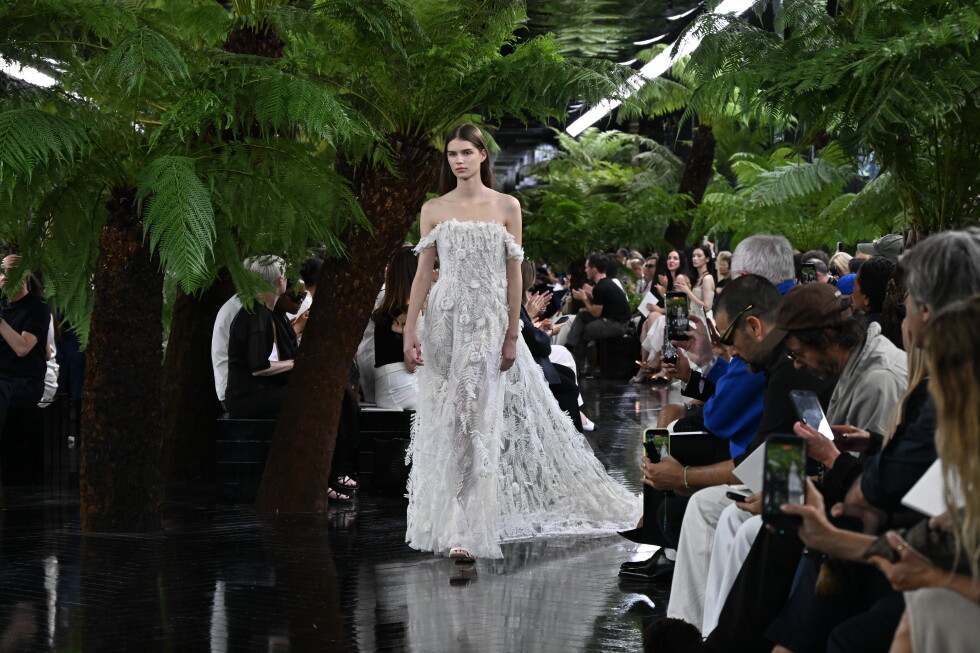
PARIS — When Jonathan Anderson stepped onto the Paris Couture Week circuit, the entire global fashion industry had one thing on its collective mind: the secret Dior wedding dress he created for global superstar Taylor Swift, who had just tied the knot with NFL icon Travis Kelce. Three days after Swift and Kelce exchanged vows at New York’s iconic Madison Square Garden — both outfitted head-to-toe in Dior designs — Anderson kicked off couture week with a bold, art-forward haute couture collection designed to redirect the world’s gaze away from the unshared celebrity gown and toward a deeply creative, medium-bending vision.
The high-profile commission to design Swift’s wedding dress marked a major career milestone for Anderson, the 41-year-old Northern Irish designer tapped just 12 months prior by LVMH, Dior’s parent company, to revamp the luxury house’s entire fashion portfolio. For months leading up to the private wedding, industry analysts and fashion insiders had widely predicted Swift would turn to an American label like Ralph Lauren, or British heritage brand Vivienne Westwood — a designer whose pieces the pop star has regularly worn for red carpet and public appearances. But Anderson landed the coveted gig, and the one dress the entire world wanted to view was the one he refused to reveal ahead of the collection showcase. So, on the opening Monday of couture week, he made a deliberate choice to shift the conversation to fine art.
Anderson’s 2024 fall haute couture collection leans into the experimental aesthetic of pioneering American artist Lynda Benglis, who rose to prominence in the late 1960s for her revolutionary process of pouring raw latex across gallery floors and allowing molten metal to fold and sag into organic, unplanned shapes. For this collection, Anderson reimagined Dior’s historic Parisian workrooms as an extension of Benglis’ studio: rather than cutting and assembling fabric through traditional couture techniques, artisans pressed, knotted and bent flat textiles into bold three-dimensional forms, mirroring Benglis’ approach to reshaping malleable raw materials. The parallel is intentional: just as Benglis bends flat, rigid material into unexpected living shapes, haute couture transforms flat fabric into wearable art.
The collection’s pieces bring this concept to vivid life. A skirt made of layered silver-foiled petals rippled with every model step, while a strapless silver lamé gown featured an oversized structural bow that anchored the fluid silhouette. Tailored trousers and blouses were finished with sharp, hand-pressed pleats that held their sculptural shape. Even Dior’s legendary signature Bar jacket — the nipped-waist design that has anchored the house’s identity since Christian Dior launched his revolutionary New Look in 1947 — got a Benglis-inspired reimagining: one iteration came in lush fern-green tweed with a frayed raw fringe, another was cut from gray houndstooth and folded into a dramatic giant bow at the waist, and a third left loose chiffon threads trailing intentionally from the hem. Other looks were constructed entirely from hand-embroidered silk flowers, and one statement gown featured a wide fan of sky-blue tulle splayed across its entire bodice. Even accessories leaned into the aesthetic: four new metallic pleated handbags were co-designed with Benglis herself.
The opening day of the showcase unfolded against the backdrop of a summer heat wave sweeping France, with temperatures climbing above 30 degrees Celsius (86 degrees Fahrenheit) in Paris. Dior included handheld fans with every guest invitation, and attendees cooled off with them throughout the runway show, which was held in the lush gardens of Paris’ Musee Rodin. The star-studded front row blended A-list pop culture names, fashion icons and contemporary artists, with guests including singer Sabrina Carpenter, actor Josh O’Connor, Priyanka Chopra Jonas, Nick Jonas, Naomi Watts, Rebecca Ferguson and Alexa Chung.
Despite the celebrity fanfare, Anderson’s core gambit is clear: one of the world’s oldest and most recognizable luxury fashion houses can lean into experimental, unconventional creativity rather than relying solely on its legacy or celebrity ties. Anderson is frequently compared to Matthieu Blazy, his counterpart at rival luxury house Chanel, who recently designed the wedding dress for pop star Dua Lipa earlier that month — a garment that has also not been publicly revealed. This couture season holds a unique, almost ironic distinction: two of the biggest fashion stories of the moment are wedding gowns that no member of the public has been allowed to see.
Staying true to longstanding couture tradition, Anderson closed the show with a bridal look. The closing gown was a pale, strapless column silhouette topped with a long veil made from hand-pleated chiffon, trimmed with delicate feathered dandelions and hand-embroidered cactus flowers. It was the second wedding dress Anderson had created this week — and it remains the only one the world has been able to see and photograph.