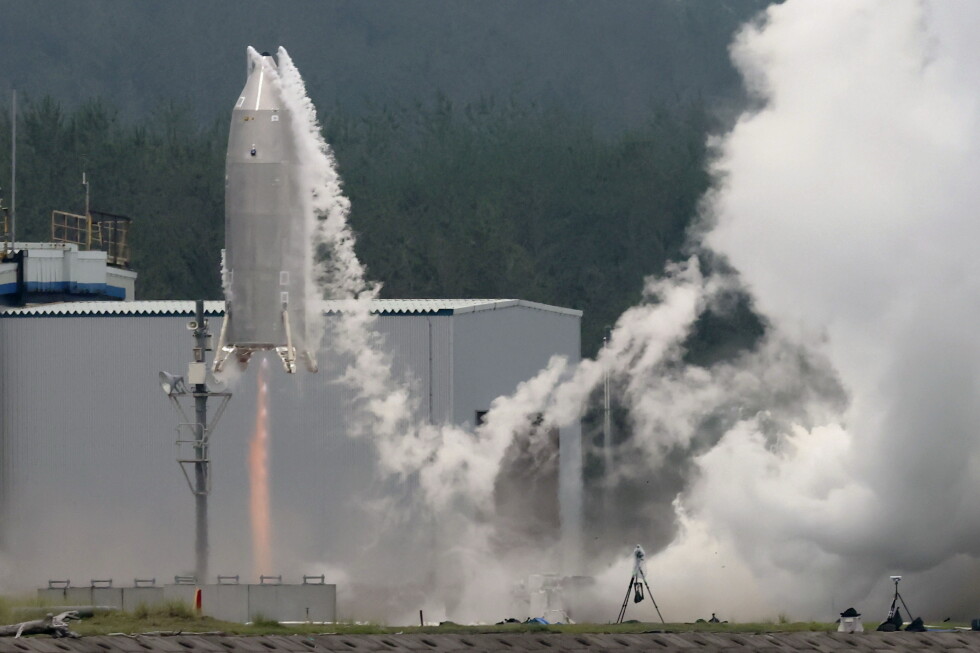
In a landmark milestone for Japan’s commercial space ambitions, the country’s first experimental reusable rocket completed a successful short test flight Saturday, marking a critical step toward mastering the cost-cutting launch technology that has revolutionized the global space industry.
Developed jointly by the Japan Aerospace Exploration Agency (JAXA) and Mitsubishi Heavy Industries, the small RV-X test vehicle executed a fully controlled flight lasting less than one minute at JAXA’s Noshiro Testing Center, located in northeastern Japan. The rocket completed all planned maneuvers: a vertical liftoff, stable hovering, controlled horizontal movement, and a precise vertical landing on the test site, with space enthusiast group NVS broadcasting the entire test live to a global online audience.
Japan’s long-term goal in developing reusable rocket technology is to narrow the gap with industry leader SpaceX, which has flown and landed reusable first-stage rockets for more than a decade. Reusable rocket designs drastically cut launch costs by allowing core rocket components to be recovered, refurbished, and flown multiple times — a change that has allowed SpaceX to dominate the global commercial launch market in recent years.
For Japan, mastering this technology is critical to upgrading its current mainstay launch fleet. The country’s existing H3 series, a replacement for the highly reliable but expensive single-use H-2A rocket, already brings modest cost improvements over its predecessor. But further reductions from reusability are required to make Japanese launch services competitive on the global open market.
Saturday’s test comes just 24 hours after China announced its own first successful recovery of a reusable rocket first stage following a launch, marking a growing global race to expand access to low-cost commercial space access. JAXA, which is also collaborating with France and Germany on reusable rocket research, will hold a public online briefing later Saturday to share preliminary data and analysis from the test. The agency has already laid out plans for future development: upcoming test flights will push the RV-X to reach altitudes of roughly 100 meters, building on the success of Saturday’s initial short-duration test to validate full-scale reusable rocket systems.
Japanese government officials have framed the development of a stable, commercially competitive domestic space launch capability as a core priority for both the country’s national space program and its national security, as access to reliable low-cost launch becomes an increasingly critical strategic asset globally.