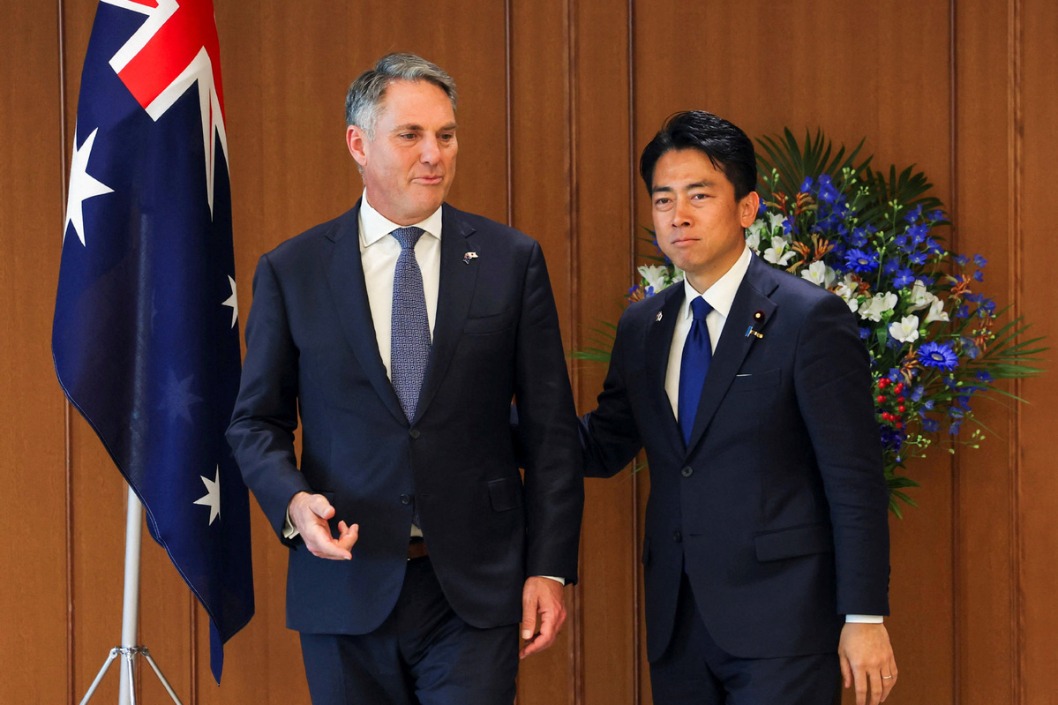
In a landmark move marking Japan’s largest post-WWII military export deal, Australia and Japan formalized a $7 billion warship procurement agreement on April 18, 2026, deepening bilateral defense ties and triggering widespread expert warnings over rising risks of bloc division in the Asia-Pacific. The deal, first awarded to Japan over Germany’s competing bid in August 2025, comes 12 years after Japan lifted its post-WWII ban on military exports, and represents a major milestone for Tokyo’s expanding global defense industry presence.
Under the terms of the memorandum signed by Australian Defense Minister Richard Marles and Japanese Defense Minister Shinjiro Koizumi during talks in Tokyo, Japan’s Mitsubishi Heavy Industries will construct the first three of the 11 planned Mogami-class frigates domestically, with the remaining eight vessels to be built at a new shipyard in Western Australia. The first completed frigate is scheduled to be delivered to the Royal Australian Navy in 2029, a development Marles frames as a core component of Australia’s ambitious plan to build a larger, more technologically advanced and lethal surface fleet.
The deal marks a significant comeback for Japan’s defense industry, which lost a high-profile 2016 Australian submarine contract to French defense contractors. For Tokyo, it also represents another step in its accelerating military buildup and expanding defense partnership network beyond its long-standing formal treaty alliance with the United States. Japan now officially labels Australia a “semi-ally”, and Koizumi described the procurement deal as a transformative step that elevates bilateral defense cooperation to an unprecedented new level, noting Japan remains an indispensable partner for Australia under Canberra’s newly updated national defense strategy.
Just days after the deal was signed, Australia unveiled its 2026 National Defense Strategy, which earmarks an extra $38.1 billion in military spending over the next decade. The plan targets lifting Australia’s total defense budget to 3% of GDP by 2033 when calculated using NATO’s inclusive methodology that accounts for military pensions and related defense-associated expenditures. Marles told the National Press Club in Canberra that the strategy includes the most sweeping modernization of Australia’s maritime military capabilities since the end of World War II.
However, the deepening defense alignment between Tokyo and Canberra has drawn sharp concern from both Chinese officials and regional security experts. In an official statement following the deal signing, Chinese Foreign Ministry spokesperson Guo Jiakun urged Japan to draw clear lessons from its wartime history, honor its international obligations, and remain committed to the path of peaceful development. His comments came amid large-scale public protests in Tokyo against the Japanese government’s ongoing push to revise the country’s pacifist post-WWII constitution. Guo stressed that preventing the resurgence of Japanese militarism is not only a core obligation for Tokyo, but also a shared firm demand of the international community, including China.
Regional security analysts warn that the growing military cooperation between the two nations is far more than a routine arms transaction. Chen Hong, director of the Australian Studies Centre at East China Normal University, explained that the bilateral security relationship has evolved steadily from early dialogues and the Reciprocal Access Agreement to regular joint military exercises, integrated intelligence sharing, and now full defense industrial cooperation. This progression, Chen noted, is building a rapidly institutionalized regional security network, and the warship deal marks a critical turning point toward full integration of the two countries’ military systems. In effect, Chen argues, the partnership has evolved into a de facto “quasi-alliance”: an unofficial but fully functional security arrangement that allows both countries to avoid the political and financial costs of a formal alliance while advancing shared security goals.
Chen added that while deeper ties with Japan give Australia a new regional military foothold and supports its existing policy narratives around supply chain and energy security, this comes at the cost of gradual erosion of Canberra’s long-standing strategic autonomy.
Liu Shuliang, an associate researcher at the Tianjin Academy of Social Sciences, noted that Japan’s closer military ties with Australia are clearly aligned with Washington’s broader Indo-Pacific strategy, and fit into existing US-led security frameworks including the trilateral AUKUS partnership between Australia, the United Kingdom and the United States. Both Japan and Australia, as key US allies, have increasingly leveraged exclusive “small bloc” arrangements to deepen military cooperation aligned with US strategic priorities, Liu explained.
This trend, experts warn, carries severe risks for the broader Asia-Pacific security architecture. Rooted in an outdated Cold War zero-sum mentality, Liu argued, this exclusive security framework weakens the central role of inclusive multilateralism in maintaining regional peace, limits space for broad multilateral cooperation, and erodes the effectiveness of existing collective security mechanisms. Beyond that, the alignment risks escalating tensions around existing regional flashpoints, accelerating destabilizing shifts in the regional military balance, fueling a new regional arms race, and deepening the widespread regional security dilemma. Chen Hong added that the development of this exclusive quasi-alliance framework will ultimately intensify regional tensions and deepen the security challenges that both Japan and Australia themselves face.