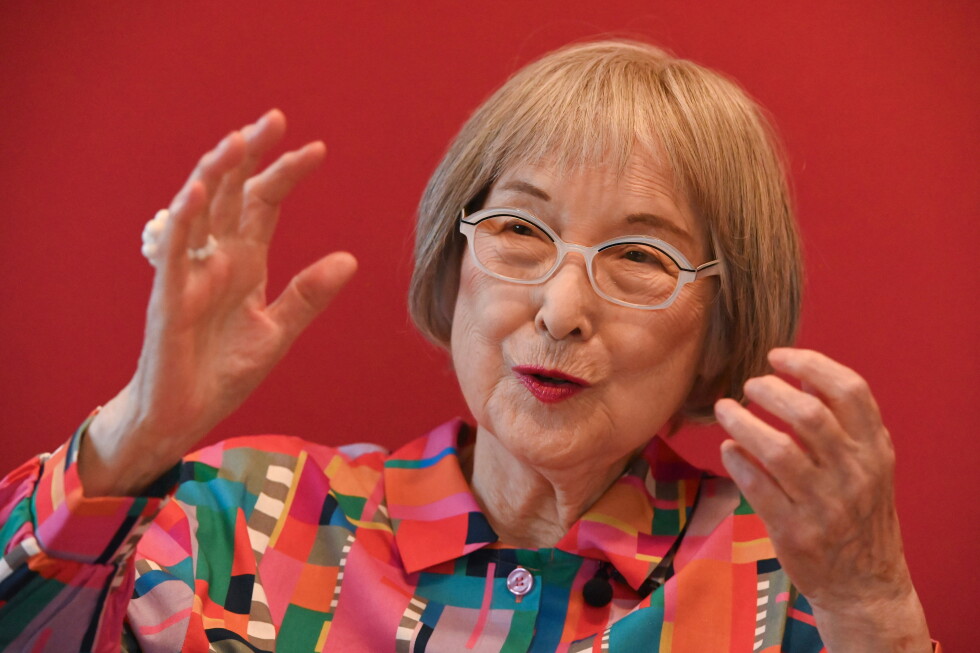
Nestled in the scenic coastal Japanese city of Kamakura, just south of Tokyo, 91-year-old beloved Japanese author Eiko Kadono welcomes visitors to a cozy home marked by a soft pink gate. The space brims with towering stacks of books, pink upholstered chairs, and a whimsical collection of animal figurines — a perfect reflection of the childlike wonder that has defined Kadono’s decades-long career crafting stories.
Widely known as the creator of Kiki, Japan’s most cherished literary witch, Kadono shows no signs of stepping away from her craft. Even as mobility challenges like climbing stairs have slowed her daily routine, she shows up to her writing desk every single day. “I never tire of writing,” she shared in an exclusive interview with the Associated Press from her home, a soft laugh escaping as she describes herself as still young at heart.
Dressed in a brightly colored smock custom-designed by her daughter — with elastic cuffs that pull up easily for writing, a feature she points out with quiet pride — and sporting her signature thick-framed glasses, Kadono embraces authenticity openly. Quick with a witty retort and a ready laugh, she shrugs off any need to hide that she wears a wig, still wears bold red lipstick, and only feels a little shy about her wrinkles. While her writing style has tightened over the decades (she notes her early work was far wordier than her current crisp prose), her passion for storytelling has stayed constant.
Kadono’s career as a writer began by happy accident, not deliberate design. For years, she was a full-time housewife raising her daughter and married to a designer, and never set out to become a published author. It was only after living in Brazil for two years in her 30s that she was asked to write about her experience there, and she quickly discovered writing was a joyful hobby, not a chore to force herself through.
The character that would make her a global household name came from an unlikely source: a childhood drawing by her 12-year-old daughter. The sketch depicted a cute young witch flying on a broomstick toward the moon, and it inspired Kadono to craft a coming-of-age fantasy following the sprightly, no-nonsense young witch Kiki and her black cat sidekick Jiji on their adventures. First published in 1985, *Kiki’s Delivery Service* was adapted into the iconic 1989 Studio Ghibli animated film by Hayao Miyazaki, cementing the story’s place in global pop culture.
Today, the original Kiki series spans six core novels and three spin-offs, and the first book was translated into English in 2020 by Delacorte Press. Its reach now extends to 25 languages worldwide, with the second installment of the series, *Kiki and the New Magic*, set to hit English bookshelves this August, translated by Emily Balistrieri and illustrated by Yuta Onoda. The work is just one of more than 200 books Kadono has published over her career, which earned her the prestigious Hans Christian Andersen Award — the top global honor for children’s literature — in 2018.
Kadono’s creative process remains rooted in analog tradition, even as she’s adapted to modern tools. While she now types finished drafts on a keyboard, tapping out one slow key at a time, every new story still starts with handwritten notes, and she sketches small illustrations to help her visualize the worlds she builds. “I want to write so that the reader can visualize what I am writing,” she explained. “I love to write.”
Last year, Tokyo opened Kiki’s Museum of Literature, a dedicated space celebrating Kadono’s work that displays hundreds of books by her and other authors, and sells branded merchandise from Kadono’s signature smocks to pink mugs and character-printed T-shirts. A statement on the museum’s wall sums up her cross-cultural impact: “The other-worldly fantasy that Kadono creates has overcome the boundaries of language, to become appreciated by a wide global audience, including children and adults, and won international accolades.” For 5-year-old visitor Tsukiko Fukuda, who toured the museum with her family, the appeal is simple: the books are fun, and pink is her favorite color too.
Looking ahead, Kadono has expressed a passionate hope that more young talent will emerge in children’s literature, to help future generations develop a lifelong love of reading. She warns that modern childhood has shifted dramatically from the era she grew up in: unstructured outdoor activities that once stoked young people’s imaginations have been replaced by digital distractions, making books more important than ever. “People must think on their own to be able to create. That’s what being human means,” she said with fervor. “Books are the only thing now that can bring about creation and imagination.”