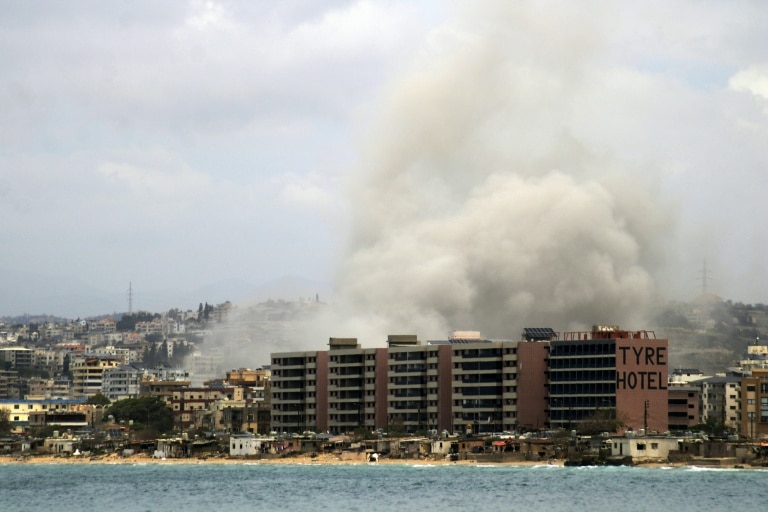
As US-mediated negotiations between Lebanese and Israeli envoys entered their second day in Washington on Friday, Israel launched a new wave of airstrikes targeting Hezbollah positions across southern Lebanon, leaving at least 37 people injured and deepening civilian hardship in the already war-battered region. The Israeli military confirmed in an official statement that it had targeted Hezbollah infrastructure sites in the vicinity of Tyre, a major coastal city in southern Lebanon. Multiple rounds of blasts were documented by an Agence France-Presse correspondent on the ground, with two strikes hitting areas close to Tyre proper. Lebanon’s state-run media added that one strike hit a facility operated by a local non-governmental organization, located just adjacent to a local hospital.
Lebanon’s Ministry of Public Health released casualty figures confirming that among the 37 wounded were six hospital staff members, nine women and four children. Local resident Hafez Ramadan, who lives near the targeted structure, revealed the building was sheltering displaced families who had already fled their hometowns to escape ongoing cross-border violence. The site also sits next to a hotel that houses additional displaced people. Ramadan noted, “There are only women, children and the elderly here. Because of this strike, people have been displaced again.”
Prior to Friday’s attacks, the Israel Defense Forces (IDF) issued evacuation orders for five towns and villages in and around southern Tyre, followed by a second warning for five additional southern Lebanese communities shortly after the strikes. The IDF also confirmed that one Israeli soldier was killed in clashes with Hezbollah in southern Lebanon, pushing the total number of Israeli soldiers killed in hostilities with the group since early March to 19. One Israeli civilian contractor was also killed in recent clashes. Lebanon’s official National News Agency reported additional strikes on southern locations that were not covered by prior Israeli evacuation warnings, expanding the scope of the offensive beyond areas Israel had flagged. In tandem with the Israeli airstrikes, Hezbollah announced it had carried out multiple coordinated attacks against Israeli troops in at least six southern Lebanese towns.
The strikes drew immediate condemnation from Imran Riza, the United Nations Humanitarian Coordinator for Lebanon, who decried the “unacceptable” civilian cost of persistent attacks. “The reality on the ground in Lebanon has been deeply alarming,” Riza said. “Airstrikes and demolitions continue daily, with an unacceptable toll on civilians and civilian infrastructure.” Despite the escalation of violence, Riza stressed that ongoing diplomatic efforts in Washington represent a critical opening to end the bloodshed, expressing hope that the talks would “pave the way toward a political solution” between the two long-belligerent neighbors.
The negotiations, hosted at the U.S. State Department, resumed shortly after 9 a.m. ET Friday, bringing together representatives from Lebanon and Israel — two countries that have remained officially at war for more than seven decades. U.S. mediators characterized the first day of talks on Thursday as productive and positive, though neither Lebanese nor Israeli officials have issued public comments on the negotiations’ progress to date. Lebanon’s core negotiating demand is a lasting extension of the current ceasefire, which is set to expire this Sunday if no extension agreement is reached, and a formal Israeli commitment to halt all offensive strikes on Lebanese territory.
The current fragile truce between Israel and the Iran-backed Hezbollah went into effect on April 17, but the agreement has failed to stop hostilities entirely. Hundreds of people have been killed in cross-border strikes since the truce took effect, with both sides repeatedly accusing one another of violating the terms of the ceasefire. According to Lebanese official data, more than 2,900 people have been killed in Israeli attacks across Lebanon since hostilities reignited in March, when Hezbollah launched a rocket barrage against Israel in retaliation for the killing of a senior Iranian leader. More than 400 of those deaths have occurred since the April truce went into force.
Leading the two negotiating delegations are veteran political figures with long-standing, hardline positions on the conflict. Lebanon’s team is headed by 76-year-old Simon Karam, a former ambassador to Washington and independent politician known for his advocacy for Lebanese national unity amid the country’s deep sectarian divides. Israel’s delegation is led by Yechiel Leiter, Israel’s current ambassador to the U.S. and a long-time close ally of Israeli Prime Minister Benjamin Netanyahu, with deep roots in Israeli conservative activism, settler politics and hardline diplomatic approach.
The negotiations are taking place amid heavy pressure from the U.S. and Israel for Lebanon to disarm Hezbollah, a demand that has sparked intense pushback domestically. Senior Hezbollah official Mahmud Qamati issued a scathing rejection of the talks Friday, describing direct negotiations between Beirut and Israel as “humiliating” and part of a broader conspiracy against Lebanese sovereignty and the group’s armed resistance. “Beirut going to direct, humiliating negotiations with the Israeli enemy is not a separate issue from a comprehensive conspiracy against the nation, its sovereignty and its resistance,” Qamati said, noting that the talks are unfolding while “the south is being destroyed and martyrs are being killed daily.”
Hezbollah has long refused any formal direct engagement with Israel, maintaining its position of non-recognition of the Israeli state. Israeli forces have already occupied swathes of southern Lebanon since the outbreak of current hostilities, carrying out widespread demolition of residential villages and infrastructure over the past several weeks, leaving thousands more Lebanese residents displaced.