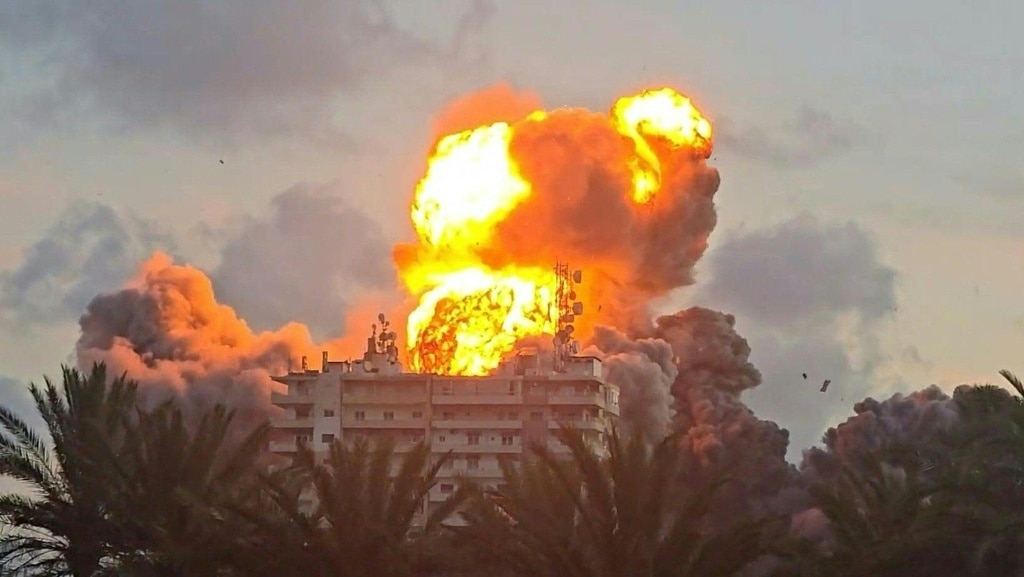
A new wave of Israeli airstrikes targeting areas near Beirut has sent tensions soaring between Israel and Lebanon’s Hezbollah movement Thursday, marking the second Israeli strike on the Lebanese capital’s vicinity since a shaky April ceasefire that has failed to hold on either side.
The escalation comes at a particularly sensitive diplomatic moment: military delegations from both Lebanon and Israel are set to meet at the Pentagon Friday for preparatory discussions, ahead of the fourth round of US-brokered negotiations early next week. The diplomatic process was launched after the latest round of full-scale conflict between Israel and Hezbollah erupted on March 2.
Lebanese security sources, speaking on condition of anonymity to Agence France-Presse (AFP), confirmed that the Thursday strike hit a residential apartment in the Choueifat district, located on the edge of Beirut’s southern suburbs—a longstanding Hezbollah stronghold. The Israel Defense Forces (IDF) only confirmed it carried out a “precise strike in Beirut” and declined to publicly name the target. Footage captured by AFPTV showed thick plumes of smoke rising from the strike site, and an AFP on-the-ground correspondent reported extensive damage to the first two floors of the residential building. Local residents were seen hastily loading belongings into vehicles and fleeing the area ahead of potential further strikes.
This strike is the second Israeli attack on south Beirut since the April 17 ceasefire between Israel and the Iran-backed Hezbollah, a truce that was never fully implemented or respected by either faction. Both sides regularly accuse the other of violating the agreement, and frame their own retaliatory strikes as a justified response to opposing truce breaches. Just hours before the Beirut-area strike Thursday, Hezbollah claimed responsibility for multiple rocket and drone attacks targeting Israeli troops deployed in southern Lebanon.
The United Nations Interim Force in Lebanon (UNIFIL), which maintains a peacekeeping presence in the border region, acknowledged that the April truce initially brought a lull in hostilities, but has warned of steady worsening violence in recent weeks. “Last month’s agreement had a positive effect in lessening the violence, but we have seen an escalation in recent weeks, and an intense escalation in recent days,” UNIFIL spokesperson Kandice Ardiel told AFP. The force’s official data confirms that roughly 670 projectiles were fired across the border Wednesday alone—the highest daily volume of fire since the April 17 truce was announced.
The current escalation began building Wednesday, when the IDF designated all of southern Lebanon south of the Zahrani River—approximately 25 miles from the Israeli border, encompassing the major southern cities of Tyre and Nabatieh—as an official combat zone, ordering all civilian residents to evacuate immediately. Israeli officials reiterated this week that they plan to ramp up military operations across Lebanon and expand ongoing ground incursions into southern Lebanese territory. On Thursday afternoon, the IDF issued a second round of evacuation orders for large swathes of Tyre and its surrounding outskirts.
Early Thursday, Israeli airstrikes hit both Tyre and the southern Lebanese port city of Sidon, leaving widespread destruction and multiple casualties. In Tyre, one strike hit a building located in the city’s protected archaeological district, with footage capturing a massive fireball erupting before smoke billowed over the historic area. Local resident Ghazouane Halawani told AFP he believes Israeli forces are deliberately targeting the ancient city’s cultural heritage. “Israel wanted to attack the ancient city’s history and its civilisation,” he said. “We’re staying here. This is our country, our land, our life.”
Lebanese Foreign Minister Youssef Raggi announced via social platform X that he had launched “intensive diplomatic contacts” after the Tyre strikes hit “its historic old neighbourhoods, churches, mosques, and cultural landmarks that have stood resilient for thousands of years.”
As of Thursday, Lebanon’s health ministry has confirmed mounting civilian casualties from the recent wave of strikes: a strike in Tyre killed two Syrian nationals, one of them a child; a separate raid on Sidon killed five people including two women; and a targeted strike on a vehicle in the southern Lebanese town of Adloun killed an entire family of six—two children, their parents, and two other relatives. Lebanon’s military confirmed one of its soldiers was killed while driving in the Nabatieh region in another strike, and the state-run National News Agency reported additional Israeli strikes across multiple other locations in southern Lebanon. On the Israeli side, the IDF confirmed one Israeli soldier was killed Wednesday by a Hezbollah drone attack near the shared border.
The conflict between Israel and Hezbollah is part of the broader regional Middle East war that erupted after Hezbollah opened fire on Israel in response to the killing of Iran’s supreme leader in a joint US-Israeli strike, prompting full-scale Israeli air and ground operations across Lebanon. Tehran has repeatedly insisted that any ceasefire agreement to end the broader regional conflict must include a formal end to hostilities in Lebanon. Tensions between the US and Iran also flared Thursday, with both sides trading accusations of violating their own recent bilateral truce following an exchange of cross-border fire.