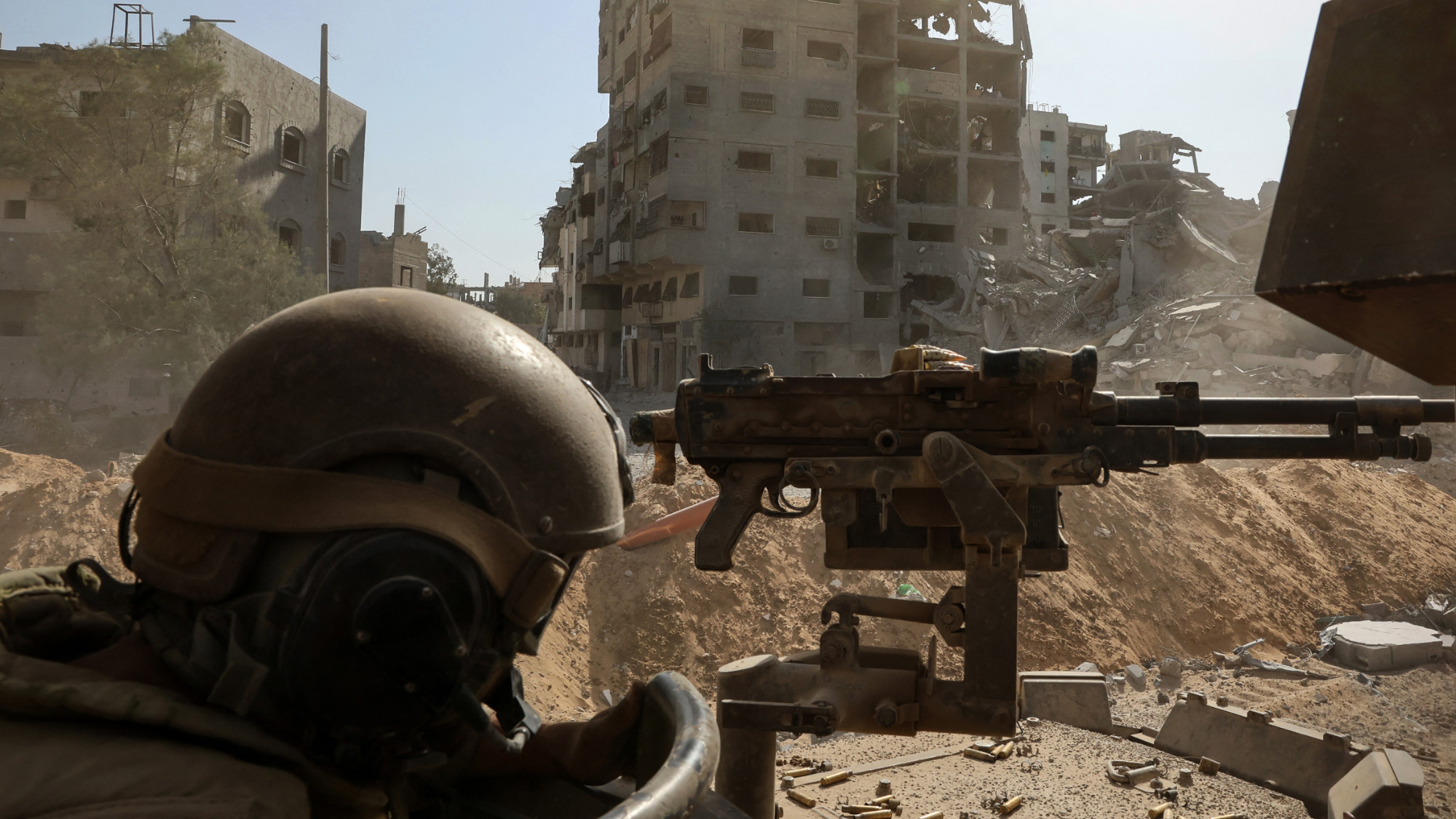
An explosive investigative report aired on Israel’s Channel 13 has pulled back the curtain on sweeping, deadly rules of engagement Israeli forces received for their 2023 ground operation in Gaza, with serving and former soldiers confirming that troops were ordered to kill any male encountered on sight, regardless of age, and told to treat all civilians as potential threats.
The testimony was collected directly by Iris Haim, whose son Yotam—one of three Israeli captives wrongfully killed by Israeli forces in Gaza City’s Shujaiya neighborhood in December 2023—was among the victims of the mistaken attack. In an account that has upended official military narratives, an anonymous soldier who admitted to opening fire on the three captives described the explicit standing orders he and his unit received. “A man, no matter what age, don’t play games with it; kill immediately,” the soldier said, adding that commanders even instructed troops to use lethal judgment against women and children if they perceived any threat, with similar protocols applied to working animals like donkeys in the area.
The December 2023 killing of the three captives sparked immediate international and domestic outcry, because the hostages were unarmed, shirtless, waving a white flag, and posed no visible threat to Israeli troops when they were shot. The newly released testimonies lay bare a stark gap between on-the-ground orders and the Israeli military’s official post-incident investigation. Per the soldiers’ accounts, no ceasefire order was issued in the moments before the shooting—directly contradicting the military’s official claim that all troops received a command to halt fire.
Recounting the fatal encounter, the soldier who participated in the shooting told Haim he operated under the mindset drilled into him by training: “I fire 500 bullets a minute. I blow things up. I don’t care. I’m here to kill terrorists.” When he spotted the three men approaching, he opened fire, believing them to be enemy fighters. After he hit two, his weapon jammed, and another soldier stepped in to kill the surviving captive, who was later identified as Yotam Haim. The investigation further confirmed that a brigade commander had instructed Yotam to approach the Israeli outpost, only for troops to open fire the moment he emerged.
In a damning exchange with Iris Haim, the brigade commander overseeing the operation explicitly confirmed the lethal policy. When asked if even unarmed people were targeted, the commander replied: “Of course, we need to kill him – yes, even if he is completely unarmed.” He added that troops were ordered to kill any approaching threat rather than attempt to take them into custody, a framing that Iris Haim said amounted to an order to “kill every person walking on two legs.”
A second soldier echoed those claims, telling investigators that all Gazans were framed as potential risks from the start of the operation. “Even an old man can blow himself up with an explosive device. The protocol was to shoot them,” he said, confirming that there were multiple documented cases of civilians waving white flags being shot on sight. The soldier added that the senior commander in charge of the captive shooting had publicly stated that distinguishing between Hamas fighters and civilian non-combatants in Gaza was impossible—yet that same commander was later promoted by Israeli Army Chief of Staff Eyal Zamir, with military officials praising him as “an outstanding officer.”
Raviv Drucker, the investigative journalist who led the Channel 13 report, accused the Israeli military of carrying out a deliberate cover-up in its official investigation into the captive deaths. He said families of the deceased captives had pushed for a full, transparent inquiry “to receive a real investigation, and not what was presented to them, which in their eyes, and in mine as well, was a cover-up and a whitewash.”
The investigation also uncovered new details of missed warnings that could have prevented the killings. Five days before the shooting, Israeli forces fired a missile at a northern Gaza building where the three captives were hiding, after an exchange of fire with Hamas fighters nearby. The captives survived the strike and moved through residential areas of Shujaiya, hanging handwritten signs requesting help from Israeli forces. But according to the report, military intelligence ignored on-the-ground reports of the captives’ presence, failing to pass the information to frontline troops.
The killings of the three captives fit into a broader pattern of Israeli military actions harming Israeli hostages held in Gaza, the report notes. Of the 251 people taken captive during the October 7, 2023, Hamas attack on southern Israel, 85 died in captivity or were killed before they could be rescued, under circumstances that remain heavily contested. While the Israeli government has repeatedly denied or declined to comment on accusations that its operations have killed captive Israelis, multiple independent reports confirm that Israeli military actions have directly and indirectly caused the deaths of many hostages. Israeli newspaper Maariv even reported in October 2025 that, per anonymous Israeli official sources, dozens of captives were killed by Israeli attacks, particularly in the chaotic early stages of the war.
From the first day of the conflict, the Israeli military activated the controversial Hannibal Directive, a longstanding military protocol that orders troops to fire on captives and abductors alike to prevent captives from being taken away, even if that puts the lives of the captives at extreme risk.
As of 2025, Israeli military operations in Gaza have killed more than 72,700 Palestinians, according to local health officials, with 850 additional deaths recorded after a ceasefire was declared in October 2025. Thousands more Palestinians remain unaccounted for, and are presumed buried under the rubble of destroyed residential and infrastructure across the enclave.