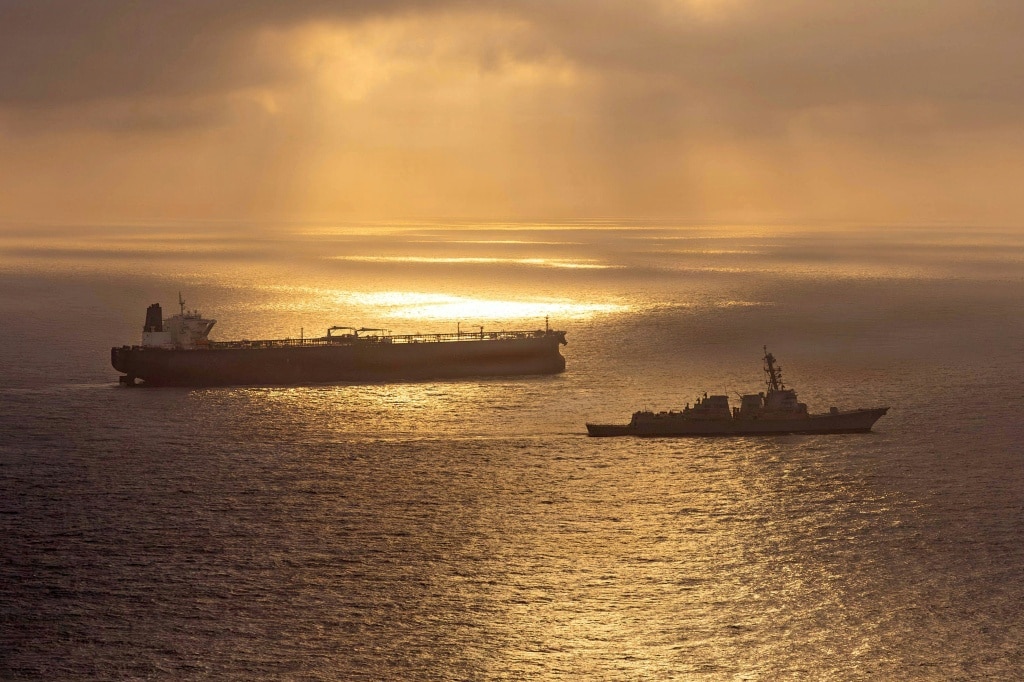
Fresh drone attacks targeting commercial vessels and Gulf Cooperation Council nations have sent tensions soaring across the Persian Gulf this week, as Iran formally announced an end to its policy of military restraint against United States interests in the region.
The string of incidents began unfolding last week, when South Korea’s Ministry of National Defense confirmed that an unidentified aerial attack damaged a South Korean-flagged cargo vessel, the HMM Namu, in the Strait of Hormuz on May 4. Two projectiles struck the ship’s stern ballast tank at roughly one-minute intervals, sparking a fire that was extinguished before the vessel proceeded safely to the Port of Dubai with no reported casualties.
On Sunday, a new wave of attacks hit closer to major Gulf infrastructure. Qatar’s Ministry of Defense confirmed that a cargo freighter traveling from Abu Dhabi to Qatari waters was struck by a drone northeast of the port of Mesaieed. The UK Maritime Trade Operations (UKMTO), which monitors commercial shipping in the region, confirmed the bulk carrier suffered a small fire that was quickly put out, with no injuries or environmental damage reported. Iranian state-affiliated Fars News Agency later claimed the vessel was owned by and sailing under the flag of the United States, though this has not been independently verified.
Hours after the Qatari attack, the United Arab Emirates formally accused Iran of launching two armed drones toward its territory. UAE air defense systems successfully intercepted and destroyed both unmanned vehicles before they could reach their targets, the country’s defense ministry announced in a social media post. Neighboring Kuwait also reported detecting and neutralizing multiple hostile drones that entered its airspace at dawn Sunday.
The coordinated attacks come amid a sharp breakdown in the fragile month-long ceasefire that has largely de-escalated cross-border hostilities between Iran and the US-led coalition in the Gulf. In public warnings issued over social media and state media, Iranian officials have made clear that their previous policy of restraint in response to US and allied actions is over. Ebrahim Rezaei, spokesman for the Iranian parliament’s national security commission, wrote Sunday that “Any attack on our vessels will trigger a strong and decisive Iranian response against American ships and bases.”
The warning followed a recent confrontation in the Gulf of Oman Friday, where a US fighter jet intercepted and disabled two Iran-flagged commercial tankers. Iran’s Islamic Revolutionary Guard Corps (IRGC) reiterated the new threat in a statement following the incident, noting that any future attack on Iranian commercial shipping would result in retaliatory strikes against US military outposts and naval assets in the Middle East.
Over the weekend, Iran’s military leadership met with Supreme Leader Mojtaba Khamenei to receive updated operational guidance for confronting perceived enemy aggression in the region, according to Iranian state television.
Tensions have been building for months over control of the Strait of Hormuz, the strategic chokepoint through which roughly one-fifth of the world’s global oil exports pass, alongside massive volumes of liquefied natural gas and agricultural fertilizer. Iran has sought to leverage control over the strait to gain economic and diplomatic leverage against the US and its regional allies, recently establishing a formal system to collect tolls from commercial shipping passing through the waterway. US officials have repeatedly rejected Iran’s claims of authority over the international waterway, calling any attempt to regulate or tax transit unacceptable. The US Navy has also maintained a regional blockade of Iranian ports, regularly intercepting, disabling, or diverting commercial vessels traveling to and from Iranian territory.
The latest escalation comes as diplomatic efforts to broker a permanent ceasefire and peace talks between Washington and Tehran remain at a stalemate. The US has awaited Iran’s formal response to a new proposal to extend the existing truce and open formal negotiations, with former President Donald Trump noting last week that he expected a response via Pakistani mediators by Friday. No official response has been made public to date.
Iranian Foreign Minister Abbas Araghchi blamed US military aggression for undermining diplomatic progress, telling state news agency ISNA that “The recent escalation of tensions by American forces in the Persian Gulf and their numerous actions in violating the ceasefire have added to suspicions about the motivation and seriousness of the American side in the path of diplomacy.”
US diplomatic leaders have been intensifying consultations with regional intermediaries in recent days. US Secretary of State Marco Rubio met Saturday with Qatari leadership in Doha; Qatar has long hosted a major US Air Force base in the region, and has served as a key go-between for Washington and Tehran. Qatari Prime Minister and Foreign Minister Sheikh Mohammed bin Abdulrahman Al Thani held a separate meeting a day earlier with US Vice President JD Vance to discuss peace brokering efforts.
Iran has previously targeted sites in Qatar during past rounds of hostilities, citing the emirate’s hosting of US military infrastructure as justification.