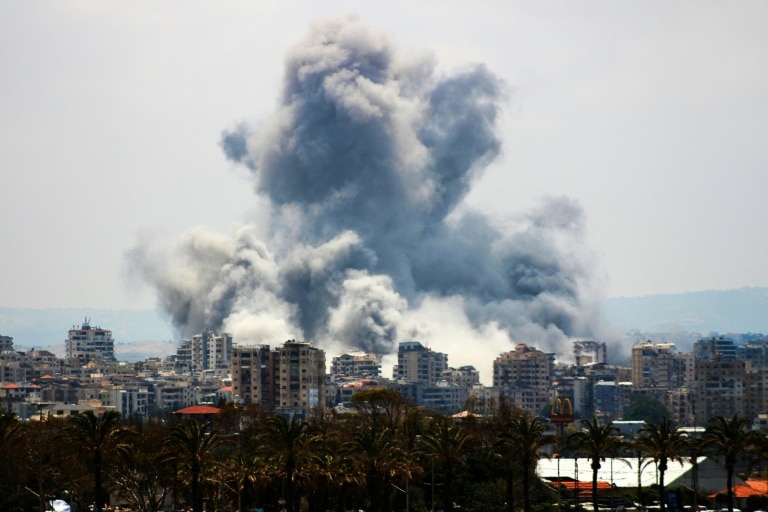
In a sharp escalation of its two-decade deepest incursion into Lebanon, Israel announced plans Monday to launch new airstrikes on Beirut’s southern suburbs, a Hezbollah stronghold that has largely avoided heavy bombardment since April. The announcement comes just hours before an emergency UN Security Council meeting convened to address Israel’s expanding military operations, and as global powers scramble to prevent a full-scale regional conflict.
In a joint statement from Prime Minister Benjamin Netanyahu and Defence Minister Israel Katz, the Israeli leadership ordered the Israel Defense Forces (IDF) to target militant positions in Beirut’s densely populated Dahiyeh district. The order frames the operation as a response to repeated ceasefire violations by the Iran-backed militant group Hezbollah, which has launched daily attacks on Israeli territory since a fragile truce took effect in mid-April. “In light of the repeated violations of the ceasefire in Lebanon by the terrorist organisation Hezbollah and the attacks on our cities and citizens, Prime Minister Benjamin Netanyahu and Defence Minister Israel Katz have instructed the IDF to strike terror targets in the Dahiyeh district of Beirut,” the statement read.
Katz doubled down on the threat in a separate remarks, warning that “there will be no calm in Beirut” if Hezbollah continues its offensive operations. He also formally outlined Israel’s new strategic goal: establishing a military-controlled security zone stretching to the Litani River in southern Lebanon, cleared of all weapons and militant presence. The announcement comes one day after Israeli troops seized the iconic Beaufort Castle (Qalaat al-Chakif), a strategic high point overlooking all of southern Lebanon that served as an Israeli military base during its 22-year occupation of the region ending in 2000. Netanyahu described the capture of the castle as a “dramatic shift” in Israel’s current policy in Lebanon.
The current cycle of conflict between Israel and Hezbollah erupted on March 2, when Hezbollah launched a massive rocket barrage into Israel in retaliation for the US-Israeli killing of Iran’s supreme military leader. A truce brokered to halt hostilities went into effect on April 17, but the agreement has never been fully respected, with both sides trading daily accusations of breaches that justify renewed attacks.
By Monday morning, panic had already spread across Beirut’s southern suburbs, with dozens of civilian families fleeing the area ahead of expected strikes. An AFP correspondent on the ground reported seeing families with young children packing only a few bags onto motor scooters to evacuate, while others loaded cars full of belongings to leave the area. “That feeling did not last long… Our fears intensified this morning after I received a series of messages about orders to bomb the southern suburbs, which caused widespread panic, and we immediately left the area,” 24-year-old resident Hadi told AFP by phone. Since April 8, when widespread Israeli strikes across Lebanon killed hundreds of people in minutes, Dahiyeh has only been targeted twice.
Along with the planned strikes on Beirut, Lebanon’s state-run National News Agency reported Monday that the IDF had issued new evacuation orders for nine towns and villages in Lebanon’s Sidon and Jezzine districts, located far from the Israel-Lebanon border. Hezbollah responded to the escalation by claiming responsibility for a missile attack on Tiberias, a city roughly 19 miles inside Israeli territory, and confirmed it had engaged Israeli ground forces operating inside southern Lebanon.
The escalating violence has drawn immediate condemnation and urgent diplomatic action. France, which requested the emergency UN Security Council meeting scheduled for later Monday, has already spoken out against the escalation. French President Emmanuel Macron said Sunday that “nothing justifies the major escalation under way in south Lebanon”, while the European Union has called on Israel to immediately “stop its military escalation”.
Diplomatic efforts to de-escalate are already underway, with the United States brokering a new round of security talks between Israeli and Lebanese military delegations. A fourth round of negotiations is set to open Tuesday, following an initial working meeting in Washington last Friday. A senior anonymous US official told AFP Sunday that Secretary of State Marco Rubio has spoken with both Lebanese President Joseph Aoun and Netanyahu to lay out a US-backed de-escalation framework: Hezbollah must cease all attacks on Israel first, in exchange for Israel backing away from its planned strikes on Beirut. The official added that Rubio has emphasized Hezbollah must take the first step to end hostilities.
For Iran, which is currently engaged in stalled negotiations with the United States to end their wider ongoing conflict, a ceasefire in Lebanon remains a non-negotiable condition for any final agreement. Iranian foreign ministry spokesman Esmaeil Baqaei reaffirmed this position during a weekly press briefing Monday, stating that “a ceasefire in Lebanon is an essential condition for any deal aimed at ending the war” with the US. Lebanese President Aoun has labeled Israel’s expanding operation as “a vicious and reprehensible Israeli aggression”.
Official casualty figures underscore the heavy human cost of the three-month conflict: Lebanon’s health ministry reports that more than 3,412 Lebanese people have been killed in Israeli attacks since March 2. Over the same period, 26 people have been killed in Israel – 25 soldiers and one civilian contractor.