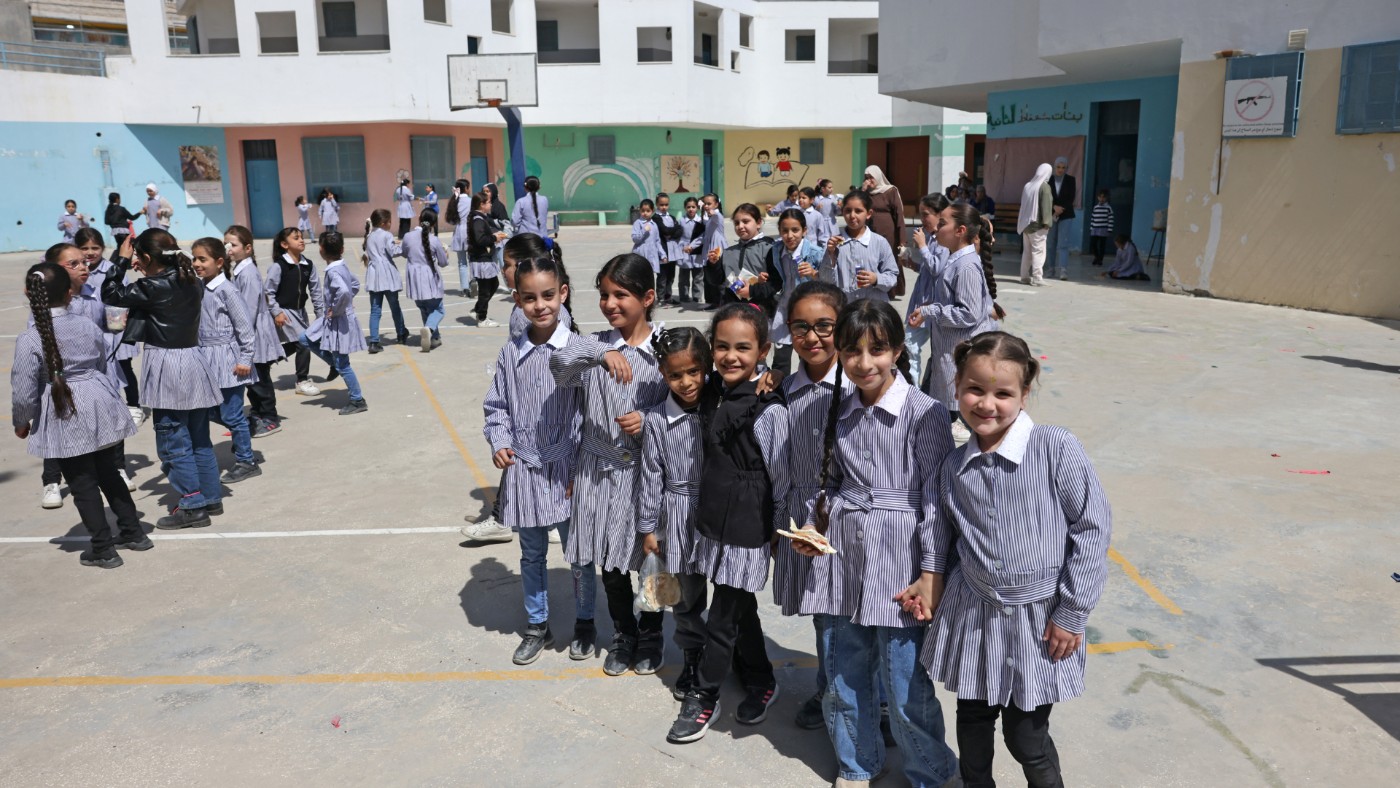
A sweeping expansion of Israeli education policy in occupied East Jerusalem is forcing more than 45,000 Palestinian students — roughly 38% of all Palestinian students in the city — to study under the Israeli national curriculum, a sharp, accelerated increase from enrollment numbers in recent years. Starting this week, all new first-grade and seventh-grade classes within East Jerusalem’s Israeli-run state school system will transition to the Israeli curriculum, completing the latest phase of a policy Palestinian officials describe as an unprecedented threat to their national identity.
This rapid expansion marks a major jump from just five years ago, when only 10,347 Palestinian students attended Israeli curriculum schools. That number climbed to 27,041 by the 2025-26 school year, and now crosses the 45,000 threshold as the policy is extended to all new entering cohorts at state-run institutions.
Palestinian students in East Jerusalem currently attend one of four school systems: schools operated by the United Nations, independent private institutions, schools run by the Islamic Waqf endowment, and Israeli municipal schools, where the new curriculum rules are now being widely enforced. The trajectory of education policy in the region has shifted dramatically since Israel occupied East Jerusalem in 1967: initially, the education system remained aligned with the West Bank, using a Jordanian-designed curriculum, which was replaced by a Palestinian Authority-developed curriculum in the 1990s. Today’s expansion of the Israeli curriculum represents the most significant change to that framework in decades.
Maarouf al-Rifai, spokesperson for the Palestinian Authority’s Jerusalem Governorate, called the decision a dangerous escalation unmatched since the 1967 occupation. He framed the policy as a direct assault on the Palestinian national and cultural identity of Jerusalem residents, noting that the Israeli curriculum systematically marginalizes core elements of Palestinian history and collective narrative. Key topics such as the Nakba, the status of Palestinian political prisoners, and the centrality of Jerusalem to Palestinian identity are erased or sidelined from the curriculum, turning education into a battleground for collective memory, national consciousness, and cultural identity in the contested city.
The curriculum expansion is not an isolated move, but part of a coordinated, systematic campaign targeting Palestinian education across East Jerusalem, Palestinian officials say. Additional restrictions have thrown the start of the new academic year into chaos for Palestinian private schools: Israel has blocked entry permits for roughly 70 West Bank-based teachers who work in East Jerusalem, and 40% of all teachers at the city’s Palestinian private schools — most of them Palestinian Christians — reside in the West Bank. In response, private schools have announced they will delay the 2026-27 academic year indefinitely until entry permits are renewed or reissued for all affected staff.
Omar Rjoob, media director for the Jerusalem Governorate, explained to Middle East Eye that the crackdown on education ties into a broader Israeli strategy to solidify the annexation of East Jerusalem and sever the city from its geographic and cultural Palestinian roots. Long-standing barriers including Israeli military checkpoints and the separation barrier constructed in the early 2000s already cut Jerusalem off from the rest of the West Bank, forcing many Palestinian residents of Jerusalem to seek employment in the Israeli labor market and increasing pressure for expanded Hebrew language education over time.
Recent policy changes have accelerated this shift: in January 2026, Israel’s parliament passed a ban barring the hiring of teachers who hold academic degrees from Palestinian Authority-affiliated universities within the Israeli education system. The rule has had an immediate, severe impact on Arabic-language education in East Jerusalem, where a large share of teaching staff graduated from Palestinian higher education institutions.
Israeli authorities have also targeted United Nations Relief and Works Agency (UNRWA) schools that serve Palestinian refugees, closing multiple campuses and seizing agency-owned educational complexes in the Shuafat and Kafr Aqab refugee camps. Israeli newspaper Haaretz confirmed that a large purpose-built UNRWA school in central Shuafat has been taken over by the Jerusalem municipality, which plans to repurpose the site to house 14 high school classes, a co-ed primary school, and five special education kindergartens.
“This entire trajectory, with all its components, represents an attempt to re-engineer the educational landscape of occupied Jerusalem to serve the Israeli occupation’s policy goals,” Rjoob told Middle East Eye. He added that the weakening of Palestinian educational institutions, movement restrictions on teachers, and forced curriculum changes collectively threaten the Palestinian identity of young students in the city, transforming education into a tool for annexation, Judaisation, and the erasure of East Jerusalem’s inherent Arab-Palestinian character.
The policy announcement comes as high-profile far-right Israeli National Security Minister Itamar Ben Gvir prepares to launch a children’s book celebrating his political “activities and achievements” to be distributed to Israeli educational institutions. Titled *The Minister Who Didn’t Stop*, the book is scheduled to launch Tuesday, the first day of the Israeli school year, at a conference for Ben Gvir’s Jewish Power party.