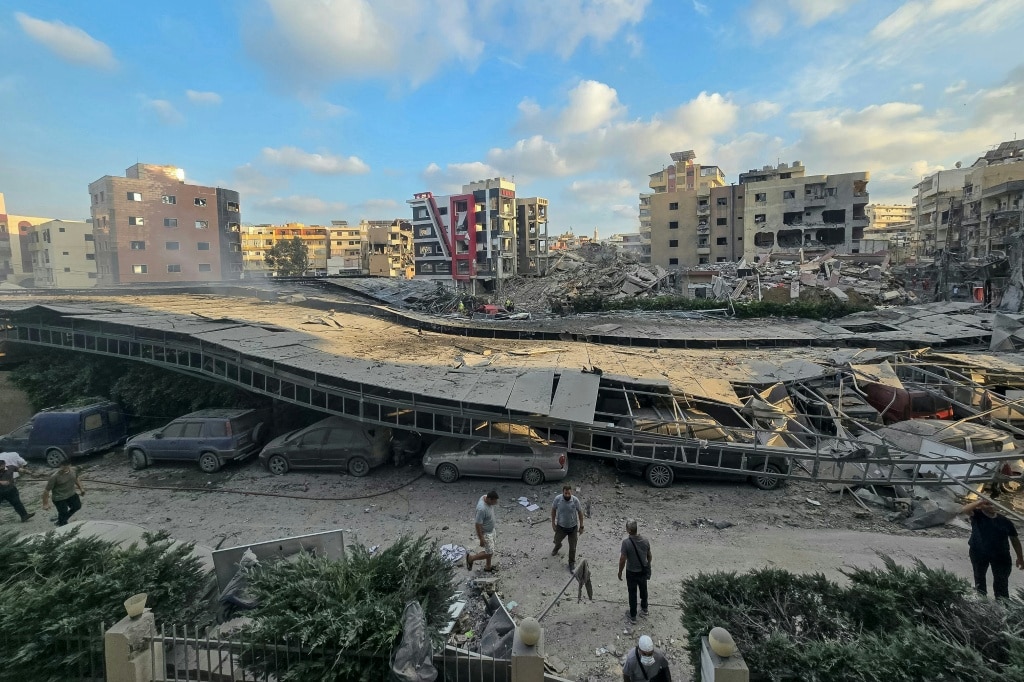
Just hours after U.S. President Donald Trump announced a surprise bilateral ceasefire agreement between Israel and the Iran-backed militant group Hezbollah, heavy fighting erupted across the Israel-Lebanon border on Tuesday, derailing hopes for a quick end to months of escalating violence.
The sudden resumption of hostilities came as both sides remained publicly divided over the terms of the deal Trump claimed to have brokered. Per Lebanese official sources, the draft agreement outlines that Hezbollah would halt all cross-border fire into northern Israel, while Israel would end its airstrikes on southern Beirut – a decades-long stronghold of the militant movement. The Lebanese presidency issued an official statement confirming the terms, noting that negotiators would work to expand the truce to cover all Lebanese territory, and the Lebanese embassy in Washington earlier claimed Hezbollah had accepted the U.S. proposal. However, the militant group has never issued an official confirmation of its acceptance of the deal.
Trump doubled down on his ceasefire push in a post to his Truth Social platform, saying he “hopefully” the two sides would end their conflict “for ETERNITY!” He also claimed that no Israeli troops would enter Beirut, and that any Israeli forces en route to the capital had already been turned back, following what he called a “very productive” call with Israeli Prime Minister Benjamin Netanyahu. But unconfirmed reporting from Axios contradicted this public posture, revealing that Trump privately called Netanyahu “fucking crazy” in off-air remarks, accusing the Israeli leader of putting planned peace talks between the U.S. and Iran at risk. Trump also claimed he held a productive call with Hezbollah representatives through intermediaries, saying both sides had agreed to a full halt to hostilities.
The renewed violence erupted against a backdrop of months of escalating conflict that has already pushed the region to the brink of a wider war. Following the killing of Iran’s supreme leader, Hezbollah opened its front against Israel on March 2, launching widespread rocket attacks. In recent weeks, Israeli forces mounted their deepest ground incursion into Lebanese territory in more than two decades, carrying out waves of heavy aerial bombardment across southern Lebanon and issuing explicit threats to strike southern Beirut’s densely populated suburbs. That threat sent thousands of local residents fleeing the area this week, with massive traffic jams clogging routes leading out of the suburbs toward central Beirut, according to on-the-ground reporting from Agence France-Presse.
By Tuesday afternoon, multiple official sources confirmed that hostilities had resumed. The Israeli military announced its air defense systems intercepted two projectiles launched from Lebanon into northern Israel, shortly after the Lebanese National News Agency reported fresh Israeli airstrikes targeting multiple locations in southern Lebanon. Netanyahu confirmed in his call with Trump that Israel would continue to strike terrorist targets in Beirut if Hezbollah did not end its attacks on Israeli towns and civilians.
The latest clash also comes as the fourth round of U.S.-hosted direct negotiations between Israeli and Lebanese military delegations is set to open this Wednesday, following preliminary security talks held last week. A previous truce brokered in April has been almost entirely ignored, with both sides accusing each other of daily violations that justify retaliatory strikes. The human cost of the conflict has mounted sharply: Lebanon’s health ministry reports that at least 3,433 people have been killed in Israeli attacks across Lebanon since March 2, while the Israeli military confirmed two additional soldier deaths in southern Lebanon this week, bringing the total Israeli military fatalities to 27 since the start of the current escalation.
International actors have moved quickly to call for restraint. Stephane Dujarric, spokesperson for United Nations Secretary-General Antonio Guterres, released a statement urging all parties to respect a cessation of hostilities. In a confidential report to the UN Security Council obtained by AFP, Guterres also recommended that the UN Interim Force in Lebanon (UNIFIL) peacekeeping mission have its mandate extended when it expires at the end of the year, warning that a withdrawal would create a dangerous security vacuum. French Foreign Minister Jean-Noel Barrot also issued a statement Tuesday saying nothing could justify Israeli forces maintaining their presence deep inside Lebanese territory, a reference to Israel’s seizure of the strategic Beaufort Castle (locally called Qalaat al-Chakif) over the weekend. The castle, which holds commanding views over most of southern Lebanon, was used as an Israeli military base during Israel’s 22-year occupation of southern Lebanon that ended in 2000.
Tehran, which has long provided financial and military support to Hezbollah, has insisted that Lebanon must be included in any final peace deal between Iran and the U.S. But Iran’s state-owned Tasnim News Agency reported this week that Tehran has suspended all diplomatic talks with Washington in response to Israel’s ongoing offensive in Lebanon, raising new doubts about the prospect of a wider regional de-escalation. For ordinary residents caught in the crossfire, the cycle of hope and violence has become a familiar pattern. Hadi, a 24-year-old resident of southern Beirut, told AFP he had dared to hope for a period of stability after Trump’s announcement, but “that feeling did not last long.”