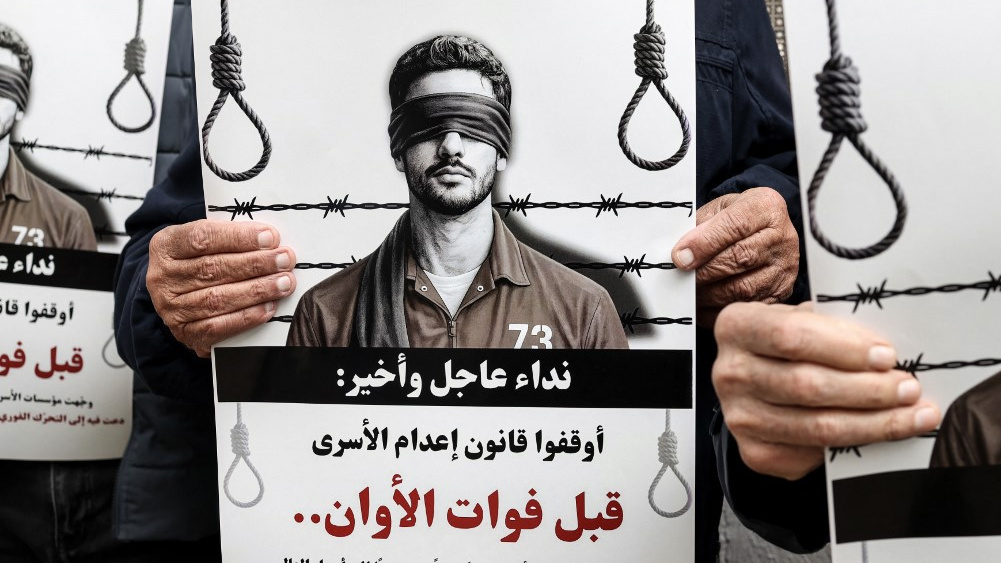
On Sunday, Israel formally activated a controversial new law that mandates the death penalty as the default sentence for Palestinians convicted of killing Israelis in the occupied West Bank, following the signing of a required military order by Central Command Major General Avi Bluth.
Under the terms of the new regulation, Israeli military courts — the only judicial bodies with jurisdiction over Palestinian residents of the West Bank — are required to hand down death sentences to Palestinians found guilty of murdering Israeli occupation soldiers or civilians. Life imprisonment can only be applied in rare, explicitly defined exceptional circumstances, shifting the entire sentencing framework to favor capital punishment as the standard outcome.
First approved by Israeli lawmakers in March, the legislation codifies a dual-track legal system that operates exclusively along identity lines in the occupied territory. Israeli citizens and permanent residents living in West Bank settlements fall under the jurisdiction of Israeli civilian courts, and are thus entirely exempt from the new law’s provisions. This separation reinforces a longstanding legal structure that has been widely labeled by human rights groups as an apartheid system.
The law’s wording further expands its reach to target acts of Palestinian resistance to occupation: one of the criteria for applying the death penalty requires only that the convicted person’s act was intended to “negate the existence of the State of Israel or the authority of the military commander in the area” — a broad standard that human rights advocates say overwhelmingly criminalizes Palestinians opposing Israeli occupation.
Top Israeli officials have welcomed the activation of the measure, framing it as a critical tool to counter Palestinian resistance. National Security Minister Itamar Ben Gvir, leader of the far-right Jewish Power party, celebrated the order as a campaign promise fulfilled. “We promised and we fulfilled,” Ben Gvir said, adding, “we do not capitulate or contain murderous terrorism, we defeat it.” Israeli Defence Minister Israel Katz also endorsed the move.
The new law has sparked fierce condemnation from Palestinian, Israeli, and international human rights organizations, which warn it formalizes systematic discrimination against Palestinians and erases what remains of their basic legal protections. Critics say the policy deepens the already entrenched apartheid-style dual legal regime in the West Bank, where two separate populations live side by side under entirely separate systems of justice.
Multiple human rights groups have labeled the move a dangerous escalation of Israeli repressive policy in the occupied territories, pointing to a sharp surge in mass arrests of Palestinians on broad, vague security charges in recent months. Since the intensification of Israel’s military campaign in Gaza, rights monitors have also documented a steep rise in reports of torture, abuse, and deaths of Palestinian detainees in Israeli custody.
Palestinian prisoners’ rights organizations have described the legislation as an “unprecedented act of savagery,” accusing Israel of codifying state violence against detainees at a time when conditions for Palestinian prisoners have deteriorated dramatically. Even leading Israeli human rights advocacy groups, including Adalah, the Public Committee Against Torture in Israel, HaMoked, and Physicians for Human Rights-Israel, have joined the condemnation, warning the law creates a deliberately “discriminatory punitive framework” that denies Palestinians equal protection under the law and removes legal safeguards against abuse.