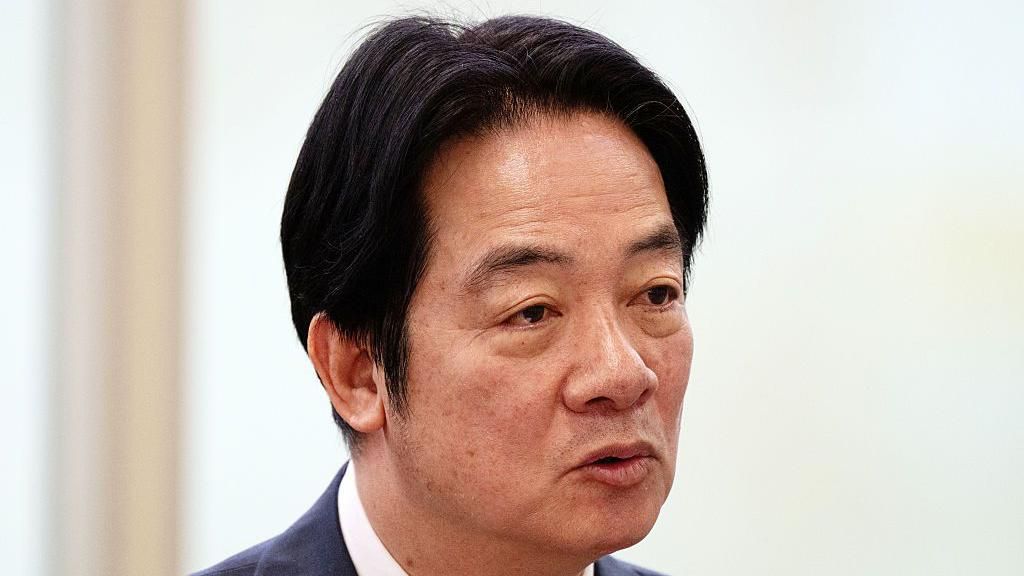
Following the high-profile summit between U.S. President Donald Trump and Chinese leader Xi Jinping that centered heavily on cross-Strait tensions, Taiwan’s leader Lai Ching-te has issued his first public direct response, laying out the island’s stance while emphasizing the critical need for the United States to maintain its longstanding arms sales policy to Taiwan.
During the meeting, Chinese state media reported that Xi framed the Taiwan issue—where Beijing claims the self-governing democratic island as an inalienable part of its territory—as the single most consequential matter in bilateral U.S.-China ties. Xi warned that mishandling the question of Taiwan could open the door to direct conflict between the two major global powers. After wrapping up his trip to Beijing, Trump made his own position clear in an interview with Fox News, stating he did not support any move toward formal Taiwan independence, while adding that U.S. policy toward the island had not shifted, and he had no intention of provoking a confrontation with Beijing. Trump also noted that Xi held deeply entrenched views on the Taiwan issue, but he had made no binding commitments to China on the matter during their talks.
For years, under the administrations of Lai Ching-te and his predecessor Tsai Ing-wen, Taiwan’s government has held the position that no formal declaration of independence is necessary, as the island already considers itself a sovereign nation. Lai reiterated this long-held stance in a public post on his Facebook page, his first direct public comment following the Trump-Xi summit. He wrote, “Taiwan, the Republic of China, is a sovereign and independent democratic country,” and added that “Taiwan’s future must follow the will of all the Taiwanese people.” Public opinion data consistently shows that a majority of Taiwan’s residents identify as citizens of a sovereign nation, though most also support maintaining the current cross-Strait status quo: rejecting both immediate unification with China and an official formal declaration of independence.
Beijing has repeatedly condemned Lai, labeling him a dangerous “troublemaker” and a threat to cross-Strait peace. In his Facebook post, Lai pushed back against these characterizations, emphasizing that Taiwan has no intention of initiating aggression or escalating tensions. “Taiwan will not provoke, will not escalate conflict, but will not under pressure give up national sovereignty and dignity, as well as the democratic and free way of life,” he wrote. He further clarified that Taiwan is a committed defender of the existing cross-Strait status quo, not a party seeking to unilaterally alter the current arrangement. Lai added that Taiwan is open to holding healthy, structured exchanges and dialogue with Beijing, as long as those talks take place on the basis of equal dignity and mutual respect. However, he firmly rejected Beijing’s practice of framing dialogue under the precondition of “unification” as a pretext to coerce Taiwan into accepting its terms.
This position echoes an earlier statement from Lai’s presidential spokesperson, who affirmed that it is self-evident Taiwan is a sovereign, independent democratic nation, and the government remains dedicated to upholding the cross-Strait status quo. For its part, Beijing has consistently stated it prefers peaceful reunification with Taiwan, but has never formally ruled out the use of military force to bring the island under its control. In recent years, Beijing has ramped up military pressure on Taiwan, conducting regular large-scale military drills—including simulated blockades of the island—around Taiwan’s territorial waters and airspace.
For more than four decades, the United States has supplied defensive arms to Taiwan under the terms of the Taiwan Relations Act, a U.S. law that requires the U.S. to provide Taiwan with the means to defend itself against potential aggression. The U.S. remains Taiwan’s most powerful international ally and its largest supplier of military equipment. In December prior to the summit, the Trump administration approved a massive $11 billion arms package for Taiwan, one of the largest single arms deals in the history of U.S.-Taiwan relations. That approval drew sharp condemnation from Beijing, which has long opposed all U.S. arms sales to the island.
After leaving Beijing, Trump told reporters aboard Air Force One that he had discussed the proposed arms sale in great depth with Xi, and would make a final decision on whether to move forward with the transaction later. When pressed on the longstanding 1982 U.S. commitment that it would not consult Beijing on arms sales decisions to Taiwan, Trump dismissed the commitment, noting the 1980s were “a long time ago.”
Over the weekend following the summit, Lai expressed gratitude to Trump for his continued support for peace across the Taiwan Strait, and reaffirmed that sustained U.S. arms sales are non-negotiable for regional stability. “Given that China has never given up the use of force to annex Taiwan and continues to expand its military power to try to change the regional and cross-strait status quo, America’s continued sale of arms to Taiwan and deeper U.S.-Taiwan security cooperation is necessary and a key factor in maintaining regional peace and stability,” Lai wrote.