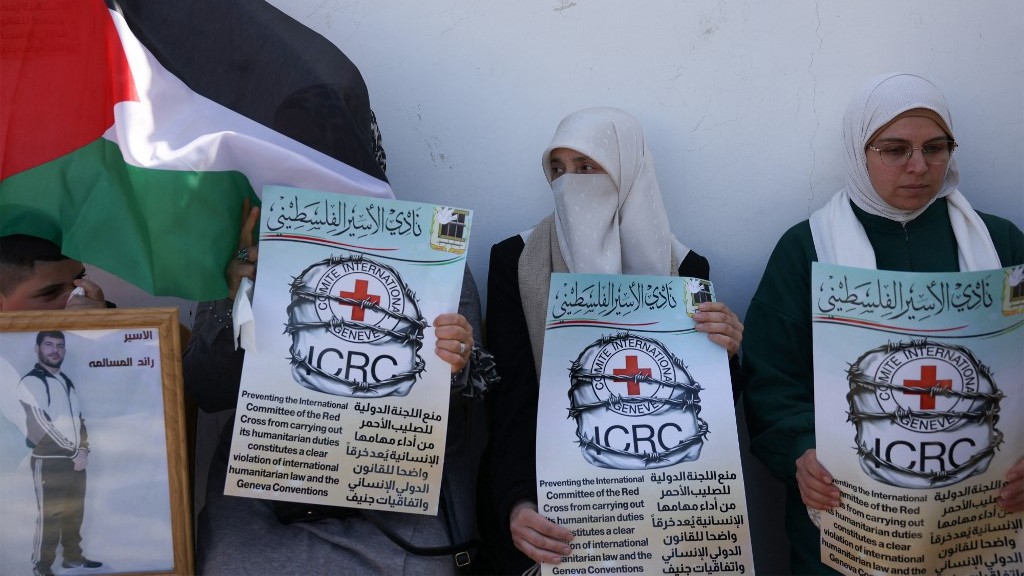
In a direct challenge to a recent Israeli High Court of Justice ruling that deemed a prior access ban unlawful, Israeli authorities have implemented sweeping new restrictions that effectively expand a blanket ban on International Committee of the Red Cross (ICRC) access to Palestinian captives held in Israeli prisons.
Last week, Israel Prison Service (IPS) Commissioner Kobi Yaakobi formalized the new sweeping regulations, which impose far-reaching limits on the humanitarian organization’s ability to carry out routine visits to detained Palestinians. Under the updated rules, Red Cross representatives are barred entirely from visiting multiple categories of Palestinian captives under any circumstances. This total ban applies to detainees the IPS labels as “highly violent”, as well as those held in solitary confinement and prisoners currently undergoing interrogation.
For the remaining detainees who are not subject to a total ban, visits are capped at just 30 minutes per meeting, and prison commanders retain full authority to cut humanitarian visits short at their own discretion without formal oversight. Additional constraints further restrict access: the Red Cross is only permitted to conduct one round of visits per quarter, and the organization is required to submit a pre-approved list of no more than five captives it intends to meet with ahead of any visit.
This latest policy shift directly defies a High Court order issued last month, which compelled the Israeli state to restore Red Cross access to Palestinian captives after an initial blanket ban was introduced immediately following the October 7, 2023 attacks in southern Israel. In a brief official statement defending the new measures, the IPS asserted that “The agency operates in accordance with the law. If any allegation is raised, it should be addressed through the appropriate channels.”
The new restrictions come just weeks after a parliamentary bill that would have formally codified a total ban on Red Cross visits failed to pass in the Israeli Knesset, falling in a 36-41 vote. The bill failed after ultra-Orthodox Haredi coalition parties boycotted the vote in protest over the ruling government’s failure to advance legislation key to their own policy agenda, in a move unrelated to the Red Cross access debate.
This report was originally published by Middle East Eye, an outlet that provides independent, on-the-ground coverage and analysis of the Middle East, North Africa and surrounding regions.