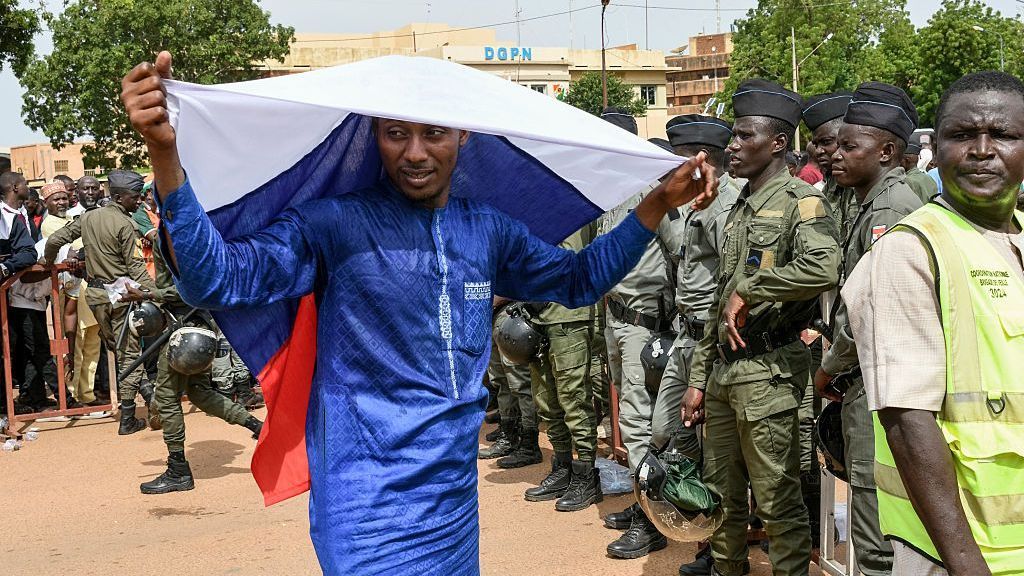
Last Saturday, a violent mutiny by dissident soldiers targeting a key strategic military installation in Niamey, Niger’s capital, brought Russia’s expanding regional footprint into sharp focus. In the aftermath of hours of fierce overnight clashes, Russia’s state-controlled Africa Corps stepped in to assist Niger’s ruling junta, helping pro-government loyalist forces retake full control of Air Base 101 at Diori Hamani International Airport.
Unlike its predecessor, the notorious private mercenary group Wagner, Africa Corps operates under the direct command of Moscow’s Ministry of Defence, with an estimated 200 to 300 personnel currently deployed across Niger. Russia’s ambassador to Niamey, Viktor Voropaev, publicly confirmed the intervention, confirming that Russian troops helped suppress the attempted uprising.
Security analysts frame the successful quashing of the mutiny as a pivotal symbolic victory for Moscow that extends its influence far beyond its stated mission of countering jihadist insurgency. For the military leaders that hold power in Niger, Mali and Burkina Faso, Russia now provides a far more critical service: direct protection for the regimes themselves.
“This is seen as a symbolic victory that will continue to put them at the centre of not just the counter-insurgency campaign, but even in the protection and prolongation of military rule,” explained Beverly Ochieng, a senior analyst at global risk consultancy Control Risks. While the intervention was not enough to resolve long-term instability in the country, Ochieng notes it provided a critical political lifeline for Niger’s junta, while also laying bare the regime’s deep dependence on Moscow for its very survival.
This is not the first time Africa Corps has intervened at the same airport: the group also played a central role in repelling a major extremist attack on the site in January 2025. Jacob Boswall, a security analyst who monitors jihadist activity for BBC Media Monitoring, says there is clear evidence that Africa Corps’ intervention was decisive in both cases. “Probably there is some substance to the claim that Africa Corps was able to restore power in that case [in January]. And I think, again, in this case as well, that intervention was very significant,” he said.
Niger’s current junta, led by General Abdourahamane Tiani, seized power in a July 2023 coup, justifying its takeover by pointing to the deteriorating security crisis and the failure of ousted elected president Mohamed Bazoum’s civilian administration to curb jihadist violence. The junta also publicly blamed Western partners for their inability to contain the spread of militant activity. Three years on, however, the insurgency remains entirely unresolved: militants linked to al-Qaeda and the Islamic State continue to launch regular deadly attacks across the Tillabéri and Dosso regions, inflicting heavy losses on Niger’s security forces.
Ochieng emphasizes that this latest mutiny stems from long-simmering grievances within Niger’s own military, compounded by relentless operational pressure on frontline counter-insurgency troops. “Counter-insurgency forces do not feel adequately supported by the military government,” she said. “There have been challenges in providing equipment and replenishments.” Today, Niger’s government faces threats on two separate fronts: extremist insurgents attacking state institutions from outside, and growing discontent within the very armed forces tasked with fighting that insurgency. While Africa Corps helped contain the internal threat this past weekend, it has yet to make meaningful progress against the extremist campaign.
Unlike the Wagner Group, whose private status allowed Moscow to maintain plausible deniability for its operations, Africa Corps is an overt instrument of Russian state power. “The whole point of Africa Corps is that it brings the power back under the control of the Russian Ministry of Defence,” Boswall noted. While the group’s official mandate is to support Sahel governments to combat Islamist militancy, the mutiny’s outcome sends a clear message to any dissidents considering challenging allied regimes across the region: Russian forces must now be factored into any planned unrest.
Analysts agree Russia has no plans to withdraw from the Sahel in the near term. Moscow’s interests in the region are explicitly transactional: in exchange for security support for allied military regimes, Russia gains access to critical natural resources. In Mali, that commodity is gold; in Niger, it is uranium, a key energy resource Russia has prioritized protecting. Beyond economic gains, Moscow also benefits from the diplomatic support of these friendly regimes in international forums, bolstering Russia’s global standing.
Like their counterparts in Mali and Burkina Faso, Tiani’s government has built its domestic legitimacy around a narrative of national sovereignty, pan-Africanism, and liberation from the influence of former Western colonial powers. All three regimes expelled French troops, formed the Alliance of Sahel States (AES), and withdrew from the Economic Community of West African States (ECOWAS), framing the new bloc as an assertion of regional independence. This narrative, however, stands in stark tension with the junta’s growing dependence on Moscow. Ochieng notes that the military governments argue they have chosen the partnership with Russia on their own terms, framing Moscow as a partner that respects their sovereignty, in contrast to former colonial power France, the European Union, and the United States.
In the wake of the mutiny, a Nigerien military captain appeared on state television to accuse Western powers including France and Chad of orchestrating the unrest, while Russia’s foreign ministry labeled the mutineers “extremists seemingly incited by European former colonial powers”. France has repeatedly denied all accusations of attempting to destabilize Niger, while Chad’s government has not responded to requests for comment. Boswall argues that Niger’s junta deliberately downplays Africa Corps’ central role in the country’s security while overemphasizing its narrative of resource nationalism and independent anti-jihadist action, as part of a broader regional battle for control of public narrative.
Russia’s ongoing full-scale war in Ukraine continues to shape the parameters of its Sahel strategy. The conflict consumes the vast majority of Russia’s military personnel and equipment, limiting Moscow’s ability to expand large-scale operations in Africa. “It’s quite a tightrope for Russia because ultimately its priority will always be Ukraine,” Ochieng explained. “It will maintain at least enough numbers to allow it to reassure the military governments in the Sahel that it continues to be a reliable partner. They’ll continue to deploy just enough weapons and supplies and logistics… to continue supporting Africa Corps.”
That support has clear limits: Moscow cannot afford to launch a sustained large-scale counter-offensive to eliminate insurgent control across the Sahel’s vast territory. This reality helps explain why protecting allied regimes has emerged as the core of Russia’s regional strategy. Defending a capital or helping crush a mutiny requires far fewer resources than recapturing and holding huge swathes of insurgent-held territory. “These are quite limited interventions, but with an outsized impact,” Boswall said. “I think at that level they’ll be able to sustain that over the foreseeable future, even with the war in Ukraine.”
While Russia’s intervention allowed Tiani to survive this latest challenge to his rule, it has done nothing to resolve the deep-seated grievances and structural vulnerabilities that fueled the mutiny in the first place. The conditions that could spark another challenge to the junta remain firmly in place.