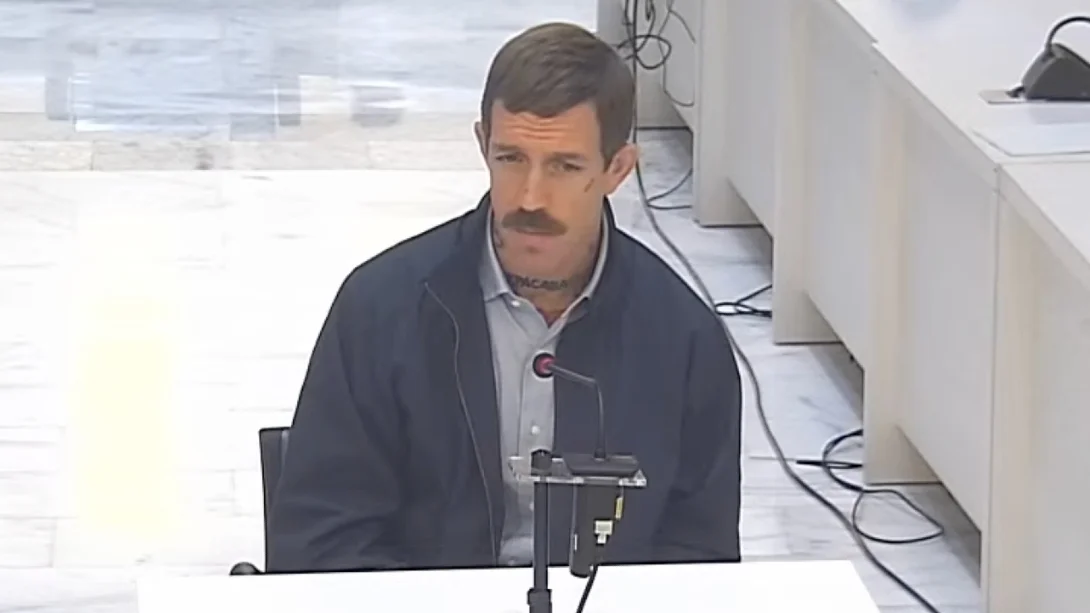
A high-profile cross-border law enforcement operation linked to the extradition case of left-wing American pro-Palestine donor Fergie Chambers has unfolded across two European nations, drawing widespread scrutiny from legal representatives and human rights observers. As first documented by the Irish Times, officers from An Garda Síochána’s Special Branch unit forcibly entered the Dublin residential property shared by Chambers and his partner, artist and activist Stella Schnabel, earlier this week, acting on an official assistance request from the former Trump administration’s U.S. authorities. Law enforcement personnel smashed through the property’s entry doors to gain access, before confiscating a wide range of personal assets including mobile phones, laptops and other electronic storage devices, alongside multiple items of personal clothing. Officers notified Schnabel during a post-raid phone call that she would be responsible for arranging and funding repairs to the damaged doors themselves. Schnabel publicly condemned the unannounced raid in a statement, describing the experience as deeply traumatizing and framing the operation as a reckless, unsubstantiated “fishing expedition” by U.S. officials desperate to uncover supplementary evidence to prop up their otherwise weak case against Chambers. Lead legal counsel for both Chambers and Schnabel, Ciarán Mulholland, has formally challenged the legality of the entire search and seizure operation, noting that Irish law enforcement failed to provide any documentation confirming they held a valid search warrant, or to specify what statutory legal authority they relied on to carry out the raid. Mulholland has submitted a formal written submission to An Garda Síochána’s national leadership, demanding full disclosure of the specific warrant used for the operation, a complete itemized inventory of every item seized from the property, and a full formal response to all questions raised within a seven-day window. He has explicitly warned that if no satisfactory substantive reply is received within that timeframe, his legal team will file for full judicial review of the operation at Dublin’s High Court, potentially leading to the seizure being ruled unlawful and all confiscated materials ordered to be returned. The raid in Ireland is just one strand of a sprawling, controversial U.S. investigation centered on Chambers, who was detained in Spain earlier this year and has remained in Spanish custody while local courts deliberate on Washington’s formal extradition request. If ultimately extradited to the United States and convicted on the top charge of international money laundering, Chambers faces a maximum statutory prison sentence of 20 years. Multiple independent outlets have uncovered irregularities in the U.S. extradition filing that have raised serious questions about the legitimacy of the case. Reporting from The Intercept earlier this month, citing documents provided by Chambers’ Spanish legal defence team, revealed that the entire U.S. criminal case against the philanthropist is based on a single sworn complaint signed by an individual FBI agent, rather than a formal indictment issued by a sitting federal grand jury – a departure from standard U.S. extradition procedure that legal experts have described as highly anomalous. Court documents confirm that U.S. prosecutors have openly acknowledged they intend to seek a formal grand jury indictment only after Chambers is physically extradited onto U.S. soil. Additional reporting from Middle East Eye confirmed that two U.S.-based pro-Palestine activists, Bridget Shergalis and Sophie Ross, have already refused to provide testimony before a federal grand jury convened in New Hampshire as part of the ongoing investigation tied to Chambers’ case. Parallel developments in Spain have thrown further major hurdles in the path of Washington’s extradition push. Just days after the Dublin raid, Spain’s national appeal court granted Chambers conditional provisional bail, allowing him to await the final extradition decision outside of formal pre-trial detention, under a set of strict monitoring requirements. The ruling came shortly after Spain’s central National Court announced it had formally extended its deadline to issue a final extradition ruling, after identifying critical errors in the Spanish translation of the U.S. government’s submitted case files. During a high-profile public extradition hearing last Friday – the first time Chambers had appeared in open court since his initial arrest in Spain – the U.S. Department of Justice conceded that it had made “substantial, material alterations” to the original English case documents during the translation process. Chambers’ defence team argued during the hearing that these deliberate changes were designed to manipulate presented evidence and artificially inflate the perceived severity of the allegations against their client. Chambers himself addressed the Spanish court directly during the hearing, explaining that his financial support for humanitarian relief operations in the Gaza Strip stemmed from his core belief that the Israeli military campaign in the Palestinian territory represented “the defining moral question of our era.” His legal team has since filed a formal motion with the National Court, requesting permission to submit a previously denied 345-page expert export analysis report, and demanding that the court appoint an independent, court-certified translator to produce a new, impartial translation of all U.S. case documents, before conducting a full reassessment of whether the original U.S. extradition request meets minimum legal reliability standards under Spanish and European law.