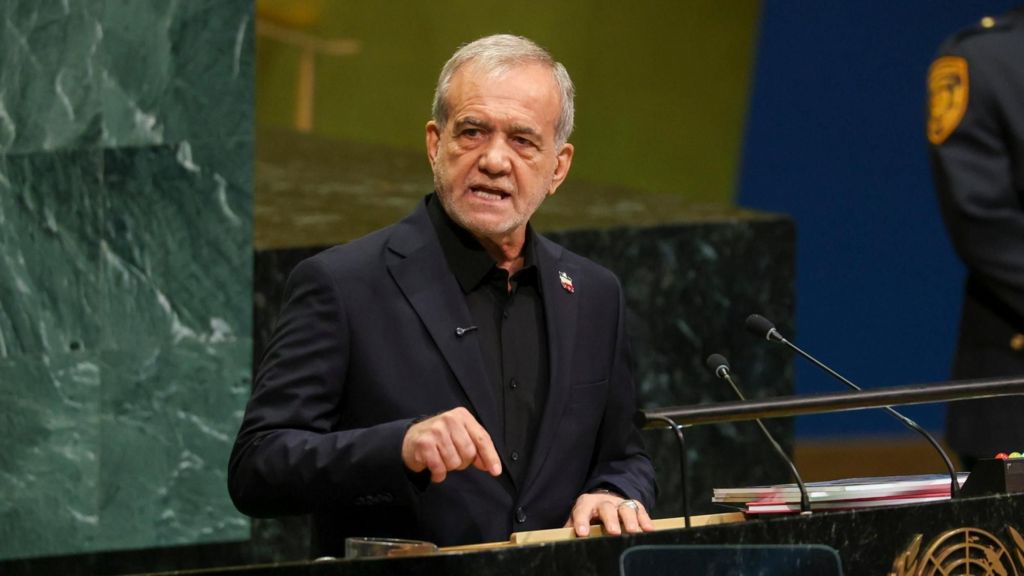
Seven months into open conflict between Iran, the United States, and Israel, Iran’s newly inaugurated President Masoud Pezeshkian delivered a defiant yet open message to the global community from the floor of the United Nations General Assembly this week. Reaffirming Iran’s unyielding stance in the face of intensifying pressure from Washington, Pezeshkian declared that the Islamic Republic would never “bend the knee” — but stressed that Tehran remains committed to pursuing a diplomatic resolution to the ongoing hostilities.
His address came in direct response to a recent threat from U.S. President Donald Trump, who warned that he would “annihilate” the Islamic Republic if a new negotiated deal was not reached in short order. Pushing back against this rhetoric, Pezeshkian emphasized that U.S. strategy of escalating sanctions, pressure campaigns, and international bullying would only strengthen Iranian public resolve. “He must know that the resistance of the Iranian people will only increase in the face of sanctions, increased pressure, increased bullying,” Pezeshkian told the assembled delegates.
The Iranian president laid out non-negotiable conditions for any lasting agreement, chief among them a full end to the U.S. naval and economic blockade of Iranian ports and shipping. Pezeshkian argued that Iran could not accept a deal that locks its commercial vessels out of key regional waterways while other nations benefit unimpeded. “It cannot be the case that everyone benefits from the Strait of Hormuz while we are denied access,” he said.
The strategic Strait of Hormuz, which normally carries roughly 20% of the world’s annual oil and natural gas shipments, has been effectively closed to commercial navigation since the outbreak of hostilities in late February. The closure stems from two overlapping factors: Iranian drone and missile attacks on transiting commercial vessels, and the U.S. naval blockade imposed in response.
This is not the first attempt at diplomacy to de-escalate the crisis. A preliminary agreement to end hostilities and reopen the strait was reached between U.S. and Iranian negotiators in June, but the deal collapsed within weeks. After Iran resumed attacks on commercial shipping, the United States reimposed its full blockade.
Even so, diplomatic efforts have resumed on the sidelines of this year’s UN General Assembly in New York. On Tuesday, Iranian Foreign Minister Abbas Araghchi and U.S. special envoy Steve Witkoff held indirect talks mediated by Qatari brokers. This meeting marked the first formal diplomatic contact between the two sides since the June agreement collapsed.
Witkoff struck an optimistic note following the discussions, telling reporters he hoped the talks would “prove constructive and promising” and confirming that Qatari mediators would continue their work to bridge the gap between the two parties. But Iranian foreign ministry spokesman Esmail Baqai struck a more cautious tone, describing the discussions as “not anything new” and confirming that Araghchi had held firm to Iran’s core preconditions: an end to the U.S. blockade, and the release of billions of dollars in frozen Iranian assets held abroad.
The renewed diplomatic push comes amid growing global concern over the economic impact of the Strait of Hormuz closure, which has sent ripples through global energy markets and raised fears of a broader regional conflict that could draw in additional powers.