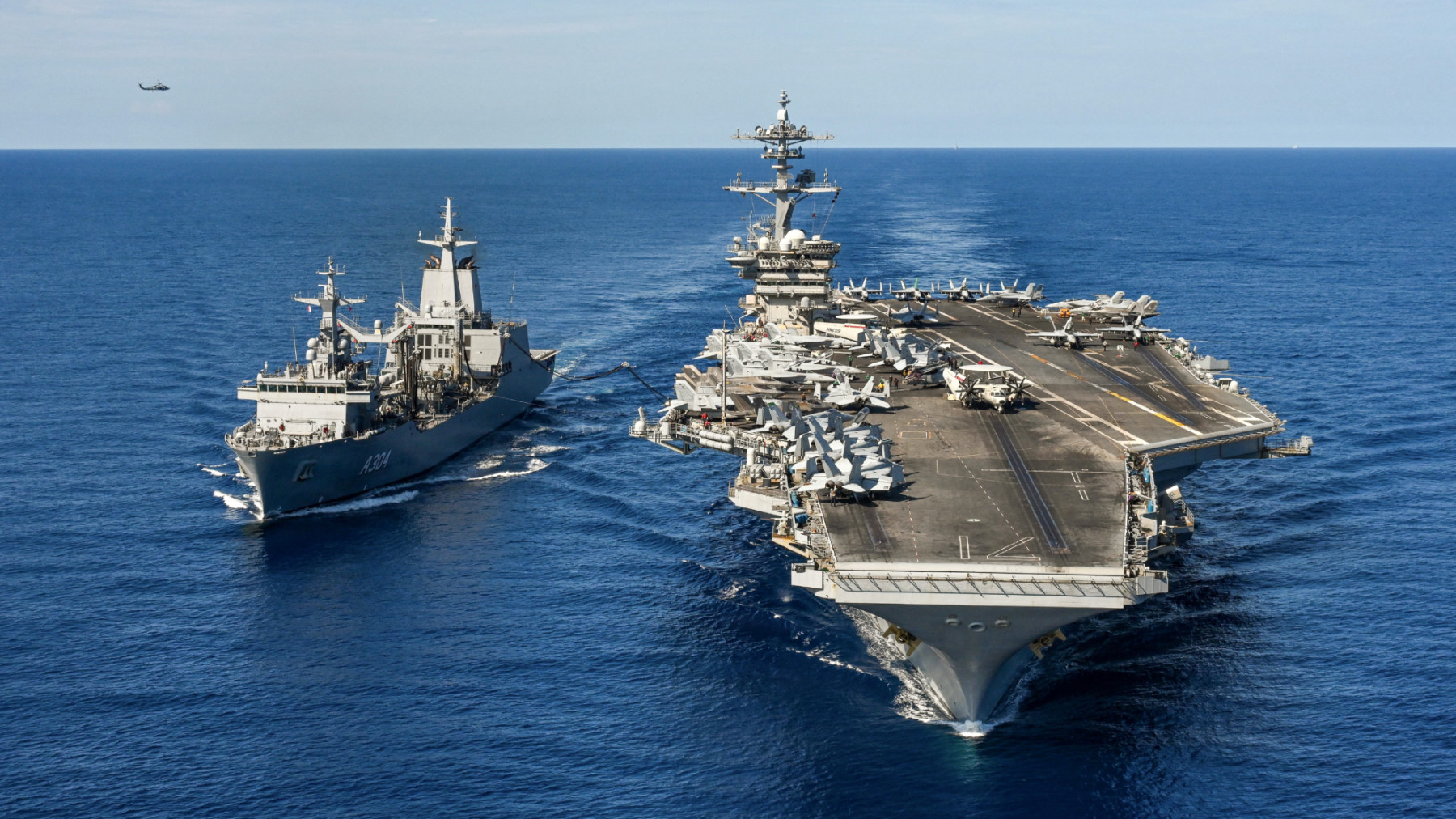
A flurry of hardline statements, media pushback, and escalating security rhetoric has emerged from Iran’s political and diplomatic circles, as the country navigates a volatile impasse with the United States and Israel that many regional analysts describe as a precarious “neither war nor peace” limbo. Amir Hayat-Moqaddam, a sitting member of Iran’s parliamentary National Security Commission, made incendiary remarks to local daily 7 Sobh arguing that a pre-emptive strike on U.S. aircraft carriers deployed 700 to 800 kilometers east of the strategic Strait of Hormuz is an “absolute necessity” to break the long-running stalemate between Tehran and Washington. The legislator insisted that targeted strikes to damage and expel U.S. naval assets from the region would demonstrate Iran’s military deterrence, and claimed that Washington must be made to understand it would suffer far greater losses in any full-scale renewed conflict. He went further to dismiss the viability of productive bilateral negotiations with the U.S., framing diplomatic engagement as nothing more than a performative step to prove to domestic and global audiences that Tehran has no interest in initiating war, citing two past instances where Iran came under direct attack while engaged in ongoing talks with American counterparts. This call to pre-emptive action is far from an isolated position: multiple Iranian political figures have echoed similar demands in recent public debates, as officials grapple with how to respond to credible threats of joint military action from the U.S. and Israel.
Parallel to the debate over military posture, a widely criticized New York Times report that claimed Iran’s national dam network was partially constructed to support hidden underground missile facilities has drawn fierce pushback from independent experts and senior state officials alike. Kaveh Madani, director of the United Nations University Institute for Water, Environment and Health – a globally respected Iranian scientist who was even named as a source in the original Times piece – took to social media platform X to condemn the reporting as irresponsible, noting that spatial proximity between dams and military sites does not equal causal proof of a military purpose for civilian water infrastructure. He emphasized that even past adversaries that have carried out attacks on Iranian soil never floated such unsubstantiated claims, warning that the sensational, reductionist narrative put civilian critical water infrastructure at severe risk of targeting. Madani later expanded his critique in a published Forbes op-ed, reiterating that no empirical evidence exists to link Iran’s public water management projects to missile deployment. Iran’s Parliament Speaker Mohammad Baqer Ghalibaf also weighed in, noting that if the international community accepts the Times’ flawed logic, Tehran would be justified in classifying all dams, ports, and power plants located near U.S. or Israeli military bases as dual-use military targets.
Critics of the flawed reporting also drew explicit parallels to the lead-up to the 2003 Iraq War: BBC journalist Shabnam Shabani shared a 2004 Guardian report documenting the New York Times’ public admission that its pre-invasion coverage of Iraq’s alleged weapons of mass destruction program was riddled with unsubstantiated sourcing and editorial failures that helped justify a catastrophic, years-long conflict.
Conservative Iranian daily Jam-e Jam has also launched a sharp public campaign against the International Atomic Energy Agency (IAEA), following the circulation of the agency’s latest confidential member-state report that raised alarms over restricted inspector access to Iranian nuclear sites, particularly the Isfahan enrichment facility, and confirmed that the IAEA can no longer independently verify the full scope of Iran’s enriched uranium stockpiles. The publication’s political desk editor Abdolreza Hadi-Zadeh Naeini published a front-page piece headlined “No to IAEA Espionage”, claiming that the agency’s inspection regime is being exploited by the U.S. and Israel to conduct covert intelligence gathering on Iranian nuclear assets. Naeini framed the critical IAEA report as a deliberate political maneuver, pointing out that the U.S. and Israel’s June 13, 2025, military strikes on Iran blocked a previously scheduled inspection of the Isfahan site, and that the agency has failed to hold those parties accountable for disrupting its oversight work. The editorial board of Jam-e Jam went as far as to urge the Iranian government to formally withdraw from the Treaty on the Non-Proliferation of Nuclear Weapons (NPT) and revise the country’s public nuclear doctrine, a position that has gained growing support among hardline conservative political factions in recent weeks.
Adding to the cascade of escalating warnings, another conservative daily Farhikhtegan published a detailed analysis arguing that any future full-scale conflict between Iran, the U.S. and Israel will not be limited to the borders of the Middle East, and will instead extend to European territories. The paper cited public statements from Mohsen Rezaei, the head of Iran’s Supreme National Security Council, who reaffirmed that Tehran will launch retaliatory strikes against “any point from which aggression against Iran originates”, a warning that explicitly includes European nations. Farhikhtegan specifically named two UK and Cypriot military bases – RAF Fairford and Akrotiri – as sites that have already been used to launch direct offensive operations against Iran, and listed additional military facilities in Portugal, Germany, France, Italy and Greece that provide logistical and operational support for U.S. and Israeli missions targeting Iranian territory. The paper added, however, that European countries that refuse to allow their territory to be used for anti-Iran military operations would not face retaliatory strikes, pointing to examples including Spain, which has publicly opposed the potential conflict despite repeated threats from former U.S. President Donald Trump, and Bulgaria, where local public and media pushback has delayed government plans to approve permanent U.S. military deployments. These latest warnings build on earlier statements from two other major Iranian publications, Hamshahri and Kayhan, which last week mapped U.S. military bases across Europe as potential retaliation targets, with Kayhan explicitly warning that a new conflict could reach “the heart of Europe”.