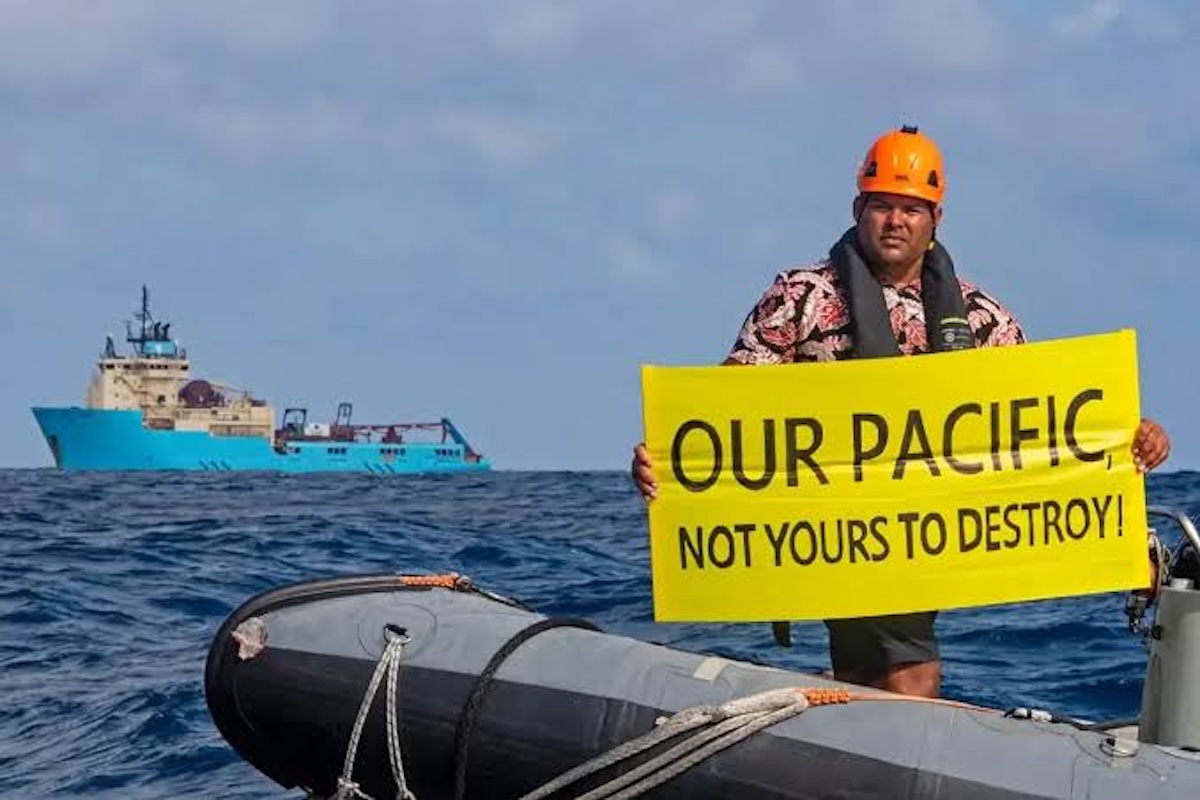
Defying a recent federal judicial finding that its earlier deep-sea mining lease approval process violated the landmark U.S. Endangered Species Act, the Trump administration moved forward Thursday to open more than 31 million acres of ocean floor in the waters adjacent to American Samoa for potential critical mineral exploration, a move critics warn will cause irreversible devastation to fragile deep marine ecosystems.
Hosted by the Department of the Interior’s Marine Minerals Administration, the landmark auction represents a core milestone in the Trump administration’s broader push to accelerate domestic seabed extraction of high-demand minerals including nickel, cobalt, copper, and manganese — raw materials that form essential components of electric vehicle batteries, consumer electronics, and other strategic industrial products. Per an Associated Press field report, the sale covered two separate, multi-million-acre seabed tracts located northeast of American Samoa’s Manua Islands. Wetstone US Ventures, a newly launched mining startup, was the sole bidder in the process, securing both 20-year leases for the mandatory minimum bid of $3 million. The awarded leases grant exclusive rights to conduct exploratory surveys and preliminary resource assessments, though full commercial extraction will require additional separate regulatory approval before any mining operations can commence.
Interior Secretary Doug Burgum framed the sale as a historic win for U.S. national security in an official public statement: “This marks the first time the United States has ever held an offshore critical minerals lease sale in the Pacific, and it is a transformative step toward strengthening America’s energy and mineral independence. Today’s action creates a formal pathway to map and evaluate the untapped resources off American Samoa’s coast, to assess whether they can help build a far more resilient, reliable domestic critical mineral supply chain for the nation.”
The auction and the administration’s accompanying deep-sea mining policy framework have sparked fierce, cross-sector pushback from environmental advocacy groups, leading marine research scientists, and Indigenous Pacific Island communities, all of whom have repeatedly warned the operations risk permanent, irreversible damage to one of the planet’s most poorly understood and ecologically vulnerable deep-sea habitats, while eroding the traditional subsistence and cultural ways of life that Samoan communities have relied on for centuries.
The sale moved forward just three days after U.S. District Judge Jill Otake, a Trump-appointed jurist based in Hawaii, issued a 41-page formal ruling that struck down the federal government’s initial environmental review for the proposed leases. Judge Otake found that the National Marine Fisheries Service had violated core provisions of the Endangered Species Act by limiting its environmental assessment exclusively to the lease auction process itself, rather than evaluating the full cumulative ecological harms that would stem from subsequent full-scale mining operations. “The court’s finding that NMFS arbitrarily and capriciously accepted this artificially narrow definition of agency action is designed to uphold the core purpose of the ESA: to prevent avoidable harm to vulnerable, at-risk species,” Otake wrote in her decision. “Extinction is a permanent, irreversible outcome, so rigorous caution and forward-looking foresight are mandatory before any regulatory action moves forward — and that level of caution can only be achieved if agencies fully examine every single potential ramification of their decisions.”
Dozens of peaceful demonstrators gathered outside the auction venue at the Ventura County Fire Department headquarters in Thousand Oaks, California, to protest the proceeding. Julia Singer, Defense Campaign Manager at global ocean conservation group Oceana, condemned the sale in a public statement: “These lease sales are the first crack in the floodgates that will unleash unregulated exploitation of our last untouched deep ocean ecosystems. The message from American Samoa’s residents, and from people across every corner of the United States, could not be more clear: we need to stop deep-sea mining before it even gets off the ground.” Singer added that the administration had deliberately ignored widespread public opposition: “Thousands of leading scientists, local elected leaders, and community members have spent years documenting the catastrophic risks deep-sea mining poses, yet the Trump administration continues to brush off this universal outcry. The U.S. government’s job is to protect the deep ocean, not rush to greenlight its destruction for corporate profit.”
Sabrina Suluai-Mahuka, founder of Finafinau, a youth-led environmental organization based in American Samoa, expressed deep intergenerational grief over the sale: “We held out hope for years that this day would never come, yet here we are, watching our ancestral ocean be auctioned off to private bidders. As a mother, I cannot and will not accept that my daughter’s future, and the futures of every generation of Samoans yet to be born, are being written off as acceptable collateral damage for an industry that our community never asked for, never consented to, and will never benefit from.” Arlo Hemphill, lead of the Oceans Are Life campaign at Greenpeace USA, noted that the sale grants the deep-sea mining industry its very first formal foothold in U.S. Pacific waters: “This administration handed the industry this opening even after a federal court confirmed it failed to properly assess the full scope of harm to endangered marine species. The industry will push relentlessly to move from these initial surveys to full exploration, then straight to commercial extraction, putting corporate profits ahead of millions of years of evolved marine life, and trampling over the culture, livelihoods, and repeated, explicit objections of Indigenous communities that have said no to this project over and over again. Once mining scrapes away seabed habitats that took tens of millions of years to form, no amount of money will ever bring them back. Congress must immediately demand the administration suspend these leases before any on-water work begins.”
David Henkin, Deputy Managing Attorney at environmental law firm Earthjustice, argued that the auction is legally invalid under Judge Otake’s earlier ruling: “The government is required to fully comply with all Endangered Species Act mandates before it can legally hold any lease sale, and they failed to meet that standard. We will use every legal tool at our disposal to aggressively pursue the full nullification of these improperly awarded leases.”
Three separate active lawsuits are currently challenging the Trump administration’s deep-sea mining regulatory framework, including a case filed by Faleula o le Manu’atele, the traditional Samoan council of chiefs, which argues that the federal government has no legitimate legal authority to lease the ocean waters surrounding their ancestral islands. Compounding these concerns, a peer-reviewed study published just last week in the journal Scientific Reports confirmed that the polymetallic nodules targeted by mining operations — rocky, mineral-dense formations scattered across the abyssal seabed — act as critical, irreplaceable habitats for countless tiny, previously undocumented organisms that live in their crevices. “Our research confirms that commercial deep-sea mining will cause the total, irreversible loss of entirely unique, undescribed biodiversity that is exclusively tied to these polymetallic nodule ecosystems,” explained Sabine Gollner, lead study co-author and professor at the Royal Netherlands Institute for Sea Research. “This critical ecological reality must be centered in all future regulatory decision-making for deep-sea mining management.” Suluai-Mahuka noted in a recent published opinion piece that more than 75,000 formal public comments were submitted in opposition to the auction, with nearly all American Samoan residents rejecting the proposed mining plans, and that the federal government never meaningfully included Indigenous community representatives in any stage of the decision-making process.