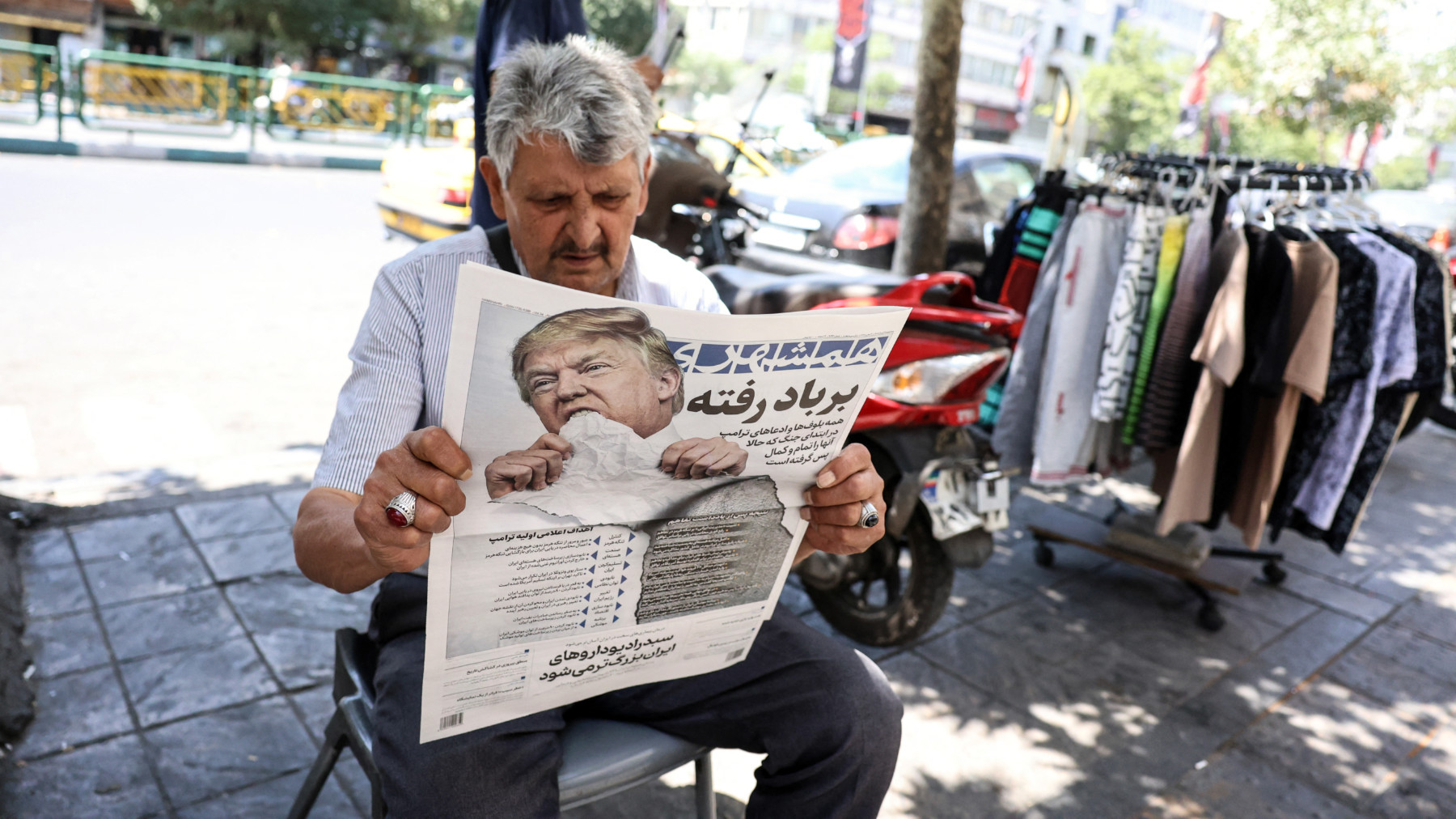
A compilation of recent Iranian press reporting, reviewed by Middle East Eye, reveals overlapping developments across Iran’s foreign policy landscape, domestic social progress, and economic stability in the wake of the 12-day US-Israeli war with the country in 2025.
On the question of Iran’s long-running regional strategy of expanding strategic depth through allied militant and political movements, one prominent Iranian analyst argues that the war has actually renewed domestic support for the policy, reversing waves of criticism that followed the June 2025 Israeli strike that triggered the conflict. Since the 1988 end of the Iran-Iraq War, Tehran has cultivated alliances with ideologically aligned groups across the Middle East, a policy framed by Iranian leaders as a core deterrent against Israeli aggression. After the 2025 war broke out, however, critics pushed back against the strategy, arguing that Iran’s regional partners had failed to prevent the attack and called the approach into question.
Writing for the reformist daily Shargh, Iranian analyst Mehrdad Ahmadi Sheikhani pushed back against this criticism, noting that Hezbollah, the Lebanese allied movement, offered Iran full backing from the opening of the war, while Yemen’s Houthi movement also aligned with Tehran. After Iran launched retaliatory strikes against Israel following an Israeli bombing of Beirut earlier this year, Sheikhani argued that the response effectively redefined Iran’s regional spheres of influence and strategic depth for the post-war era. This counters claims that the strategy had become obsolete after the fall of the Syrian government, he added.
Sheikhani also framed the conflict in sweeping historical context, arguing it marks a return to a level of Iranian regional power not witnessed in more than 200 years. Following the 1797 assassination of Agha Mohammad Khan Qajar, founder of the Qajar dynasty, Iran experienced a steady erosion of territory and regional influence amid conflicts with the Russian, Ottoman, and British empires. Unlike those historical defeats, Sheikhani emphasized that Iran emerged from the 2025 war without ceding any territory despite facing coordinated attacks from major global and regional powers, a historic shift. He also highlighted that the conflict exposed previously unknown precision and operational planning in Iran’s defense capabilities, building a new level of deterrence that the country has not held in more than two centuries.
Alongside debates over regional strategy, new details have emerged about the human toll of US strikes on Iranian territory following the ceasefire agreement between Tehran and Washington. Seyyed Moussa Mousavi, a member of the Iranian parliament from the southern city of Lamerd, told state news agency IRNA that the Precision Strike Missiles (PrSM) deployed by the US on the first day of the war were fitted with controversial tungsten-fragment warheads that had not been publicly detailed before. While earlier reporting confirmed that upgraded PrSM variants were used in attacks on Iran, no specific information about the warhead design had previously been released.
Mousavi explained that these munitions detonate before reaching ground level, leaving no impact craters but shattering into as many as 180,000 tiny high-velocity tungsten projectiles per missile. On February 28, four of these missiles struck Lamerd, a small city of roughly 30,000 residents. In just 35 seconds, approximately 720,000 tungsten fragments rained across the city, leaving 21 civilians dead and 150 wounded in strikes that hit residential neighborhoods and a local sports hall. Mousavi drew a sharp rebuke of the attack, framing the munitions as a deliberate targeting of civilian populations, noting that per capita, every resident of Lamerd was effectively exposed to 24 tungsten projectiles in the strike.
In a separate positive domestic development, Iranian officials confirmed that long-standing restrictions on women obtaining motorcycle licenses will be lifted within the next month. Zahra Behrouz Azar, Iran’s vice president for Women and Family Affairs, told Shargh that all administrative procedures for the policy change have been finalized. While no Iranian law explicitly bans women from riding motorcycles, national traffic police have for decades refused to issue licenses to female applicants, even though women have long held full legal rights to drive passenger cars in the country.
Under the new policy, the minimum age for a female motorcycle license will be 18. Licenses will first be issued to female motorcycle instructors and women competing officially in motorcycle sports through Iran’s national motorcycle federation, before a broader rollout. The policy shift follows years of grassroots advocacy by Iranian women, who have openly defied the restriction by riding motorcycles on public roads, repeatedly clashing with police and having their vehicles seized in protests against the ban.
Despite this social progress, prominent Iranian economist and former Central Bank governor Valiollah Seif has issued a stark warning that the country is at growing risk of hyperinflation, driven by ongoing international sanctions and the cumulative economic shock of two major wars over the past 12 months. Writing for Khabar online news outlet, Seif noted that while Iran has not yet hit the technical definition of classic hyperinflation, it is currently experiencing extremely high inflation that sits just below the threshold for chronic monetary instability, putting the country at severe risk.
Seif identified five core factors that have left Iran’s economy increasingly vulnerable: sustained expansion of the national money supply, long-standing structural government budget deficits, extreme volatility in the value of the Iranian rial, repeated geopolitical shocks from war and international sanctions, and eroding public confidence in the national currency. He added that the current post-war political landscape amounts to a prolonged state of “no war, no peace,” with no permanent ceasefire in place to resolve ongoing tensions. This prolonged uncertainty, he argued, is uniquely damaging to Iran’s economic outlook: it does not allow for a return to full domestic stability, nor does it contain the damage of war to a short-term shock, instead keeping the economy in a sustained state of limbo. “Simply put, the economy does not die in this situation, but it is gradually eroded,” Seif concluded.
This report is compiled from an Iranian press digest, and its claims have not been independently verified by Middle East Eye, which specializes in independent coverage of the Middle East and North Africa region.