Geopolitical upheaval in the Middle East has sent shockwaves through global agricultural markets, sending chemical fertilizer prices soaring and pushing smallholder and commercial farmers alike across multiple continents to accelerate a shift toward organic and bio-based alternatives. For farmers in Senegal, one of West Africa’s most food-dependent nations, the impact of tensions around the Strait of Hormuz has been felt almost immediately after U.S. missile strikes on Iran earlier this year. Since the outbreak of conflict in late February, domestic fertilizer prices in the country have jumped 40%, creating an unprecedented crisis for small-scale producers reliant on imported agricultural inputs.
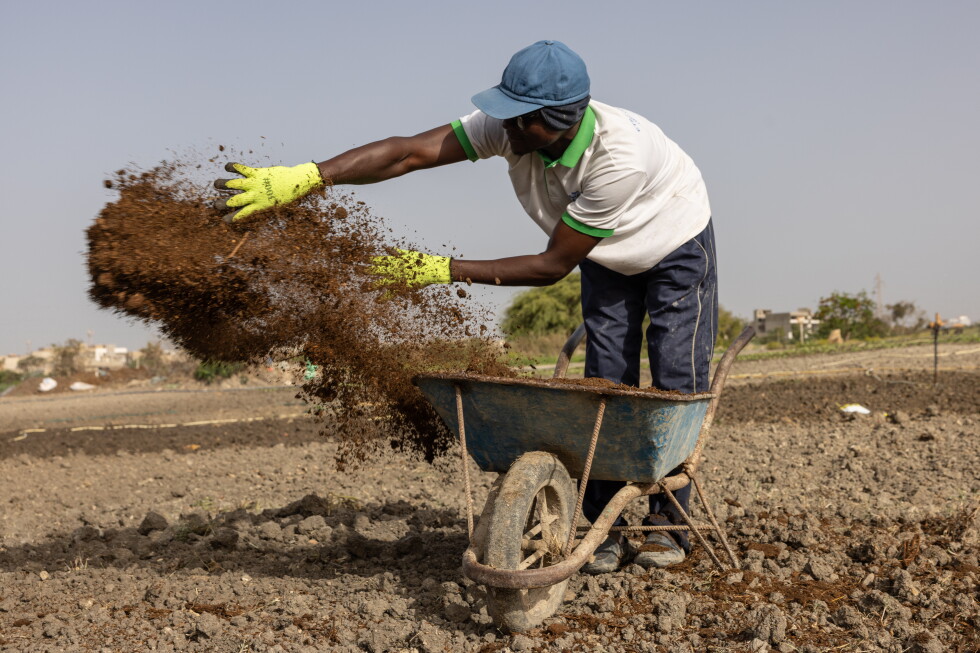
Abou Sow, a Senegalese farmer who made the switch from chemical fertilizers to organic compost eight years ago, has been far better insulated from the price shock than many of his neighbors. Today, he leads a grassroots movement urging local farmers to source manure from regional livestock herders and teaches hands-on composting techniques, pointing to wriggling earthworms in finished compost as a key marker of nutrient-rich soil. “We can’t afford to wait for a ceasefire,” Sow said. “It’s simply too risky to depend on imported chemical fertilizers when global supply chains are so unstable.”
The disruption stems from Iran’s control over the Strait of Hormuz, a critical global shipping chokepoint that impacts both natural gas supplies – a core input for chemical fertilizer production – and global maritime trade. Data confirms the scope of the crisis: the Gulf region accounts for 30% of all globally traded chemical fertilizer, and the World Bank’s global fertilizer price index has recorded a 50% price increase since tensions escalated. The global food security community has sounded the alarm, with Maximo Torero, chief economist at the United Nations Food and Agriculture Organization, warning “the clock is ticking very hard” as risks to global food supplies mount.
Beyond easing supply chain dependency, experts note that a global shift away from chemical fertilizers carries major environmental benefits. The production and application of synthetic fertilizers generate substantial greenhouse gas emissions, the primary driver of anthropogenic climate change. In contrast, organic and natural fertilizers sequester carbon in soil and reduce the water pollution caused by chemical runoff from agricultural lands. “It’s good for the planet because you’re weaning food production off fossil fuels,” explained Susan Chomba, a member of the International Panel of Experts on Sustainable Food Systems, an independent global think tank.
Senegal, which imports 125,000 tons of chemical fertilizer annually, illustrates the uneven nature of the transition. While Senegalese Agriculture Minister Mabouba Diagne has stated the government secured enough chemical fertilizer for the current growing season, many farmers report that supplies are increasingly hard to access on the ground. Farmer Aliou Fall blames the U.S. for the crisis, arguing “He [Donald Trump] brings war to the world and he doesn’t even think about it. Now farmers are suffering.”
For Sow, proximity to a regional sheep-rearing community has kept his compost supplies steady: he applies six tons of organic compost to his fields each year, avoiding the sticker shock of synthetic inputs. But access remains a major barrier in remote rural areas, where sourcing and transporting large volumes of manure is logistically and financially unfeasible. Sow warns that without broader support, some vulnerable smallholders may be forced to abandon their fields entirely this growing season.
Industry-backed alternatives are already gaining traction across the continent: biofertilizers, which contain naturally occurring bacteria and microorganisms that help crops draw essential nitrogen from air and soil, offer a scalable solution. A growing number of African firms now produce commercial-scale compost from municipal organic waste, turning discarded food scraps into nutrient-rich fertilizer. In response to the crisis, the Senegalese government announced a program in April to subsidize and distribute 30,000 tons of organic fertilizer to smallholders, but Sow argues the support is far from sufficient to meet growing demand.
Systemic barriers continue to slow the global transition, experts note. The Organization for Economic Co-operation and Development estimates that governments around the world spend $700 billion annually on agricultural subsidies, with the vast majority directed toward supporting synthetic fertilizer production and distribution. This policy landscape keeps chemical fertilizer artificially cheap and makes sustainable alternatives less cost-competitive for producers. “You’re incentivizing the wrong sort of products,” Chomba said of the current subsidy structure.
The trend toward alternative fertilizers is playing out across major agricultural economies globally. In Brazil, one of the world’s top exporters of soybeans, coffee, sugarcane, and beef, more than 80% of all chemical fertilizer is imported, leaving the sector extremely exposed to global price shocks. Luis Barbieri, founder of the Brazilian Folio Institute that connects farmers and agricultural researchers, reports that fertilizer prices in the country have risen 50% since the outbreak of the Iran conflict. “Whenever we have a war, farmers’ use of biofertilizers is turbocharged,” Barbieri said.
Notably, chemical fertilizers have long been less effective in Brazil’s tropical climate: high temperatures and heavy rainfall accelerate runoff, reducing their impact on crop yields. Brazil’s state-run agricultural research corporation Embrapa reports that the country’s biofertilizer sector grew 15% between 2023 and 2024, and flexible national patent laws allow smallholders to produce their own biofertilizers on-farm at a fraction of the cost of imported synthetic alternatives. The pace of transition varies widely, however: in Mexico, progress has been glacial, due to persistent government subsidies for chemical fertilizer and a lack of public funding for sustainable alternatives, according to Gerardo Noriega, a research professor at the Autonomous University of Chapingo and one of Mexico’s leading advocates for organic fertilization. Even so, Noriega predicts the current global crisis “may force (farmers) to adopt organic fertilizers more quickly than they had imagined.”
In India, another major agricultural economy that imports 60% of its fertilizer from the Gulf region, the central government has launched a national push to scale natural farming. In the southern states of Telangana and Andhra Pradesh, more than 1.7 million farmers have already shifted to natural systems that rely on on-farm organic inputs rather than commercial synthetic fertilizers. Manohara Chari, a farmer in Telangana, now produces jivamrita – a nutrient-dense fertilizer blend made from cow dung, cow urine, flour, soil, and jaggery – to replace the synthetic products he used for decades. “We do not depend on companies,” Chari said, explaining the self-sufficiency of the natural farming model.
Earlier this year, Indian Prime Minister Narendra Modi launched a national mission to scale natural farming across the country, setting a target of cutting chemical fertilizer use by 50% within the coming years. The Indian government has already spent heavily to subsidize imported chemical fertilizer and secure alternative supply chains to offset the Gulf disruption, but agricultural scientists report growing farmer interest in low-input natural farming since the conflict began. “There’s certainly been more interest this year in natural farming, especially after the Middle East conflict began,” said G.V. Ramanjaneyulu, an agricultural scientist with the Center for Sustainable Agriculture. Many farmers are now setting aside test plots on their land to trial natural methods before committing to a full transition.
The shift to natural farming does require additional on-farm labor and a multiyear transition period as soil health regenerates, and farmers say government policy remains misaligned to support the change. Chari argues that redirecting even a small share of existing chemical fertilizer subsidies to support natural farmers would drive a much faster, broader transition across the country. The current global supply crisis, producers and experts agree, has created an urgent opening to reorient global agricultural policy toward more resilient, sustainable systems that benefit both smallholders and the climate.