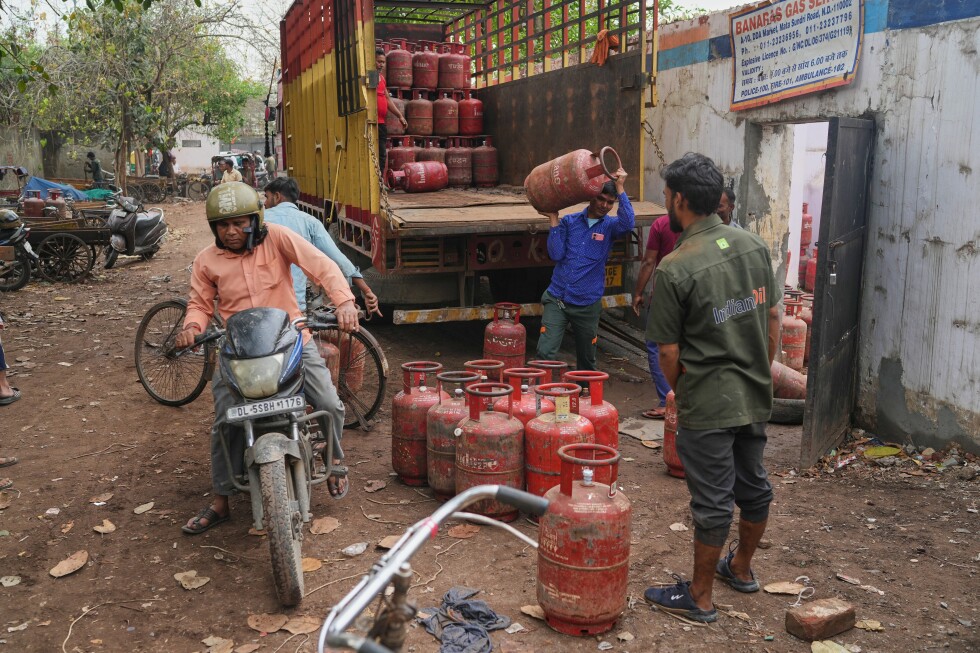
The ongoing Iran war has triggered crippling energy supply shocks across Asia, with the closure of the Strait of Hormuz — the world’s most critical energy shipping chokepoint — upending fuel access and sending prices soaring for millions of ordinary households. From the crowded streets of New Delhi to the coastal hubs of Southeast Asia, consumers are grappling with steep cost hikes and disrupted daily routines, pushing regional governments to accelerate plans to expand biofuel use as a buffer against global energy volatility.
In New Delhi, taxi driver Ravi Ranjan, who supports his wife and young child on his driving income, has seen his cooking fuel costs triple amid widespread shipping delays and supply shortages. “I used to pay 1,000 rupees ($11) for a standard LPG cylinder. Now I’m forced to pay 3,000 rupees ($31) on the black market just to put food on the table,” he explained. Halfway across the country in Chennai, advertising executive Sushmita Sankar faces similar strains: her gasoline and cooking fuel bills have skyrocketed, and the 20% ethanol-blended gasoline that is now standard at Indian pumps has cut her car’s fuel efficiency, adding extra time and stress to her already packed schedule of work and childcare.
“With prices going up and mileage dropping, I now have to spend far more time queuing to fill my tank or track down cooking gas,” Sankar said. “It’s turned a routine chore into another major source of stress.”
For India, which imports nearly 90% of its crude oil to meet domestic energy demand, the supply disruptions from the Iran war have hit every corner of the economy — from private motorists and home cooks to industrial operations reliant on natural gas. Only the country’s national power grid, powered mostly by coal with a growing share of renewables, has remained largely unaffected. Prime Minister Narendra Modi has publicly called on Indian citizens to make “nationally responsible choices” to conserve fuel, urging more carpooling, greater use of public transport, and cutting back on non-essential international travel.
To address the long-term risk of global energy shocks, New Delhi has laid out aggressive plans to ramp up domestic ethanol production and increase the share of biofuel blended into national gasoline supplies. The country already hit its 20% ethanol blending target nationwide in 2025, five years ahead of its original schedule, and policymakers are now weighing a push to 27% blending by 2030. In a policy shift that signals a major push for higher biofuel adoption, India’s transport ministry has recently proposed allowing passenger and commercial vehicles to run on blends of 85% ethanol, or even 100% pure ethanol, a move designed to pressure automakers to begin manufacturing engines compatible with these higher concentrations. To protect domestic supplies of feedstock for ethanol production, the government has also banned all sugar exports through at least September, ensuring enough raw material is available to scale up output.
Proponents frame the policy shift as a win for both energy security and climate action. “Moving toward higher ethanol blends reflects the government’s long-term vision for energy security, lower emissions, and reduced dependence on imported crude oil,” explained Chandra Kumar Jain, president of the Grain Ethanol Manufacturers Association. Data from the Institute for Energy Economics and Financial Analysis (IEEFA) shows the current 20% ethanol blend already cut India’s crude oil imports by 2.5% in 2025.
But the rapid push for higher crop-based ethanol blending has drawn sharp criticism from analysts, who warn of multiple trade-offs for consumers, food security, and the environment. Drivers already report reduced fuel mileage with existing 20% blends, and ethanol’s lower energy density means higher blends will lead to even greater efficiency losses. Environmental and energy analysts warn that diverting large volumes of corn, rice, and sugarcane — staples of India’s food system — to ethanol production could create competition for arable land, drive up food prices, and worsen existing water stress. Producing just one liter of grain-based ethanol requires between 3,000 and 10,000 liters of water, a major concern in a country already facing widespread groundwater depletion.
“It’s not clear how higher ethanol blends will perform in existing vehicle engines, and it will take years to scale up manufacturing of new engines built to handle these higher concentrations,” said Shyamasis Das, a senior researcher at the New Delhi-based Centre for Social and Economic Progress. “The broader climate benefits of crop-based ethanol are also very limited when you account for land use change and water consumption. Only ethanol produced from agricultural residues, municipal waste, and used cooking oil — materials that don’t require new land or water inputs — can truly qualify as sustainable.”
India is not alone in turning to biofuels amid the current energy crisis. Across Southeast Asia, governments are also rolling out new policies to expand biofuel blending to boost energy sovereignty and insulate their economies from global price shocks. In Indonesia, President Prabowo Subianto launched a new program in March that aims to increase biodiesel blending from 40% to 50%, with the country relying on palm oil as its primary biofuel feedstock.
“We are going in a big way to biofuel,” Subianto said. The policy also helps support Indonesia’s domestic palm oil industry by creating a larger local market for the commodity, but analysts warn that expanded production could drive new land clearing and deforestation of old-growth tropical forests.
Malaysia, another major palm oil producer, followed suit in April, approving a plan to gradually increase biodiesel blending to 15%, with a future target of 20% under consideration. “Skyrocketing fuel prices from the Iran war have revived political and public support for expanded biofuel use,” said Kuala Lumpur-based energy analyst Ahmad Rafdi Endut. “But higher blends require extensive additional testing, and many consumers are already wary of the reduced fuel efficiency that comes with higher biofuel mixes.”
Despite the sudden policy momentum driven by the Iran war energy crisis, industry analysts caution that it will still take years for higher ethanol and biodiesel blends to become widely available across Asia. Developing the full supply chain, testing new fuel formulations, and rolling out vehicles compatible with high-concentration blends all require significant lead time. Many analysts also note that biofuels are at best a temporary buffer against energy shocks, arguing that electric vehicles paired with expanded renewable energy generation represent a more sustainable long-term solution for both energy security and climate action.
“The current crisis has pushed governments to prioritize near-term energy independence, but rapid expansion of crop-based biofuels carries new long-term risks for food security and environmental protection,” said IEEFA analyst Charith Konda. “Moving forward, the focus needs to be on scaling sustainable non-crop biofuels and accelerating the transition to electric vehicles and renewables.”